
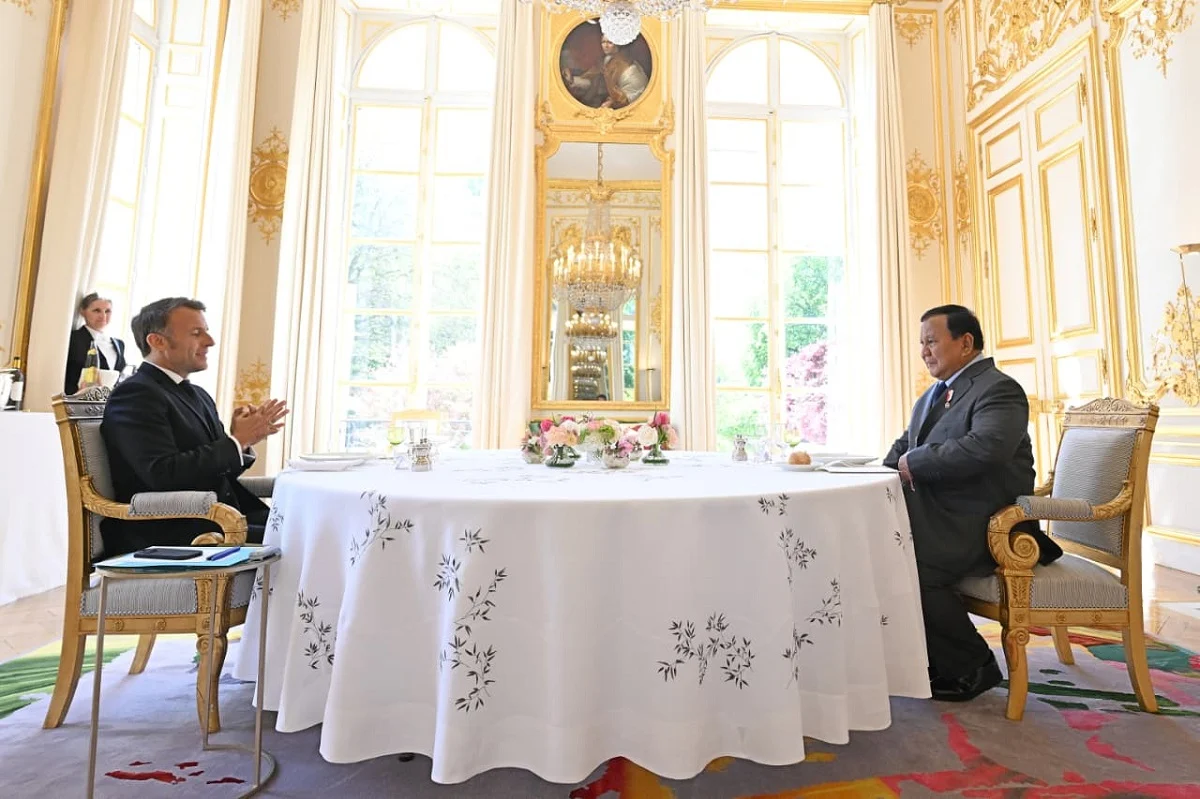
PARIS – Indonesian President Prabowo Subianto held a high-stakes bilateral meeting with French President Emmanuel Macron at the historic Élysée Palace in Paris on Tuesday, April 14, 2026. The pivotal discussions between the two heads of state encompassed a broad spectrum of cooperation, from bolstering defense capabilities through advanced military equipment procurement to accelerating the transition towards sustainable energy sources. This engagement marked a significant chapter in Indonesia’s burgeoning diplomatic outreach, coming on the heels of President Prabowo’s visit to Moscow, underscoring Jakarta’s strategic balancing act in its foreign policy.
President Prabowo’s arrival at the Élysée Palace was met with full ceremonial honors, including a Guard of Honor from the French armed forces, a clear testament to the esteemed diplomatic relations between Indonesia and France. The solemn military tribute symbolized not only the enduring friendship but also the high regard France holds for Indonesia as a crucial partner in the Indo-Pacific region. The meeting, which extended beyond initial schedules, delved into concrete avenues for strengthening a multifaceted partnership that spans critical areas of national development and geopolitical importance.
A Strategic Diplomatic Tour: From Moscow to Paris
President Prabowo Subianto’s European tour commenced with a significant visit to Russia, where he met with President Vladimir Putin at the Kremlin on Monday, April 13, 2026. This sequencing of visits—first to Moscow, then to Paris—has drawn considerable attention from international observers, highlighting Indonesia’s commitment to an independent and active foreign policy. Jakarta seeks to cultivate strong, balanced relationships with major global powers, leveraging these partnerships to advance its national interests, particularly in defense modernization and economic development, without aligning exclusively with any single bloc. The stop in Paris immediately following the Russian engagement underscored Indonesia’s strategic imperative to diversify its partnerships and maintain open channels with various influential nations.
The official account of the Indonesian presidency, @presidenrepublikindonesia, detailed the continuation of President Prabowo’s agenda: "Usai merampungkan kunjungan kenegaraannya ke Rusia, Presiden melanjutkan agenda kunjungan ke Prancis dan bertemu dengan Presiden Republik Prancis, Yang Mulia Emmanuel Macron." This itinerary reflects a carefully calibrated diplomatic strategy aimed at reinforcing existing alliances while exploring new opportunities for collaboration across different geopolitical landscapes. The choice of France, a key European Union member with significant strategic interests in the Indo-Pacific, as the next destination after Russia, speaks volumes about Indonesia’s pragmatic approach to international relations.
Deepening Defense Cooperation: Modernizing Indonesia’s Capabilities
At the heart of the discussions in Paris was the critical issue of defense cooperation, particularly the procurement of advanced defense equipment (alutsista) and the strengthening of Indonesia’s domestic defense industry. Indonesia, an archipelago nation with vast maritime territories and a growing strategic role in Southeast Asia, has been actively pursuing an ambitious military modernization program. France, a global leader in defense technology and a significant arms exporter, has emerged as a crucial partner in this endeavor.
The relationship has seen substantial growth in recent years. In 2022, Indonesia finalized a landmark agreement to purchase 42 Rafale fighter jets from Dassault Aviation, with the first batch expected to be delivered around the 2026-2027 timeline. This deal, valued at approximately $8.1 billion, represents a major upgrade to the Indonesian Air Force’s capabilities and signifies a strategic shift in its defense procurement strategy, diversifying away from traditional suppliers. Furthermore, discussions have been ongoing regarding potential acquisitions of French-made submarines (such as the Scorpène-class), naval vessels, and other sophisticated military hardware.
President Prabowo, a former special forces general and Indonesia’s defense minister prior to his presidency, has consistently prioritized the strengthening of the nation’s defense capabilities. His vision emphasizes not only the acquisition of state-of-the-art equipment but also technology transfer, local production, and joint research and development initiatives to build a self-reliant defense industry. This aspect was a key topic during his meeting with President Macron, with both leaders reportedly exploring mechanisms to facilitate greater industrial collaboration and knowledge exchange, ensuring that procurement deals contribute to Indonesia’s long-term strategic autonomy. The French commitment to its Indo-Pacific strategy, which aims to foster security and stability in the region through partnerships, aligns well with Indonesia’s defense modernization goals.
Pioneering the Green Transition: Energy and Renewable Development
Beyond defense, the two leaders dedicated significant attention to the urgent global challenge of climate change and the imperative of energy transition. Indonesia, a major developing economy and one of the world’s largest emitters, has set ambitious targets for reducing carbon emissions and increasing the share of new and renewable energy (NRE) in its energy mix. The nation aims to reach net-zero emissions by 2060 and has been a recipient of the Just Energy Transition Partnership (JETP), an international financing mechanism designed to accelerate its clean energy transition.
France, a country with a strong track record in nuclear energy and a growing footprint in various renewable technologies—including solar, wind, and hydro—stands as a valuable partner for Indonesia in this sector. The discussions between President Prabowo and President Macron explored potential collaborations in:
- Renewable Energy Projects: French companies could invest in and develop large-scale solar farms, offshore wind projects, and geothermal plants across the Indonesian archipelago.
- Hydrogen Technology: Both nations have expressed interest in green hydrogen as a future energy carrier, and cooperation could involve pilot projects, research, and infrastructure development.
- Energy Efficiency and Smart Grids: France’s expertise in optimizing energy consumption and modernizing grid infrastructure could benefit Indonesia’s burgeoning urban centers and industrial zones.
- Capacity Building and Technology Transfer: Training Indonesian engineers and researchers in advanced renewable energy technologies and facilitating the transfer of French know-how.
President Macron, a vocal advocate for global climate action, likely reiterated France’s commitment to supporting developing nations in their green transitions. For Indonesia, partnering with France offers access to cutting-edge technologies, financial mechanisms, and a wealth of experience in building sustainable energy systems. This collaboration is crucial for Indonesia not only to meet its climate commitments but also to diversify its energy sources, enhance energy security, and foster green economic growth.
Broadening the Horizon: Infrastructure, Education, and Creative Economy
The comprehensive discussions extended into several other vital sectors, reflecting the depth and breadth of the Indonesia-France strategic partnership. These areas are critical for Indonesia’s long-term economic development and human capital enhancement.
- Infrastructure and Transportation: Indonesia’s ambitious infrastructure development agenda, including new capital city Nusantara, high-speed rail projects, port expansions, and urban transit systems, presents vast opportunities for French engineering and construction firms. French companies like Vinci and Alstom have a strong global presence in these fields. Discussions likely focused on potential French investment and technical expertise in smart city development, sustainable urban planning, and advanced transportation solutions.
- Education: Strengthening educational ties, including student exchange programs, scholarships, and research collaborations, was also on the agenda. France has a world-renowned higher education system, and increased academic partnerships could help Indonesia develop a skilled workforce capable of driving innovation and economic growth. Collaborations could also extend to vocational training, particularly in areas relevant to green industries and advanced manufacturing.
- Creative Economy: Indonesia boasts a vibrant creative sector, encompassing digital content, fashion, culinary arts, and traditional crafts. France, with its rich cultural heritage and thriving creative industries, offers a fertile ground for collaboration. Discussions likely explored ways to promote cultural exchange, facilitate market access for Indonesian creative products, and encourage joint ventures in areas like film production, gaming, and digital innovation. This sector holds significant potential for job creation and economic diversification for Indonesia.
France’s Indo-Pacific Strategy and Indonesia’s Role
The meeting between President Prabowo and President Macron must also be viewed within the broader context of France’s evolving Indo-Pacific strategy. As a nation with overseas territories and significant economic interests in the region, France considers itself an Indo-Pacific power. Its strategy emphasizes multilateralism, adherence to international law, and the promotion of a rules-based order, particularly in areas like maritime security and freedom of navigation.
Indonesia, as the largest economy in Southeast Asia, a G20 member, and a prominent voice in ASEAN, is a cornerstone of France’s engagement in the region. Paris views Jakarta as a critical partner in achieving its strategic objectives, which include:
- Security and Stability: Collaborating on maritime security, counter-terrorism, and disaster response.
- Economic Partnerships: Expanding trade and investment ties, especially in high-tech and sustainable sectors.
- Climate Action: Working together on global environmental challenges.
- Cultural and Academic Exchange: Deepening mutual understanding and cooperation.
President Macron’s repeated visits to the Indo-Pacific region and his emphasis on diversifying European partnerships beyond traditional alliances underscore the strategic importance of countries like Indonesia. The Élysée Palace likely conveyed France’s recognition of Indonesia’s growing geopolitical significance and its commitment to fostering a long-term, mutually beneficial relationship.
Official Responses and Broader Implications
While specific quotes from the closed-door meeting were not immediately released, official statements from both sides typically highlight areas of convergence and mutual benefit. The Indonesian presidential office’s statement emphasized the pursuit of "kerja sama berkelanjutan dengan Prancis guna membuka peluang kolaborasi baru yang semakin konkret dan saling menguntungkan bagi kedua negara." This underscores Indonesia’s pragmatic approach, seeking tangible outcomes that directly contribute to its national development goals.
For France, the meeting reaffirms its commitment to strengthening ties with key players in the Indo-Pacific. A spokesperson from the Élysée Palace, speaking on background, likely pointed to Indonesia as an indispensable partner for advancing shared values of multilateralism, sustainable development, and regional stability. The Guard of Honor extended to President Prabowo was a clear signal of the diplomatic weight France places on this relationship.
From an analytical perspective, this meeting holds several key implications:
- Diversification of Partnerships: For Indonesia, it showcases a successful strategy of diversifying its defense suppliers and economic partners, reducing reliance on any single nation. This enhances its strategic autonomy.
- Strengthening European-ASEAN Ties: The engagement reinforces the broader relationship between the European Union and ASEAN, with France acting as a crucial bridge.
- Global Energy Transition: Collaboration in renewable energy between a major developing economy and a technologically advanced European nation can serve as a model for other countries navigating similar challenges.
- Geopolitical Balancing Act: President Prabowo’s swift diplomatic tour, visiting both Russia and France, demonstrates Indonesia’s sophisticated approach to navigating complex global power dynamics, prioritizing national interests above ideological alignment.
The discussions between President Prabowo Subianto and President Emmanuel Macron represent more than just a routine diplomatic exchange; they signify a deepening of a strategic partnership that is vital for both nations. As Indonesia continues its trajectory of economic growth and increasing geopolitical influence, and as France seeks to solidify its role as an Indo-Pacific power, the concrete collaborations forged in Paris across defense, energy, and economic sectors are poised to yield substantial benefits, contributing to regional stability and global progress in the years to come.
