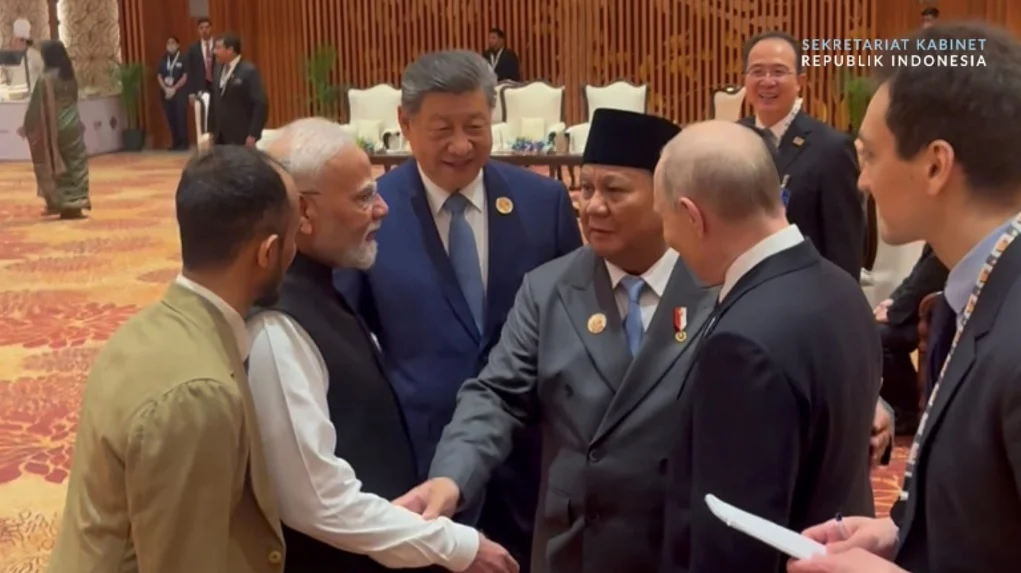
President Prabowo Subianto engaged in a series of warm, informal discussions with Indian Prime Minister Narendra Modi, Russian President Vladimir Putin, and Chinese President Xi Jinping on the sidelines of the 18th BRICS Summit held at the Bharat Mandapam in New Delhi, India, on Saturday, September 12, 2026. This interaction, which took place just moments before the official opening ceremony, served as a significant display of personal diplomacy, highlighting the evolving nature of Indonesia’s international engagements under the current administration.
The images of the four leaders—representing some of the world’s most influential economies—conversing in a relaxed setting have drawn considerable attention from geopolitical analysts and global media. According to a statement issued by Cabinet Secretary Teddy Indra Wijaya, the encounter was characterized by a spirit of camaraderie and mutual respect, reflecting the diplomatic rapport that often bridges the gap between formal policy negotiations.
The Significance of the 18th BRICS Summit
The 2026 BRICS Summit in New Delhi represents a critical juncture for the bloc, which has expanded its reach and influence significantly over the past few years. Originally founded as a grouping of emerging economies—Brazil, Russia, India, China, and South Africa—the organization has sought to redefine the global economic architecture, challenging the dominance of Western-led financial institutions.
For Indonesia, participation in the BRICS framework is an extension of its long-standing "free and active" (bebas dan aktif) foreign policy. By engaging with these powerhouses, Jakarta aims to diversify its economic partnerships and secure a stronger foothold in the Global South. The presence of President Prabowo at the Bharat Mandapam underscores Indonesia’s desire to ensure its national interests are represented in discussions concerning global trade, energy security, and the reform of international financial systems.
A Chronology of Diplomatic Engagement
The events in New Delhi followed months of meticulous preparation by Indonesia’s Ministry of Foreign Affairs. Following his inauguration and subsequent regional tours, President Prabowo prioritized the strengthening of bilateral ties with the BRICS member states.
- Early 2026: Indonesia signaled an increased interest in deepening cooperation with BRICS nations, particularly in the sectors of infrastructure development, digital technology, and food security.
- August 2026: Diplomatic channels were finalized to ensure a high-level delegation from Jakarta would participate in the New Delhi summit.
- September 11, 2026: Arrival of President Prabowo in India, marked by initial meetings with representatives from various participating delegations.
- September 12, 2026: The morning of the opening session at Bharat Mandapam. It was here, in the moments preceding the formal plenary, that the informal dialogue between the four leaders occurred.
- September 12, 2026 (Afternoon): Official participation in the plenary sessions, focusing on economic cooperation and the challenges of the multipolar world order.
Analyzing the Informal Interaction
While official communiqués from summits are often heavily scripted, informal interactions—often referred to as "corridor diplomacy"—frequently provide the most accurate insight into the state of international relations. The sight of President Prabowo conversing with President Putin, Prime Minister Modi, and President Xi is highly symbolic.
From a strategic perspective, these interactions serve several purposes:
- Building Personal Trust: In the world of high-stakes diplomacy, personal chemistry between heads of state can facilitate smoother negotiations when complex issues arise.
- Signaling Alignment: For the international community, the presence of an Indonesian leader in such an intimate discussion with the BRICS core leadership suggests a move toward closer alignment on issues like trade connectivity and non-Western financial mechanisms.
- Conflict Mitigation: By maintaining open and friendly channels with leaders from both sides of the current global geopolitical divide, Indonesia reinforces its role as a bridge-builder, capable of maintaining constructive relations with nations that may have strained ties with one another.
Economic and Strategic Implications for Indonesia
Indonesia’s participation in the BRICS summit is not merely symbolic; it carries heavy economic weight. As an emerging middle-power economy, Indonesia is looking for investment opportunities that do not come with the political conditionalities often attached to traditional developmental loans.
India and China are already among Indonesia’s largest trading partners. Engaging with them within the BRICS framework allows Jakarta to harmonize its trade policies, push for better commodity pricing, and seek support for its "downstreaming" (hilirisasi) agenda, which seeks to turn raw materials into high-value finished products before export.

Furthermore, the discussion with President Putin likely touched upon energy security. Given Russia’s position as a major energy producer and Indonesia’s growing domestic energy demand, the potential for diversified energy cooperation remains a topic of high interest. Similarly, the conversation with Prime Minister Modi highlighted the growing "Look East" alignment, with India increasingly viewing Indonesia as a key partner in maritime security and the digital economy in the Indo-Pacific region.
Official Responses and Media Reception
The Indonesian government’s official stance, as communicated by Cabinet Secretary Teddy Indra Wijaya, emphasized that the interaction was a natural byproduct of the summit’s environment. "The leaders took the opportunity to engage in a friendly manner before the opening session," the Seskab stated, noting that such exchanges are standard practice for fostering positive international relations.
International media outlets covering the event have noted that President Prabowo’s ability to navigate the complex social dynamics of the BRICS summit suggests a sophisticated approach to foreign policy. Analysts from various think tanks have observed that Indonesia is carefully balancing its relations with the West while aggressively pursuing its interests within non-Western blocs.
Contextualizing the BRICS Expansion
It is essential to understand that the 2026 BRICS summit is occurring in a world that is vastly different from the one that existed when the group was formed. The rise of the "Global South" as a coherent political and economic bloc has changed the way international summits are conducted.
For the average citizen, the significance of these meetings may seem abstract. However, the outcomes of these discussions—ranging from the stability of currency exchange rates to the accessibility of global supply chains—have a direct impact on the domestic economy. President Prabowo’s presence in New Delhi is intended to ensure that Indonesia’s voice is heard during these pivotal discussions on the future of the global financial system.
The Role of Personal Diplomacy
President Prabowo’s background as a former Defense Minister and his extensive experience in international relations have clearly influenced his diplomatic style. He is known for a pragmatic approach, favoring direct communication with his counterparts. This style was on full display in New Delhi. By opting to engage in informal dialogue, the President bypasses the rigidity of formal bureaucratic channels, allowing for more candid and efficient exchanges.
This method is particularly effective in a summit setting where dozens of heads of state are competing for attention. The ability to secure a moment of genuine connection with the leaders of India, Russia, and China is a testament to the respect Indonesia currently commands on the world stage.
Looking Ahead
As the 18th BRICS Summit concludes, the focus will shift to the implementation of the agreements reached in New Delhi. Indonesia will be expected to follow up on the initial discussions held between the leaders. For President Prabowo, the challenge will be to translate the warm, friendly atmosphere of the Bharat Mandapam into concrete policies that benefit the Indonesian people—specifically through increased foreign direct investment (FDI), technology transfer, and expanded market access for Indonesian goods.
The informal meeting serves as a harbinger of a more assertive and engaged Indonesian foreign policy. As the nation continues to navigate the complexities of the 21st century, the ability to build and maintain relationships with diverse global powers will remain a cornerstone of its national interest. The "warm and friendly" interaction in New Delhi is, in many ways, just the beginning of a broader strategic realignment that aims to position Indonesia as a central player in the emerging global order.
In summary, the images shared by the Cabinet Secretariat are more than just a media moment; they represent a deliberate diplomatic strategy. By positioning himself among the architects of the BRICS bloc, President Prabowo has reinforced Indonesia’s commitment to multilateralism, ensuring that the country remains a key voice in the dialogue that will shape the international landscape for years to come. Whether these interactions lead to substantial shifts in regional policy remains to be seen, but the initial signs indicate a proactive and highly focused administration in Jakarta.