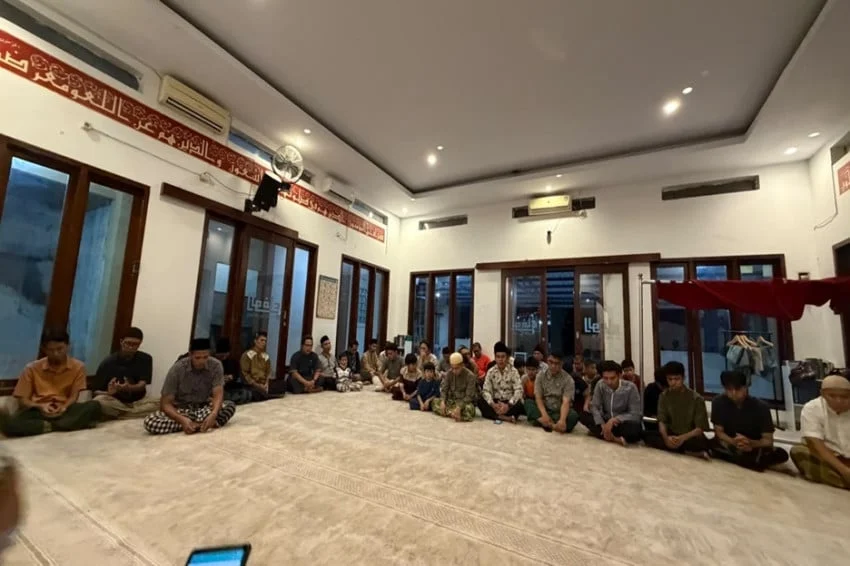
JAKARTA — An atmosphere of deep concern and collective hope enveloped the Nuansa Asri residential complex in Cinangka, Depok, West Java, as local residents, friends, and family members gathered to conduct a special prayer service. The poignant gathering, held on Thursday evening, September 10, 2026, was organized to pray for the safety and swift rescue of Yudistiro Pranoto, a dedicated photojournalist with iNews Media Group, alongside the captain and crew of the speed boat transporting them during a high-stakes journalistic assignment.
The incident has sent shockwaves through the Indonesian journalistic community and the local neighborhood where Yudistiro is known as a dedicated professional and a cherished community member. As the sun set, dozens of residents packed into the Al-Wafa Mosque following the Isya prayers. With heads bowed and hands raised in supplication, the congregation engaged in collective istigosah—a traditional Islamic prayer seeking divine assistance during times of distress or calamity—clinging to the hope that Yudistiro and his colleagues would be found safe and sound.
A Community United in Hope and Solicitous Prayer
Inside the mosque, the mood was solemn and reverent. Residents sat cross-legged, filling the prayer hall as religious leaders led the congregation in heartfelt supplications. The collective prayers were not only offered for the safe return of Yudistiro Pranoto, but also extended to encompass all journalists and vessel crew members who went missing under perilous circumstances while covering the volcanic activity of Mount Anak Krakatau in the treacherous waters of the Sunda Strait.
Hanes, the local neighborhood association (RT) head who helped coordinate the spontaneous gathering, expressed the community’s profound anxiety and solidarity. According to Hanes, the event was organized rapidly in response to the unfolding tragedy, mobilizing residents to offer spiritual support to the Pranoto family during their darkest hour of uncertainty.
"We invited all the residents of this housing complex to hold a joint prayer and istigosah," Hanes stated during the gathering. "Our hope is simple yet profound: that Yudis and the entire missing crew are protected, found swiftly, and returned to their families in good health."
The impromptu prayer service highlights the personal human toll behind maritime tragedies and dangerous news reporting assignments. For the residents of Nuansa Asri, Yudistiro is more than a recognizable face on television or a byline in digital media; he is a neighbor, a friend, and an integral part of the local social fabric.
Background Context: The Perilous Assignment at Mount Anak Krakatau
The disappearance of Yudistiro Pranoto and his fellow crew members is tied directly to a high-risk journalistic expedition in one of Indonesia’s most volatile natural laboratories. Mount Anak Krakatau, located in the Sunda Strait between the islands of Java and Sumatra, has long been a focal point for scientific study and intense media coverage due to its frequent eruptions and potential to trigger tsunamis.
Journalists and media crews frequently deploy to the waters surrounding the active volcano to capture visual documentation of seismic and geological activities, providing crucial public awareness regarding maritime safety and volcanic warnings. However, the Sunda Strait is notoriously unpredictable. Rapidly shifting weather patterns, towering swells, erratic currents, and sudden volcanic ejections present extreme hazards to small watercraft operating in the vicinity.

The mission involving Yudistiro and other members of the press corps was intended to document ongoing geological developments at the volcano. However, communication with the speed boat carrying the team was abruptly lost, triggering an immediate emergency response and a massive search and rescue (SAR) operation spanning the rough open waters between the Banten coast and the Lampung coastline.
Chronology of Events and the Search and Rescue Operation
The disappearance of the five journalists and the boat crew has initiated a frantic, multi-agency search and rescue operation coordinated by the National Search and Rescue Agency (Basarnas), alongside marine police, the Indonesian Navy, and local volunteer groups.
While the official timeline of the incident continues to be updated as new evidence emerges, search operations have faced significant hurdles due to inclement weather conditions and vast search radiuses in the open sea. Early breakthroughs in the SAR operation heightened both tension and concern among families and colleagues alike. Notably, search teams recovered key pieces of maritime safety equipment belonging to the vessel, including life jackets, drifting in the Sunda Strait.
The discovery of the life jackets has served as a focal point for investigators and rescue coordinators attempting to map out the vessel’s drift patterns and final operational coordinates. Marine experts and rescue officials have analyzed wind directions, tidal movements, and current velocities in the Sunda Strait to narrow down the search zones. Despite these rigorous efforts, as of Thursday evening, the primary hull of the speed boat and its occupants remain officially listed as missing, prompting ongoing round-the-clock sweeps by rescue vessels and aerial surveillance teams.
Broader Implications for Press Freedom and Journalist Safety
The unfolding crisis in the Sunda Strait has reignited critical national conversations regarding the occupational hazards faced by media workers in Indonesia, particularly those assigned to disaster zones, conflict areas, and hazardous natural environments.
Media advocacy groups, press councils, and journalism unions have closely monitored the rescue operations, issuing statements of solidarity and calling for heightened safety protocols during field assignments. Reporting on active volcanoes, maritime disasters, and extreme weather phenomena inherently carries elevated risks. Critics and safety experts frequently emphasize the delicate balance between the public’s right to timely, eyewitness journalism and the absolute imperative of ensuring comprehensive risk assessments and safety gear for field reporters.
In the wake of the incident, media organizations across Indonesia have reviewed their operational protocols for hazardous deployments. Standard operating procedures (SOPs) governing marine transport, mandatory communication check-ins, weather monitoring, and the use of certified, seaworthy vessels are under renewed scrutiny. For newsrooms dispatching personnel to remote or volatile locations, the tragedy underscores the reality that frontline journalism often demands immense personal sacrifice.
As the search for Yudistiro Pranoto and his fellow missing crew members enters its critical phases, the collective prayers echoing from the Al-Wafa Mosque in Depok resonate far beyond the local neighborhood. They reflect a nationwide chorus of hope, solidarity, and deep respect for the unwavering dedication of media workers who routinely put themselves in harms way to inform the public. The families, friends, and colleagues of the missing individuals continue to wait by the shores of the Sunda Strait, holding fast to the belief that perseverance, professional rescue efforts, and an outpouring of communal prayer will bring their loved ones home.