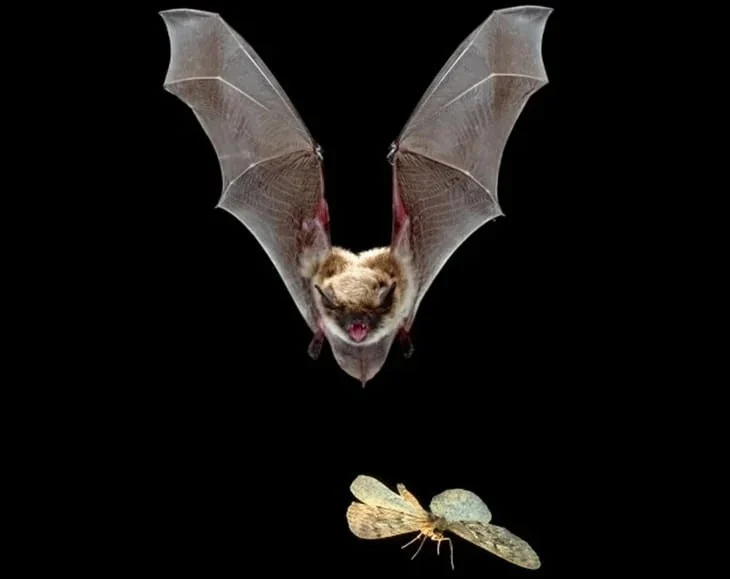
In the nocturnal battle for survival, the evolutionary arms race between predators and prey has produced some of the most sophisticated biological weaponry in the natural world. Recent scientific findings have unveiled a startling defensive mechanism in the insect kingdom: several species of moths have evolved the ability to emit ultrasonic pulses directly from their genitalia to deter echolocating predators, most notably bats. This discovery, detailed in findings reported by the Florida Museum of Natural History, highlights a remarkable instance of convergent evolution, where distinct lineages have independently developed similar survival strategies over the course of 30 million years.
The Mechanism of Sonic Defense
The research focuses primarily on the hawk moth, a family of insects known for their high-speed flight and intricate behaviors. Biologists discovered that these moths possess specialized structures within their reproductive organs capable of generating high-frequency sound waves. Unlike crickets, which produce sound by stridulation—the act of rubbing wings together—or spiders that hiss by scraping limbs, male hawk moths utilize a unique biological friction mechanism.
The sound production involves specialized scales located on the genital structures. When these scales are rubbed against modified surfaces on the abdomen, they vibrate at ultrasonic frequencies. These frequencies are specifically calibrated to exist within the hearing range of bats, effectively disrupting their ability to navigate and hunt using sonar. By emitting these pulses, the moths essentially "jam" the bat’s acoustic sensors, creating a chaotic auditory environment that allows the moth to escape undetected.
Evolutionary Chronology and Convergent Development
The timeline of this adaptation is perhaps the most significant aspect of the study. According to the data analyzed by the Florida Museum of Natural History, the ability to produce these defensive ultrasonic sounds has emerged independently at least seven times throughout the evolutionary history of moths over the last 30 million years. This suggests that the pressure exerted by bat predation is a massive, consistent driver of evolutionary change.
This phenomenon is defined as convergent evolution, where organisms that are not closely related evolve similar traits as a result of having to adapt to similar environments or ecological niches. In this case, the niche is the night sky, and the environmental pressure is the constant threat of aerial predation by bats. The study identified at least three distinct physical methods through which these moths generate their ultrasonic signals, proving that nature has found multiple pathways to solve the same existential problem.
The Science of Echolocation Interference
To understand the gravity of this discovery, one must examine the fundamental mechanics of bat hunting. Bats utilize biosonar, or echolocation, by emitting high-frequency sounds that bounce off objects, including prey, to create a detailed spatial map of their surroundings. This allows bats to hunt with extreme precision in near-total darkness.
When a moth emits its own ultrasonic pulses, it is not merely creating noise; it is engaging in a sophisticated form of "acoustic camouflage" or "jamming." Scientists believe the sound pulses serve two primary purposes. First, they can act as a startle response, confusing the predator at the critical moment of interception. Second, the sound may communicate a warning—an acoustic signal known as an aposematic warning—suggesting that the moth may be unpalatable or toxic, thereby discouraging the bat from attacking.
Broader Biological Implications
The implications of this study extend far beyond the classification of moth species. It offers a deeper look into the intricate co-evolutionary dance between insects and their primary predators. As bat populations and behaviors shift due to climate change and habitat loss, the acoustic defenses of moths may continue to evolve.
Dr. Akito Kawahara, a curator at the Florida Museum of Natural History who led aspects of the research, has noted that the diversity of these mechanisms is a testament to the versatility of insect physiology. "The fact that this has happened multiple times shows that there is a clear, repeatable evolutionary trajectory when it comes to survival," Kawahara explained in discussions regarding the research findings. The team’s analysis of the genital structures involved the use of high-resolution imaging and comparative anatomy, allowing researchers to track the morphological changes across different moth lineages.
Analysis of the Evolutionary Arms Race
From a bio-engineering perspective, the moths’ ability to produce high-frequency sounds using such a small, localized area of the body is a masterclass in biological efficiency. The energy expenditure required to produce these sounds must be carefully balanced against the moth’s need for flight and reproduction. The fact that these structures are located on the genitalia is particularly interesting, as it suggests that these insects have repurposed existing anatomical features to serve a vital defensive function.
The findings have also sparked interest in the field of biomimicry. By studying how these moths generate and utilize ultrasonic signals, engineers may be able to develop new, non-invasive methods for acoustic jamming or sensor protection. Furthermore, this research underscores the importance of biodiversity conservation. If these predator-prey relationships are disrupted by external factors such as light pollution—which is known to interfere with the navigational abilities of both moths and bats—the delicate evolutionary balance maintained over millions of years could be permanently compromised.
Methodology and Future Research Directions
The research team employed a multi-disciplinary approach to verify their findings. This included:
- Comparative Anatomy: Analyzing the genital morphology of various moth species using electron microscopy.
- Acoustic Recording: Utilizing high-frequency microphones to capture the ultrasonic output of live specimens in controlled environments.
- Phylogenetic Modeling: Mapping the emergence of these traits onto existing evolutionary trees to determine how often the trait appeared and disappeared over the last 30 million years.
While the current study provides a robust framework for understanding the "why" and "how" of these defenses, questions remain regarding the specificity of these signals. For instance, researchers are still investigating whether different species of moths produce unique "signatures" that might be recognized by specific bat species. There is also ongoing research into the genetic markers responsible for the development of these specialized scales, which could provide further insight into the speed of evolutionary adaptation in insects.
Conservation and Ecological Significance
The discovery also highlights the importance of nocturnal ecosystems, which are often overlooked in conservation efforts compared to diurnal habitats. Bats play a crucial role in pest control and pollination, and moths are essential pollinators for many plant species that bloom at night. Understanding the complex communication and defense mechanisms within these groups is vital for developing effective conservation strategies.
As the scientific community continues to analyze the data provided by the Florida Museum of Natural History, the focus will likely shift toward the broader ecological context. How does the presence of these "sonic" moths affect the hunting efficiency of local bat populations? Do bats evolve counter-measures to detect these jammer signals? These questions represent the next frontier in understanding the perpetual evolutionary arms race that defines the natural world.
Final Synthesis
The discovery of genital-based ultrasonic defenses in moths is more than a biological curiosity; it is a profound example of the resilience and innovation inherent in nature. Through 30 million years of selective pressure, these insects have transformed their reproductive anatomy into a vital shield against one of the most efficient predators in the sky. As researchers continue to delve into the mechanics and history of this phenomenon, we are reminded of the hidden complexities of the world around us. Every flicker of a wing and every pulse of sound tells a story of survival, shaped by a history that predates human civilization by millions of years. The integration of high-frequency physics and biological evolution remains a burgeoning field of study, and the hawk moth stands as a premier example of how, in the fight for survival, evolution leaves no stone—or scale—unturned.