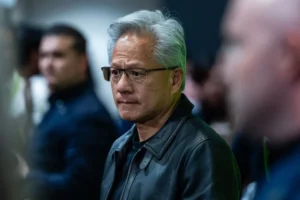
The intersection of high-stakes global geopolitics, cutting-edge semiconductor technology, and personal scandal has thrust Nvidia CEO Jensen Huang into the center of a burgeoning controversy. Recent reports originating from Beijing suggest that a purported romantic entanglement involving Huang and a prominent Chinese businesswoman may be more than a tabloid sensation; some observers suggest it could be a calculated element in a broader effort to undermine Western technological dominance. This alleged scandal, which links the personal life of one of the world’s most influential tech leaders to the clandestine smuggling of artificial intelligence chips into China, has intensified scrutiny over the resilience of the global AI supply chain and the effectiveness of United States export controls.
The Anatomy of the Allegations
At the core of the controversy are allegations that a Chinese entrepreneur, allegedly connected to Huang, has been instrumental in navigating the complex web of sanctions imposed by the U.S. Department of Commerce. The claim, which has yet to be verified by official legal channels, suggests that this individual facilitated the movement of restricted AI hardware into mainland China. While the details of the personal relationship remain unconfirmed, the implications for Nvidia are significant. The company, which has become the bedrock of the global AI revolution, finds itself in a precarious position where the private lives of its leadership are being weaponized in the ongoing tech war between Washington and Beijing.
The narrative surrounding this scandal has been seized upon by various actors as evidence of the "soft underbelly" of corporate leadership in the semiconductor sector. Whether these allegations are a genuine breach of security protocols or a coordinated disinformation campaign remains a subject of intense debate among geopolitical analysts. However, the timing of these reports—coinciding with China’s aggressive push for technological self-sufficiency—is viewed by many as highly suspicious.
Chronology of the AI Semiconductor Conflict
To understand the weight of these accusations, one must examine the timeline of the escalating tensions between the U.S. and China regarding semiconductor technology:
- October 2022: The U.S. Bureau of Industry and Security (BIS) implements sweeping export controls aimed at restricting China’s access to advanced computing chips and semiconductor manufacturing equipment.
- March 2023: Nvidia adapts by creating the A800 and H800, performance-tuned versions of its flagship chips designed to comply with U.S. regulations.
- October 2023: The U.S. government closes loopholes in the initial order, banning the sale of even the modified A800 and H800 chips to China, effectively cutting off access to the most advanced AI processing power.
- Early 2024: Reports emerge of a robust "underground" market for AI chips in China, where small batches of Nvidia hardware are smuggled through third-party intermediaries, often involving complex shell company structures.
- Late 2024: Discussions arise regarding the H200 chip and its availability in the Chinese market under strict licensing agreements, with reports suggesting that U.S. authorities are demanding a 25% "tax" or revenue share on these sales to mitigate security concerns.
The Resilience of Chinese AI Development
Despite the tightening net of U.S. sanctions, Chinese technology firms—most notably DeepSeek, Moonshot AI, and Z.ai—have continued to unveil increasingly sophisticated large language models (LLMs). This persistent progress has forced industry observers to question the efficacy of the U.S. blockade. If China can continue to innovate at a rapid pace without the latest Nvidia Blackwell or Rubin chips, the long-term strategic value of these sanctions is called into question.
The current debate centers on whether Chinese firms are effectively pivoting to domestic alternatives, such as the Huawei Ascend series, or if they are successfully utilizing illicit supply channels to keep their research and development engines running on Nvidia hardware. Analysis by the AFP on November 10, 2024, highlighted that while Nvidia’s GPU architecture is currently the global gold standard for AI training, the fundamental ability to parallel process massive datasets is becoming a "commodity" capability that China is determined to replicate domestically.
Economic Stakes and Market Valuation
Nvidia’s trajectory has been nothing short of historic. The surge in global demand for generative AI, sparked by the release of ChatGPT in late 2022, transformed the company from a gaming-centric hardware manufacturer into a cornerstone of the global economy. With a market capitalization reaching $4.5 trillion, Nvidia now rivals Apple as the most valuable company in the world.
However, this valuation is tethered to a fragile geopolitical situation. The Chinese market historically accounted for a significant portion of Nvidia’s total revenue. The loss of that market, coupled with the regulatory costs associated with the H200 sales, has forced Nvidia to diversify its client base. The alleged scandal involving Jensen Huang adds an element of reputational risk to this already volatile environment. If investors perceive that the company’s leadership is compromised or that its distribution network is being manipulated by foreign intelligence services, the impact on stock stability could be profound.
Official Stances and Regulatory Pressure
The U.S. government maintains that its restrictions are essential for national security. The concern is that advanced AI chips can be repurposed for military simulations, nuclear weapons design, and the development of autonomous weapons systems. The requirement for Nvidia to pay a portion of its revenue from authorized sales of lower-tier chips like the H200 to the U.S. treasury is a novel attempt to treat these companies as instruments of state power.
Nvidia has consistently stated that it complies with all international trade laws and export regulations. In response to the circulating rumors, company representatives have underscored the importance of transparency and internal governance. However, the company has not issued a specific rebuttal regarding the personal allegations against Huang, likely following a policy of ignoring speculative tabloid reports to prevent legitimizing them.
Analysis: Implications for Global Tech
The implications of this scandal extend far beyond the personal life of an executive. It highlights the vulnerability of the global semiconductor supply chain. If high-end chips are being leaked into a restricted market, it suggests that the "choke point" strategy employed by the U.S. may be fundamentally flawed.
- The "Workaround" Economy: The existence of a gray market for high-performance chips indicates that demand in China is so inelastic that firms are willing to pay significant premiums for smuggled hardware. This sustains the ecosystem of intermediaries, making it nearly impossible for the U.S. to achieve a "hard stop" on technology flow.
- Domestic Innovation Acceleration: Continued pressure from the U.S. is acting as a catalyst for China’s domestic semiconductor industry. By cutting off access, Washington has provided a powerful economic incentive for Chinese firms to bypass Western technology entirely, potentially leading to the emergence of a bifurcated global tech stack—one led by the U.S. and another by China.
- Leadership Vulnerability: The targeting of Jensen Huang serves as a warning for other tech leaders. As the semiconductor industry becomes the "new oil" of the 21st century, its key figures are becoming prime targets for geopolitical maneuvering. The weaponization of personal narratives is a classic intelligence tactic, and its appearance here signals a deepening of the conflict.
Conclusion
The allegations surrounding Jensen Huang serve as a microcosm of the broader struggle for supremacy in the age of artificial intelligence. While the veracity of the "romance-based" scandal remains unproven, the underlying reality of a high-stakes, clandestine trade in AI hardware is indisputable. As Nvidia navigates the path between its fiduciary duty to shareholders and the demands of U.S. national security, it remains caught in a geopolitical crossfire.
Whether this event marks a turning point in the regulation of the AI industry or merely serves as a distraction in the ongoing tech war, the outcome will have lasting consequences for the global economy. For now, the world remains watching, waiting to see if the world’s most valuable chipmaker can continue to thread the needle of global compliance while maintaining its position at the vanguard of the AI revolution. The resilience of Chinese innovation, paired with the relentless demand for compute power, suggests that the conflict over AI hardware is far from reaching its conclusion.