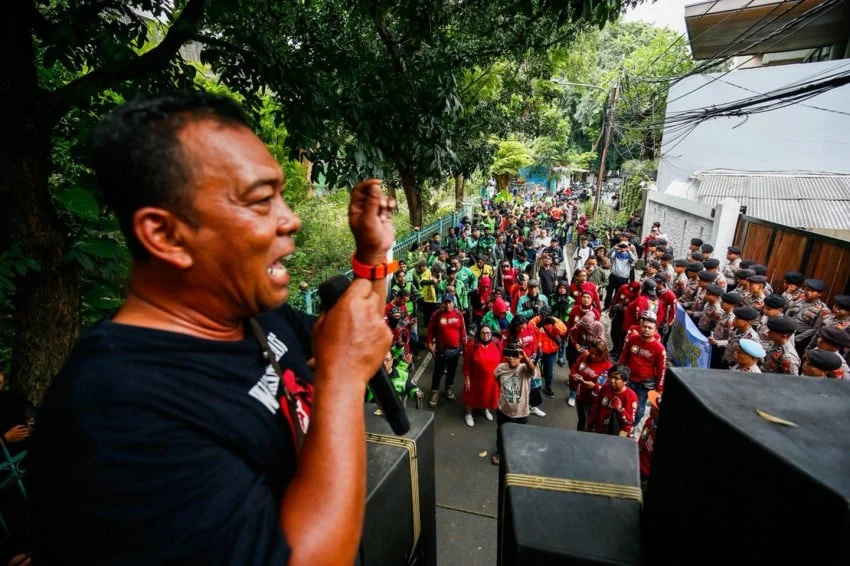
The offices of Saiful Mujani Research and Consulting (SMRC) in Gondangdia, Central Jakarta, became the focal point of a significant public demonstration on Tuesday, April 14, 2026, primarily involving large numbers of online motorcycle taxi (ojol) drivers. This protest erupted following controversial statements made by SMRC founder Saiful Mujani, which were perceived as alluding to attempts to undermine or even "topple" the administration of President Prabowo Subianto. The incident, quickly amplified through social media, escalated into a broader discussion about freedom of expression, political stability, and the increasingly polarized nature of Indonesian public discourse. Saiful Mujani himself acknowledged the unfolding events via his social media platform X (formerly Twitter) on Wednesday, April 15, 2026, confirming the Tuesday protest and anticipating further demonstrations by student groups, encapsulating his sentiment with the phrase, "The arena of conflict expands from the people vs. the palace to the people vs. the people. The cost of a stance."
Chronology of Escalation and Public Outcry
The genesis of the protest can be traced back to Saiful Mujani’s remarks, which, while not explicitly detailed in the initial report, were widely interpreted as critical of the newly inaugurated administration. While the precise content of his original statement remains subject to public speculation and various interpretations, it reportedly touched upon alleged efforts or sentiments aimed at destabilizing the government. Such a statement, particularly from a prominent political analyst and head of a respected polling institution like SMRC, carries considerable weight in Indonesia’s sensitive political climate.
On Tuesday, April 14, 2026, a substantial contingent of online motorcycle taxi drivers began to gather outside the SMRC headquarters in Gondangdia. The mobilization appeared rapid and well-coordinated, suggesting underlying organizational structures or widespread discontent. By mid-morning, the crowd had swelled, transforming the usually bustling street into a scene of intense protest. Chants demanding the "Arrest and Prosecution of Saiful Mujani" echoed through the area, signaling the seriousness with which the demonstrators viewed his comments. Banners and placards displayed similar messages, condemning what they perceived as an attack on the legitimacy of the presidency and an attempt to incite public unrest.
The presence of online motorcycle taxi drivers as a primary force in the protest is notable. These drivers, often forming cohesive communities through their respective ride-hailing applications, have historically been a significant demographic capable of rapid mobilization for various causes, ranging from advocating for better working conditions to expressing political support or dissent. Their involvement in this particular protest underscored the potent combination of social grievances and political sentiment that can be harnessed in Indonesia.
The protest on Tuesday remained largely orderly, albeit vocal, with Jakarta Metro Police personnel deployed to manage the crowd and ensure public safety. However, the intensity of the demands indicated a deep-seated reaction to Mujani’s statement. The following day, Wednesday, April 15, 2026, Saiful Mujani took to his X account, providing a real-time commentary on the unfolding situation. He stated, "People calling themselves the ojol association, and today a group of students, they say, will besiege my office." This tweet not only confirmed the previous day’s protest but also foreshadowed a potential second wave of demonstrations, further intensifying the political drama. His subsequent reflection, "The arena of conflict expands from the people vs. the palace to the people vs. the people. The cost of a stance," resonated deeply within the Indonesian political sphere, highlighting the growing polarization and the personal risks associated with expressing critical political opinions.
Background and Context: SMRC and the Indonesian Political Landscape
Saiful Mujani Research and Consulting (SMRC) is one of Indonesia’s most influential and frequently cited public opinion research institutions. Founded by Dr. Saiful Mujani, a highly respected political scientist and public intellectual, SMRC has played a crucial role in shaping public discourse through its rigorous polling data, analytical reports, and expert commentary on elections, public policy, and social trends. The institution is known for its independence and often provides data that can be critical of various political actors or government policies, contributing significantly to informed public debate.
Dr. Saiful Mujani himself is a prominent figure, recognized for his incisive analysis and willingness to voice opinions that challenge conventional wisdom. His work often involves dissecting the nuances of Indonesian political behavior and electoral dynamics, making his statements particularly impactful. Given SMRC’s standing, any controversy involving its founder or findings inevitably draws significant public and media attention.
The timing of this incident is also critical, occurring within the nascent stages of President Prabowo Subianto’s administration. Following a highly contested and emotionally charged presidential election, the political atmosphere in Indonesia remains sensitive. New administrations often face intense scrutiny, and any perceived threat to their legitimacy or stability can elicit strong reactions from their supporters. The term "topple" (menggulingkan) carries significant historical weight in Indonesia, evoking memories of past political upheavals and revolutions, making its mere mention highly provocative.
The involvement of online motorcycle taxi drivers in political protests is not unprecedented. As a large, often economically vulnerable, and digitally connected demographic, ojol drivers have emerged as a significant force in Indonesian civil society. They have been mobilized for various causes, from advocating for better wages and working conditions to expressing support for particular political candidates or protesting government policies. Their ability to quickly organize and deploy large numbers of people makes them a powerful, albeit sometimes controversial, element in public demonstrations. The question of whether such mobilizations are entirely organic or are orchestrated by external political actors often arises in these contexts.
Statements and Reactions from Involved Parties
In the wake of the protests, various parties have either responded directly or are expected to issue statements addressing the escalating situation.

Saiful Mujani Research and Consulting (SMRC): While an official, comprehensive statement from SMRC’s institutional leadership beyond Mujani’s personal tweets has not been widely reported, it is highly probable that the institution would emphasize its commitment to academic freedom, objective research, and the right to freedom of expression. SMRC would likely reiterate its role as an independent research body that provides data and analysis without partisan bias, and would likely condemn any attempts at intimidation or suppression of critical thought. They might also highlight the importance of constructive dialogue over confrontational protests, urging for a rational engagement with their findings rather than emotional reactions.
Law Enforcement (Jakarta Metro Police): The Jakarta Metro Police would confirm the deployment of officers to manage the protest, ensuring public order and preventing any escalation into violence. They would likely issue a statement urging all parties to respect the law and to resolve disagreements through peaceful and legal channels. Depending on the nature of the protest and any potential violations of public order regulations, the police might also indicate an investigation into the organization of the demonstration and whether any laws, such as those pertaining to incitement or public nuisance, were breached. Their primary objective would be to maintain security and ensure the safety of both the protesters and the general public.
Protesting Ojol Groups: Representatives of the online motorcycle taxi drivers who participated in the protest would likely articulate their core demands, which center on the "Arrest and Prosecution of Saiful Mujani." They would justify their actions by arguing that Mujani’s statements were not merely critical analysis but rather provocative remarks that threatened national stability and insulted the office of the President, whom they see as representing the will of the people. They might also deny any allegations of being politically manipulated, asserting that their participation was a genuine expression of their collective indignation and loyalty to the state.
Student Groups (Anticipated Protest): If student groups proceed with their anticipated demonstration, their statements would likely reflect a mix of concerns. Depending on their specific affiliations and ideological leanings, some might echo the ojol groups’ demands, focusing on national stability and presidential legitimacy. Others might frame their protest as a defense of freedom of speech and academic freedom, arguing that any attempt to silence critical voices undermines democratic principles. Their demands could range from calling for accountability from Mujani to advocating for broader protections for intellectual discourse.
Government and Presidential Palace: While direct intervention from the Presidential Palace might be reserved for more severe crises, a general statement from a government spokesperson or a relevant ministry would likely emphasize the government’s commitment to upholding both freedom of expression and national unity. Such a statement would typically call for all citizens to exercise their rights responsibly, avoid actions that could destabilize the nation, and seek redress for grievances through established legal and democratic mechanisms. The government would likely reiterate its dedication to democratic processes and its expectation that all public figures and institutions contribute to a constructive and peaceful political environment.
Independent Political Analysts and Civil Society Organizations: Many independent observers and civil society groups would likely weigh in on the situation, often highlighting the delicate balance between freedom of speech and the potential for incitement. They might express concerns about the growing trend of public intimidation against critical voices, which could have a chilling effect on academic freedom and independent research. Analysts would likely discuss the implications of such protests for democratic discourse, warning against the normalization of "people vs. people" conflicts as a means of resolving political disagreements.
Broader Impact and Implications
The protests against SMRC and Saiful Mujani carry significant implications for Indonesia’s democratic health, freedom of expression, and the role of research institutions in public life.
Chilling Effect on Freedom of Speech and Academic Freedom: The most immediate concern is the potential for a chilling effect on critical commentary and academic freedom. When prominent public intellectuals and research institutions face direct public intimidation, it can deter others from expressing dissenting or critical views, leading to self-censorship. This is particularly problematic in a democracy, where robust debate and independent analysis are essential for accountability and informed decision-making. The incident underscores the fragility of these freedoms in an environment where public opinion can be quickly mobilized.
Political Polarization and "Rakyat vs. Rakyat": Saiful Mujani’s poignant observation, "The arena of conflict expands from the people vs. the palace to the people vs. the people," accurately captures the escalating political polarization in Indonesia. This incident illustrates how segments of the population can be mobilized against others based on perceived political allegiances or interpretations of national interest. This internal conflict, where citizens confront each other rather than focusing on the government, risks fragmenting society and diverting attention from substantive policy debates. It also raises questions about the methods and motivations behind such mass mobilizations.
Role of Research Institutions in a Democracy: The protest challenges the very function of institutions like SMRC, which are designed to provide objective data and analysis, even when those findings are uncomfortable for political actors. If research institutions are subject to public pressure and intimidation for their intellectual output, their ability to conduct independent work is severely compromised. This could lead to a decline in data-driven policy-making and an erosion of trust in expert opinions, further complicating the public sphere.
Social Media as a Double-Edged Sword: The incident once again highlights the dual nature of social media platforms like X. While they enable rapid dissemination of information and serve as a crucial space for public discourse and mobilization, they also facilitate the swift amplification of controversies, misinformation, and calls for direct action, often without sufficient context or verification. Mujani’s own use of X to comment on the protests underscores its centrality in contemporary political communication.
Future of Political Discourse: This event sets a precedent that could influence future political discourse in Indonesia. It might encourage a more cautious approach from public figures in expressing critical views, or conversely, it could embolden groups to use public demonstrations as a primary tool to silence perceived opposition. The manner in which the authorities, SMRC, and the protesting groups manage the aftermath will be crucial in shaping the trajectory of political engagement in the country. A constructive resolution would ideally involve reaffirming the importance of peaceful dialogue, respecting freedom of expression, and ensuring that legitimate grievances are addressed through appropriate channels, rather than through intimidation.
In conclusion, the protests at the SMRC office are more than just a localized incident; they are a significant indicator of the current political temperature in Indonesia. They force a critical examination of the boundaries of free speech, the dynamics of political mobilization, and the enduring challenges of maintaining democratic principles in an increasingly polarized society. The "cost of a stance," as Saiful Mujani articulated, extends beyond individual inconvenience, touching upon the fundamental tenets of a functioning democracy.