
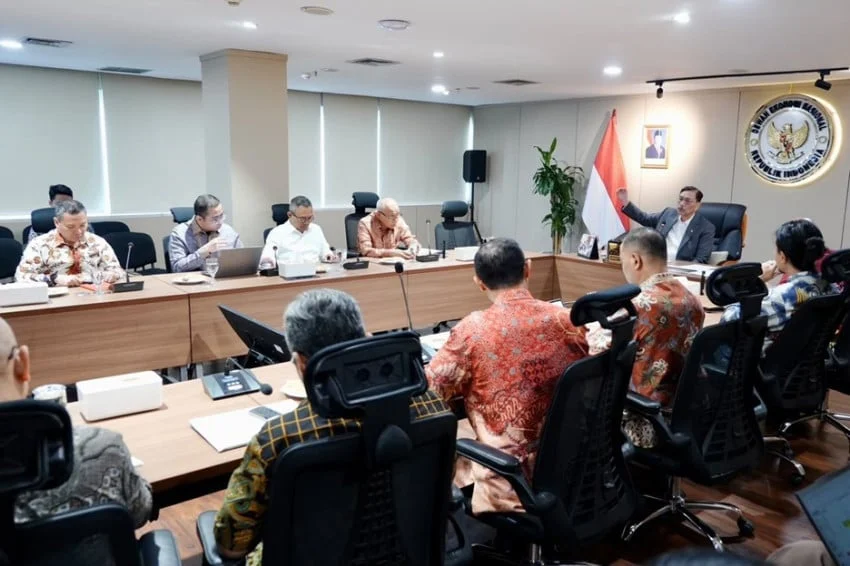
The debate surrounding the implementation and enforcement of Indonesia’s Anti-Corruption Law (UU Tipikor) has reached a critical juncture, drawing the attention of prominent national figures, academic alumni networks, and key economic policymakers. On Friday, November 6, 2026, the Ikatan Alumni Institut Teknologi Sepuluh Nopember (IKA ITS), alongside representatives from several of the country’s most influential university alumni organizations, formally proposed a comprehensive reform of the legal framework governing corruption eradication. The proposal was presented during a high-level strategic discussion held at the National Economic Council (DEN) Building in Jakarta, hosted by DEN Chairman Luhut Binsar Pandjaitan.
The coalition of alumni associations—which included representatives from the Bandung Institute of Technology Alumni Association (IA ITB), the University of Indonesia Alumni Association (ILUNI UI), IKA ITS, the Gadjah Mada University Alumni Association (KAGAMA), Airlangga University Alumni Association (IKA UNAIR), Padjadjaran University Alumni Association (IKA UNPAD), alongside various industry professionals—converged on a singular urgent message. They argue that while the eradication of corruption remains an absolute national priority, the current statutory definitions and enforcement mechanisms often conflate genuine criminal intent with administrative missteps and legitimate business risks. Consequently, this ambiguity creates a chilling effect on decision-makers within state-owned enterprises (SOEs) and the broader public sector, ultimately hampering national economic growth and deterring competent professionals from entering public service.
Background Context and the Genesis of the Discussion
The meeting at the DEN headquarters represents the culmination of mounting anxieties within Indonesia’s corporate and bureaucratic leadership regarding the legal vulnerabilities tied to public sector management. Over the past decade, Indonesia has aggressively pursued anti-corruption measures, a mandate deeply rooted in the reform movement of 1998 and institutionalized through the establishment of the Corruption Eradication Commission (KPK) and the enactment of Law Number 31 of 1999 on the Eradication of Criminal Acts of Corruption, as amended by Law Number 20 of 2001 (UU Tipikor).
However, as the economic landscape has evolved, so too have the complexities of state-owned enterprise operations, corporate governance, and large-scale infrastructure procurement. SOEs and their subsidiaries now operate in highly competitive commercial environments that require agility, risk-taking, and rapid corporate decision-making. Despite this commercial reality, corporate actions within SOEs remain heavily scrutinized under public law frameworks, exposing executives and corporate directors to criminal investigations for decisions that result in financial losses, even when those decisions were made in good faith under standard business judgment rules.
Recognizing the friction between aggressive anti-corruption enforcement and the practical demands of economic development, the National Economic Council, under the leadership of Luhut Binsar Pandjaitan, has opened its doors to structured dialogues with academia, legal experts, and professional organizations. Friday’s forum served as a formal platform for these stakeholders to present empirical evidence, legal critiques, and international benchmarks aimed at refining the legal architecture without weakening the state’s resolve against graft.
The Core Argument: Protecting Corporate Judgment and Public Service
During the session, Boy Robyanto, Vice General Chairman of IKA ITS, delivered a comprehensive presentation detailing the systemic issues arising from the vague interpretation of statutory provisions, particularly concerning the nebulous concept of "state financial losses" (kerugian negara).
Robyanto emphasized that the lack of clear statutory boundaries regarding what constitutes a criminal act of corruption versus a standard administrative error or commercial miscalculation has generated widespread apprehension among decision-makers in state-owned enterprises. When corporate executives operate under the perpetual threat of criminal prosecution for routine business losses, institutional paralysis sets in. Decision-making becomes excessively bureaucratic, risk aversion replaces strategic innovation, and the execution of vital public infrastructure projects slows down. Ultimately, these operational delays diminish the competitiveness of national corporations on both regional and global stages.
"The uncertainty surrounding the application of anti-corruption provisions, particularly regarding state losses, has created profound apprehension among decision-makers within state-owned enterprises," Robyanto stated during the meeting. "This condition risks causing professionals to hesitate in making essential business decisions, which in turn hampers public service delivery and reduces the competitiveness of national enterprises."
Revisiting Articles 2 and 3 of the Anti-Corruption Law and the New Criminal Code
A central focus of the discussion was the legal interpretation and practical application of Articles 2 and 3 of the original UU Tipikor, the substances of which have now been integrated into Articles 603 and 604 of Indonesia’s newly enacted Criminal Code (KUHP).
For years, legal scholars, practitioners, and business leaders have criticized Articles 2 and 3 for their sweeping and elastic phrasing. Article 2 penalizes any person who unlawfully enriches themselves, another person, or a corporation in a manner that can cause financial losses to the state. Article 3 addresses the abuse of authority, opportunity, or facilities available due to office or position, similarly tethered to the existence of state losses. Because the threshold defining "unlawful acts" and "state losses" has historically been interpreted broadly by investigators and courts, routine business decisions that incurred financial losses—despite being executed through proper internal procedures—have frequently been investigated as corruption.
Robyanto specifically pointed out that the core elements of these articles require immediate legislative and judicial clarification. "The elements of state financial losses, unlawful acts, and criminal intent need to be formulated and interpreted much more clearly so that business risks, administrative errors, and actual acts of corruption do not become hopelessly intermingled," he asserted.
Legal experts supporting this viewpoint argue that without clear separation between civil breach of contract, administrative malpractice, and criminal corruption, the legal system inadvertently penalizes entrepreneurial initiative and punishes corporate governance failures with the full weight of criminal law, bypassing more appropriate civil or administrative remedies.
Aligning with International Standards: The UNCAC Framework
Expanding the scope of the dialogue beyond domestic legal confines, the IKA ITS delegation reminded policymakers of Indonesia’s international commitments. Indonesia officially ratified the United Nations Convention Against Corruption (UNCAC) through Law Number 7 Tahun 2006, signaling its intent to harmonize its anti-corruption regime with globally recognized legal standards and best practices.
As Indonesia marks two decades since the ratification of UNCAC, Robyanto argued that the country must evaluate its current enforcement practices against international benchmarks. True international best practices, as outlined in global anti-corruption frameworks, emphasize the importance of precision in criminal law, the protection of institutional integrity, and the avoidance of over-criminalization in commercial spheres. Aligning domestic enforcement with these principles ensures that the fight against corruption remains robust and targeted, rather than sweeping and counterproductive to broader economic goals.
Case Studies: The Pelindo Precedents
To substantiate their arguments with empirical realities from the field, the alumni representatives highlighted specific legal cases within Indonesia’s maritime logistics sector, focusing particularly on incidents involving state-owned port operator PT Pelabuhan Indonesia (Pelindo) and its subsidiaries.
The first major case cited involved the dredging activities at Tanjung Perak Port in Surabaya, carried out by Pelindo’s subsidiary, PT APBS (Akselerasi Potensi Bandar Surabaya). According to the factual background presented, the dredging project was fully executed and successfully delivered tangible operational benefits to the port, significantly improving vessel turnaround times and accommodating larger cargo ships.
Despite the successful operational outcome and the delivery of public utility, the corporate profits generated from the project became the subject of intense legal scrutiny. Prosecutors and investigators contested the procurement process, arguing that procedural deviations occurred during the awarding and execution of the contract. Consequently, the legal proceedings evaluated the matter through a criminal lens, with the court identifying unlawful acts that allegedly enriched the corporation, even though the individual defendants on trial were explicitly proven not to have personally profited or enriched themselves from the venture.
Alumni associations utilized this case study to illustrate a structural anomaly in how economic crimes are prosecuted in Indonesia. When a corporate entity delivers physical infrastructure that serves the public interest, yet corporate gains are criminalized solely due to administrative irregularities in the procurement phase, it establishes a precarious precedent for corporate actors. Executives are left questioning whether successful project completion matters if administrative compliance is later re-interpreted retrospectively as a criminal conspiracy.
Broader Economic Implications and Industry Reactions
The proposals put forward by IKA ITS and allied alumni organizations have triggered broader discussions across Indonesia’s economic and legal sectors. Economists and corporate governance experts have long warned that legal uncertainty is one of the primary non-tariff barriers hindering foreign and domestic investment in Indonesia.
When corporate leaders face personal criminal liability for business decisions that incur losses due to shifting market conditions or minor regulatory misinterpretations, capital allocation becomes overly conservative. State-owned enterprises, which control massive assets and drive critical national infrastructure projects, are particularly vulnerable to this paralysis. If directors and commissioners refuse to approve high-impact, high-reward projects out of fear of anti-corruption investigations, national development targets—such as logistics cost reduction, energy transition, and digital transformation—suffer direct setbacks.
Conversely, anti-corruption activists and civil society watchdogs maintain a cautious stance regarding any push to revise or soften anti-corruption laws. Historically, watchdogs have argued that any attempt to narrow the definition of "state losses" or "abuse of authority" could be exploited by corrupt elites to create legal loopholes, thereby weakening the investigative capacity of law enforcement agencies like the KPK, the Attorney General’s Office, and the National Police.
Addressing this inherent tension is precisely why the dialogue hosted by the National Economic Council is viewed as a pivotal milestone. By bringing together economic planners, technical experts, and legal minds, the forum attempts to forge a balanced consensus: maintaining uncompromising deterrence against genuine corruption while establishing robust legal safeguards—such as the explicit codification of the Business Judgment Rule—to protect bona fide professional actions in the public and corporate sectors.
Looking Ahead: Potential Pathways for Legal Reform
The constructive exchanges at the DEN Building on November 6, 2026, are expected to serve as foundational inputs for future policy recommendations submitted to the executive and legislative branches. Several potential pathways for reform have emerged from the discussions:
- Clarification of Statutory Definitions: Pushing for binding judicial guidelines (such as a Supreme Court Regulation or PERMA) or legislative amendments that explicitly differentiate between administrative losses, civil default, and criminal corruption.
- Codification of the Business Judgment Rule: Strengthening legal protections for SOE directors and public managers who make commercially reasonable decisions based on adequate information and without personal conflict of interest, even if those decisions ultimately result in financial loss.
- Enhanced Coordination between Oversight and Law Enforcement: Improving institutional synergy between internal auditors (such as the BPKP and Inspectorates) and law enforcement agencies to ensure that administrative findings are first subjected to internal remediation before immediate criminalization.
- Benchmarking with UNCAC Standards: Conducting a systematic review of Indonesia’s anti-corruption jurisprudence against international standards to ensure that enforcement mechanisms support, rather than stifle, economic vitality and investor confidence.
As Indonesia continues its trajectory toward becoming a major global economy, harmonizing the imperatives of rigorous law enforcement with the realities of modern commercial governance remains an inescapable policy challenge. The proactive stance taken by IKA ITS, ILUNI UI, IA ITB, KAGAMA, IKA UNAIR, IKA UNPAD, and the National Economic Council signals a collective recognition that sustainable national development requires not only a clean government, but also a courageous, legally secure, and economically empowered professional leadership.
