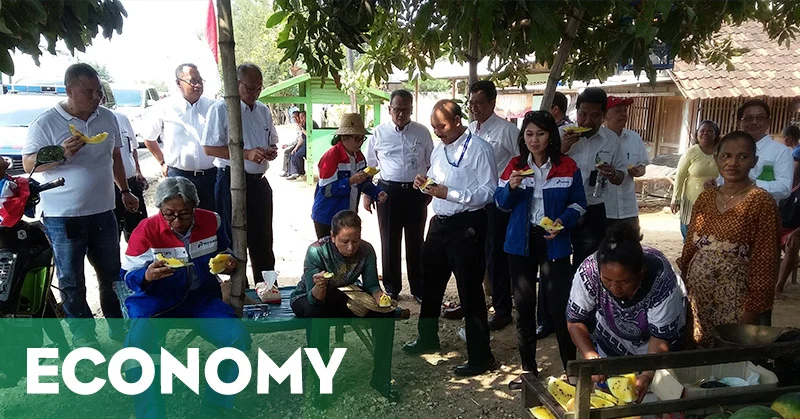
The revitalization of strategic national assets often unfolds against a backdrop of high-stakes political oversight, technical evaluations, and rigorous corporate planning. However, moments of spontaneous human connection frequently punctuate these high-level governmental inspections. Such an instance occurred on Wednesday, November 11, 2015, in the coastal regency of Tuban, East Java. Prior to conducting a formal inspection of the long-dormant PT Trans Pacific Petrochemical Indotama (TPPI) refinery, President Joko Widodo, accompanied by State-Owned Enterprises (SOE) Minister Rini Soemarno, Pertamina President Director Dwi Soetipto, and a high-ranking delegation of government and energy sector officials, paused briefly to engage with local residents. Amidst the heavy security and intense media scrutiny surrounding the multi-million-dollar energy installation, the leadership cadre took a moment to walk through the surrounding neighborhood, interact with community members, and sample local produce—specifically, fresh watermelons harvested from nearby agricultural lands.
This seemingly minor cultural vignette occurred just moments before official briefings commenced at the refinery complex. While the gesture was casual, the visit itself carried profound economic and industrial significance. The TPPI facility was not merely another industrial plant; it represented a critical nexus in Indonesia’s ongoing struggle for energy independence, fiscal stabilization, and domestic fuel supply chain security. The presence of the nation’s highest executive, alongside the heads of state-owned energy giants, underscored the immense pressure facing the administration to resurrect stalled infrastructure and reduce the nation’s heavy reliance on costly refined petroleum imports.
Background Context of the TPPI Refinery
The PT Trans Pacific Petrochemical Indotama refinery, situated in Tuban, East Java, has long been a focal point of Indonesia’s complex petrochemical and energy landscape. Conceptualized decades prior to its eventual operational phases, the facility was designed to serve as a cornerstone for domestic petrochemical production and fuel refining. However, its trajectory has been fraught with financial distress, legal disputes, management changes, and prolonged operational halts. For years, the refinery sat underutilized or completely idle, representing a massive immobilization of capital in a country desperately in need of refined petroleum products to fuel its expanding economy.
Before state intervention brought the facility back under the operational umbrella of national energy champion PT Pertamina (Persero), TPPI struggled with mounting debts and corporate governance challenges. The plant’s strategic value lies in its dual capacity: it can produce crucial petrochemicals such as paraxylene, benzene, and orthoxylene, while also playing a vital role in processing condensate into high-octane motor gasoline (mogas) and diesel fuel. When operating at optimal capacity, the refinery has the potential to significantly alleviate the burden on Indonesia’s current account deficit by curbing massive crude and fuel imports.
Prior to the November 2015 inspection, the Indonesian government had intensified efforts to untangle the web of financial and legal obstacles plaguing the facility. Bringing TPPI back to life was viewed by economic planners as a litmus test for the administration’s ability to rescue distressed state-backed projects and redirect national resources toward productive economic use. Consequently, the visit by President Joko Widodo and his top economic and energy lieutenants was heavily anticipated by market analysts, industry observers, and local communities alike.
Chronology of the Inspection Day
The events of Wednesday, November 11, 2015, followed a carefully choreographed yet dynamic itinerary designed to provide the presidential entourage with both a macro-level overview of the facility and a grassroots perspective of the surrounding area.
The day commenced with the arrival of President Joko Widodo and his presidential aircraft delegation in East Java. Traveling by road toward the Tuban industrial corridor, the presidential convoy arrived near the perimeter of the TPPI complex. Accompanying the President were State-Owned Enterprises Minister Rini Soemarno, Pertamina President Director Dwi Soetipto, Pertamina Vice President of Communication Wianda Pusponegoro, and Director General of Oil and Gas at the Ministry of Energy and Mineral Resources IGN Wiratmaja Puja.
Rather than driving directly through the main gates in armored vehicles, members of the delegation opted to walk sections of the approach route. This unexpected maneuver allowed local residents, who had gathered in anticipation of the presidential visit, to approach the officials. Community members seized the opportunity to take photographs with the visiting dignitaries, creating a relaxed, accessible atmosphere that contrasted sharply with the typical formality of high-level industrial tours.
As the walking tour progressed through the neighborhood flanking the facility, the entourage paused at a modest local storefront operated by a resident who also sold fresh agricultural produce. Recognizing the local harvest, Minister Rini Soemarno invited her colleagues to stop and sample the goods. Urging the delegation to partake, she remarked on the quality of the locally grown fruit, noting aloud that the watermelons cultivated in the fields surrounding the Tuban refinery were exceptionally sweet. Following this brief interlude—during which several slices of watermelon were consumed amidst lighthearted conversation—the officials resumed their walk, arriving at the main gates of the TPPI complex to begin their technical and operational review.
Official Statements and Stakeholder Reactions
While the informal watermelon-tasting session provided a memorable human-interest anecdote for the media, the substantive discussions inside the refinery gates centered on hard economic metrics, operational readiness, and production targets.

State-Owned Enterprises Minister Rini Soemarno, who had been at the forefront of orchestrating the government’s push to consolidate state assets, emphasized the importance of community integration alongside industrial development. Her willingness to engage with local vendors reflected a broader political strategy of ensuring that major national infrastructure projects maintain positive social license within their host regions.
Simultaneously, Pertamina leadership under President Director Dwi Soetipto faced mounting expectations regarding the technical resuscitation of the plant. Speaking to the press and accompanying officials during the walkthrough, Pertamina representatives outlined the immediate steps being taken to integrate TPPI into the state-owned enterprise’s downstream supply chain. The reactivation strategy relied heavily on utilizing condensate feedstock supplied by Pertamina’s upstream units, ensuring a steady stream of raw materials to keep the refinery’s distillation columns running continuously.
Director General of Oil and Gas IGN Wiratmaja Puja provided regulatory context, noting that the Ministry of Energy and Mineral Resources viewed the resumption of TPPI operations as a critical milestone for national energy security. According to regulatory assessments shared during the visit, bringing the facility back online would provide immediate relief to domestic fuel supply lines, reducing logistical bottlenecks and lowering distribution costs across the eastern regions of Java and beyond.
Broader Economic Implications and Strategic Impact
The visit to the Tuban refinery on November 11, 2015, holds significance when analyzed within the broader framework of Indonesia’s national energy policy during the mid-2010s. At the time, Indonesia was grappling with structural vulnerabilities in its energy sector, having transitioned from a net exporter of oil to a net importer years prior. This shift placed enormous pressure on foreign exchange reserves, as the country had to purchase billions of dollars worth of refined petroleum products from international markets to meet soaring domestic demand.
The revitalization of the TPPI refinery offered a three-fold strategic advantage for the Indonesian economy:
-
Reduction of Import Dependency: By domesticating the refining process for condensate and crude inputs into high-demand fuels like premium gasoline and diesel, the facility directly displaced a significant volume of costly fuel imports. This reduction played a measurable role in easing pressure on the national current account deficit.
-
Enhancement of Petrochemical Self-Sufficiency: Beyond fuel production, TPPI’s output of aromatic petrochemicals—such as paraxylene—served as vital raw materials for Indonesia’s domestic manufacturing sector, particularly the textile and packaging industries. Securing a reliable local source of these chemical inputs shielded domestic manufacturers from global commodity price volatility.
-
Optimization of State Assets: The successful intervention in TPPI demonstrated a new paradigm in state-owned enterprise management under the Jokowi administration. Instead of allowing distressed assets to languish in prolonged liquidation processes or fall entirely into foreign hands, the government leveraged its majority-controlled entities, led by Pertamina, to absorb and rehabilitate strategic infrastructure.
Challenges and Long-Term Outlook
Despite the optimism surrounding the November 2015 inspection, reviving the Tuban facility was not without its hurdles. Analysts at the time pointed out that long-term sustainability would depend heavily on transparent supply contracts, consistent feedstock availability, and prudent financial restructuring to manage the legacy debts inherited from the plant’s previous operators. Furthermore, maintaining rigorous environmental and safety standards in a densely populated industrial and agricultural region like Tuban required continuous oversight from both corporate management and regulatory bodies.
The brief moment of levity involving Minister Rini Soemarno and the local Tuban watermelons served as a public relations triumph, humanizing the technocrats tasked with steering the nation’s economic engine. However, the true test of that November day lay in the months and years that followed, as the refinery transitioned from political promises and ceremonial inspections into a fully functioning cog of Indonesia’s national energy infrastructure.
Ultimately, the 2015 visit to TPPI encapsulated the dual realities of governance in emerging economies: the heavy burden of systemic economic reform juxtaposed with the simple, grounded realities of local communities whose lands host the nation’s grandest industrial ambitions.