
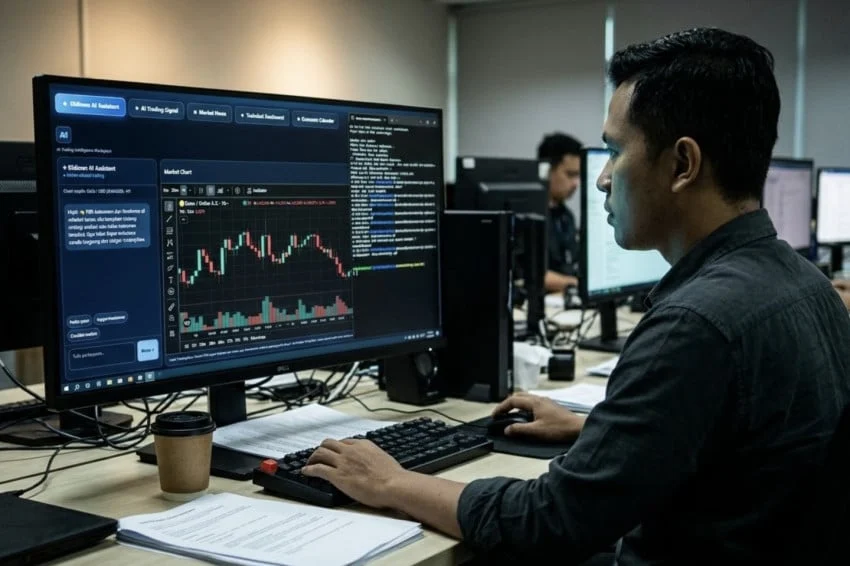
The landscape of retail financial trading is undergoing a profound transformation as artificial intelligence (AI) transitions from a sophisticated institutional tool to a readily accessible companion for individual market participants. In Jakarta and across the broader Southeast Asian financial markets, brokerage firms are increasingly integrating generative AI assistants directly into their trading platforms. These tools, capable of analyzing complex market data, identifying support and resistance levels, and explaining intricate risk management strategies, are now being offered to traders, often free of charge. While this democratization of analytical power promises to lower the barrier to entry for novice traders, it also prompts critical questions regarding the reliability of machine-generated insights in a volatile financial environment.
The Evolution of Trading Technology: From Manual Charts to Algorithmic Assistance
For decades, the ability to engage in professional-grade trading was tethered to a steep learning curve—the requirement to master technical analysis, understand macroeconomic indicators, and interpret complex candlestick charts. Traditional traders spent years honing their ability to identify trends and execute orders based on subjective market sentiment. The introduction of the internet and digital trading platforms in the late 1990s and early 2000s facilitated access to real-time data, but the analytical burden remained squarely on the individual.
The emergence of AI-driven assistants represents the third wave of this evolution. The first wave was the digitization of order execution, followed by the second wave of automated technical indicators. Now, the third wave—generative AI—is providing a layer of natural language interpretation that bridges the gap between raw data and actionable intelligence. Brokerages, such as the Indonesian-based firm Didimax, have begun deploying these AI assistants within their trading ecosystems. By eliminating the pay-per-token or subscription-based models common in general-purpose AI platforms, these brokers are positioning technology as a standard utility for their clients rather than a luxury add-on.
Functionality and Scope of AI in Modern Trading
The capabilities of these integrated AI assistants are multifaceted. At the most fundamental level, they serve as an educational bridge. A trader can input queries such as, "What are the primary factors influencing XAU/USD gold prices today?" or "Explain the concept of risk-to-reward ratio in a bear market." The AI parses vast datasets—ranging from historical price action to current geopolitical headlines—to provide a concise, structured response.
Beyond education, these tools are increasingly used for technical and quantitative analysis. Users can inquire about specific support and resistance levels for gold or major currency pairs. The AI processes real-time price movements and historical patterns to suggest boundaries that define market sentiment. Furthermore, the technology is being leveraged to provide "trading signals," which serve as references for potential entry and exit points. By processing thousands of data points in milliseconds, the AI aims to provide a second perspective for traders who may otherwise be influenced by emotional bias or cognitive fatigue.
Chronology of AI Adoption in the Financial Sector
The integration of AI into retail brokerage services did not occur in a vacuum. It is the culmination of a decade of rapid technological acceleration:
- 2015–2018: The era of "Robo-Advisors." Firms began using algorithms to automate portfolio management based on risk profiles, primarily for passive investors.
- 2019–2021: The rise of high-frequency trading (HFT) and institutional AI. Major hedge funds solidified their reliance on machine learning to identify arbitrage opportunities, leaving retail traders at a distinct disadvantage.
- 2022–2023: The "Generative AI" boom. Following the public release of large language models (LLMs), financial institutions began fine-tuning these models for market analysis, sentiment tracking, and client support.
- 2024–Present: Mainstream integration. Retail brokers are now embedding these models directly into trading platforms to compete for market share by providing value-added services that enhance user engagement and retention.
Market Data and the Complexity of Modern Trading
The necessity for AI-driven assistance is driven by the sheer volume of information that defines today’s markets. According to data from the World Gold Council and various financial intelligence providers, the volatility of gold (XAU/USD) has been significantly impacted by central bank interest rate decisions, inflation reports, and geopolitical tensions. In a single trading session, a gold trader may need to monitor the U.S. Federal Reserve’s monetary policy, inflation prints (CPI), and safe-haven demand stemming from international conflicts.
For an individual trader, processing this information concurrently is an immense challenge. AI, however, excels at this task. By aggregating sentiment from news sources and correlating it with price action, AI assistants offer a macro-view that was previously reserved for professional analysts at investment banks. However, the data also suggests that market volatility remains unpredictable. No amount of AI processing can fully account for "Black Swan" events or sudden shifts in market psychology that deviate from historical data patterns.
Official Perspectives and Industry Implications
Industry experts and regulators are closely watching this trend. While many brokers view AI as a tool for "empowering the trader," there is a clear consensus that these machines are intended to be assistants, not decision-makers. A spokesperson for an industry-leading brokerage noted that the goal of AI integration is to "help traders process the overwhelming volume of information in the market, allowing them to make better-informed decisions rather than guessing."
However, there is a cautionary sentiment regarding the "black box" nature of some AI algorithms. If a trader relies solely on an AI-generated signal without understanding the underlying technical or fundamental logic, they are susceptible to catastrophic loss should the model fail to account for market anomalies. Regulatory bodies, including the Commodity Futures Trading Regulatory Agency (Bappebti) in Indonesia, have consistently emphasized the importance of financial literacy. The prevailing industry view is that AI should act as a supplement to, not a replacement for, professional judgment and robust risk management practices.
The Risks of Algorithmic Dependency
The primary concern among financial analysts is the potential for "over-reliance." When an AI assistant provides a clear, seemingly confident answer about a price trend, it may induce a false sense of security in the user. This is particularly dangerous for novice traders who may lack the experience to identify when the AI is outputting a low-confidence prediction.
Furthermore, AI models are trained on historical data. While they are adept at identifying patterns that have occurred in the past, they are inherently limited by the nature of probability. In the financial markets, past performance is never a guarantee of future results. There is also the issue of "hallucinations," where AI might misinterpret market data or provide inaccurate information based on flawed training data. As such, the responsibility for the final trade execution rests entirely with the human trader.
Broader Implications for the Future of Retail Trading
The inclusion of free, high-performance AI assistants is set to alter the competitive landscape for brokerage firms. Those that offer sophisticated analytical tools will likely attract more users, creating an arms race for better, more accurate AI integration. This will likely lead to a standard where basic market analysis is commoditized, shifting the value proposition of a broker from merely providing access to a market, to providing the tools required to navigate it effectively.
Looking ahead, the next phase of this development will likely involve "Personalized AI Trading Assistants" that learn from a specific user’s trading history, risk tolerance, and psychological patterns. This level of customization could theoretically help traders stay within their pre-defined risk parameters, acting as a "guardrail" against impulsive or emotionally driven trades.
Conclusion: Balancing Innovation with Prudence
The arrival of AI in retail trading marks a significant milestone in the history of finance. By providing individual traders with tools that were previously inaccessible, these technologies are leveling the playing field. However, the excitement surrounding this technological leap must be tempered with a realistic understanding of its limitations.
AI is a powerful analytical engine, but it lacks the human capacity for contextual judgment in the face of unprecedented events. The most successful traders of the future will likely be those who treat AI as a partner in a dialogue—using it to verify hypotheses, expand their scope of analysis, and manage risk—while maintaining full oversight of their own capital and strategy. As the industry continues to evolve, the integration of AI will undoubtedly become more seamless and sophisticated, but the fundamental principle of trading—the disciplined management of risk—remains a human endeavor. Whether through an AI assistant or traditional methods, the success of a trade will always depend on the user’s ability to synthesize information, manage emotions, and remain resilient in the face of the market’s inherent, and often chaotic, nature.
