
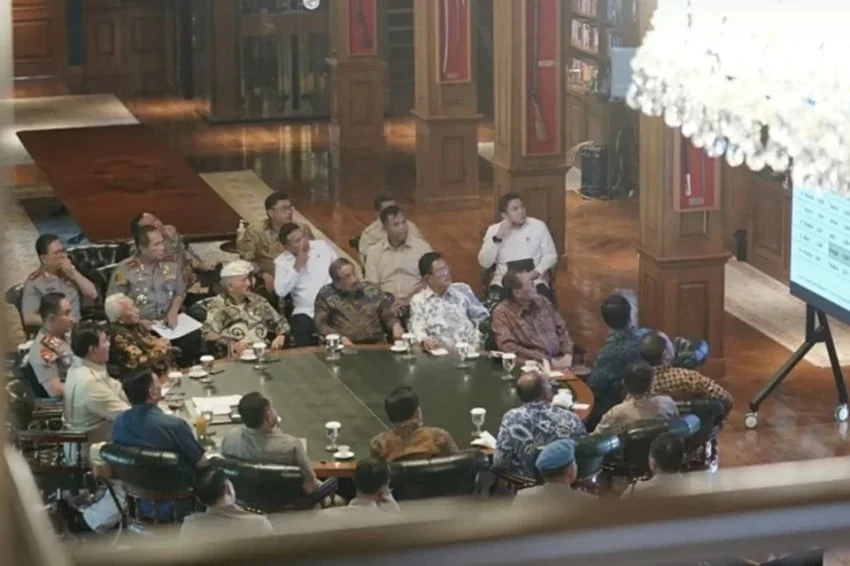
BOGOR — President Prabowo Subianto expressed profound astonishment upon discovering that he was allegedly targeted by a clandestine wiretapping operation orchestrated within the top echelons of the Indonesian National Police (Polri). The revelation came to light following a high-profile, closed-door gathering at the president’s private residence in Hambalang, Bogor, where President Prabowo hosted several former Chiefs of the Indonesian National Police (Kapolri) on Sunday, November 8, 2026.
The meeting, which quickly became the center of intense political and institutional scrutiny, addressed a brewing national security crisis involving allegations of electronic surveillance directed at the nation’s highest office. Among the attendees was retired General Da’i Bachtiar, who later provided candid insights to the press regarding the somber tone of the discussions and the visceral reaction of the head of state to the breach.
The unfolding scandal has sent shockwaves through Indonesia’s political and law enforcement landscapes, pitting the administration against elements within its own security apparatus. As investigations develop, the incident has raised critical questions regarding institutional loyalty, the integrity of intelligence-gathering operations, and the rule of law within the democratic framework of the republic.
The Hambalang Summit and the Disclosed Shock
The gathering at President Prabowo’s residence in Hambalang was initially perceived as a routine consultation between the sitting president and his seasoned predecessors from the national police force. However, discussions quickly gravitated toward what participants privately described as an unprecedented institutional crisis. The focal point of the deliberation was the unearthing of an alleged wiretapping operation that reportedly targeted President Prabowo, with fingers pointing toward individuals associated with former Kapolri General Listyo Sigit Prabowo and several other high-ranking officers.
Speaking to journalists on Monday, November 9, 2026, Da’i Bachtiar detailed the emotional atmosphere of the meeting and articulated the president’s direct response to the espionage allegations. According to Da’i, the president did not conceal his disbelief upon realizing the scale and proximity of the breach.
"Yes, he said that, ‘I was also shocked, truly shocked, when this [the wiretapping] happened,’" Da’i Bachtiar recounted, conveying the president’s personal reaction to the security failure.
Da’i further characterized the gravity of the situation by framing the scandal not merely as an isolated legal infraction, but as a collective failure of institutional ethics within the police force. Acknowledging the involvement of several high-ranking police officers in the unfolding controversy, he candidly described the ordeal as a dark chapter for the organization. "We all happen to know about it. I would call it a disaster for the police," Da’i remarked.
Unraveling the Chronology: From Whispers to Full-Scale Scandal
The genesis of the wiretapping allegations dates back several weeks prior to the Hambalang meeting, as leaked intelligence reports began circulating among senior government officials and political elites in Jakarta. Initial murmurs suggested that sensitive communications involving state leaders, including then-Defense Minister and subsequently President Prabowo Subianto, had been intercepted using advanced surveillance equipment.
The situation escalated dramatically as internal reviews by state intelligence agencies and specialized cyber-investigative units uncovered physical evidence of unauthorized surveillance devices. Legal experts and administration officials were subsequently brought in to assess the extent of the security compromise. Yusril Ihza Mahendra, a senior legal figure within the administration, had previously offered detailed disclosures regarding the initial discovery of the case and the specific technical apparatus allegedly utilized to breach the presidential communications network.

The involvement of high-ranking law enforcement personnel transformed the security breach into a full-scale political crisis. The alleged participation of individuals tied to the tenure of General Listyo Sigit Prabowo thrust the leadership of the national police force into an uncomfortable defensive posture, prompting emergency consultations among active and retired law enforcement officials to prevent a complete collapse of institutional trust.
Institutional Implications and the National Police "Disaster"
The metaphor utilized by Da’i Bachtiar—referring to the scandal as a "disaster" for the Indonesian National Police—underscores the profound psychological and structural impact of the event on the country’s premier law enforcement body. For decades, Polri has navigated complex political transitions, striving to maintain public confidence while executing its mandate of maintaining internal security and public order.
The revelation that elements within the police apparatus may have engaged in the surveillance of the nation’s chief executive threatens to reverse years of hard-won institutional reforms. Analysts note that such actions violate the foundational principles of civilian oversight and the separation of powers between the executive branch and the security forces.
Furthermore, the scandal highlights vulnerabilities in the cybersecurity and communications infrastructure of high-ranking state officials. In an era where digital espionage poses a ubiquitous threat to national security, the ability of domestic actors to compromise the communications of the president exposes critical gaps in defensive protocols that were ostensibly designed to thwart foreign intelligence operations, let alone internal subversion.
Responses and Legal Ramifications
As the investigation widens, pressure is mounting on the judicial and investigative authorities to deliver a transparent, thorough, and impartial accounting of the events. The handling of the officers implicated in the wiretapping scheme will serve as a crucial test for the administration’s commitment to accountability, regardless of rank or institutional affiliation.
While official statements from active leadership within Polri have remained guarded, internal disciplinary boards and criminal investigators are reportedly examining the chain of command to determine who authorized the surveillance, who operated the equipment, and what intelligence was gathered. Legal analysts suggest that the offenses could encompass treason, violations of electronic information and transactions laws, and abuse of official authority.
The involvement of former Kapolri figures, such as Da’i Bachtiar, in advising the president reflects a traditional mechanism of Indonesian statecraft, wherein elder statesmen are called upon to help stabilize institutions during periods of severe stress. Their collective counsel is expected to guide the administration in purging compromised elements while preserving the operational continuity of the police force.
Broader Outlook on Civil-Military and State-Police Relations
The wiretapping controversy arrives at a delicate juncture for the Indonesian government, which is actively pursuing ambitious national development agendas requiring absolute internal stability. Trust between the executive branch and the security apparatus is the bedrock of governance in the archipelago, and any fracture in this relationship reverberates across financial markets, foreign policy, and domestic stability.
The administration faces the dual challenge of prosecuting the wrongdoers to the full extent of the law while reassuring the public that the state’s security apparatus remains firmly under civilian control. President Prabowo’s visible shock, as revealed by Da’i Bachtiar, humanizes the leadership’s response to the betrayal but also underscores the gravity of the systemic challenges that persist within Indonesia’s bureaucracy.
Ultimately, the fallout from the Hambalang meeting and the ongoing investigations into General Listyo Sigit Prabowo and associated officers will likely reshape the regulatory framework governing state surveillance, intelligence gathering, and accountability mechanisms within Polri for years to come. As the legal proceedings unfold, the nation watches closely to see whether the promise of institutional reform can withstand the pressures of this unprecedented domestic intelligence scandal.
