
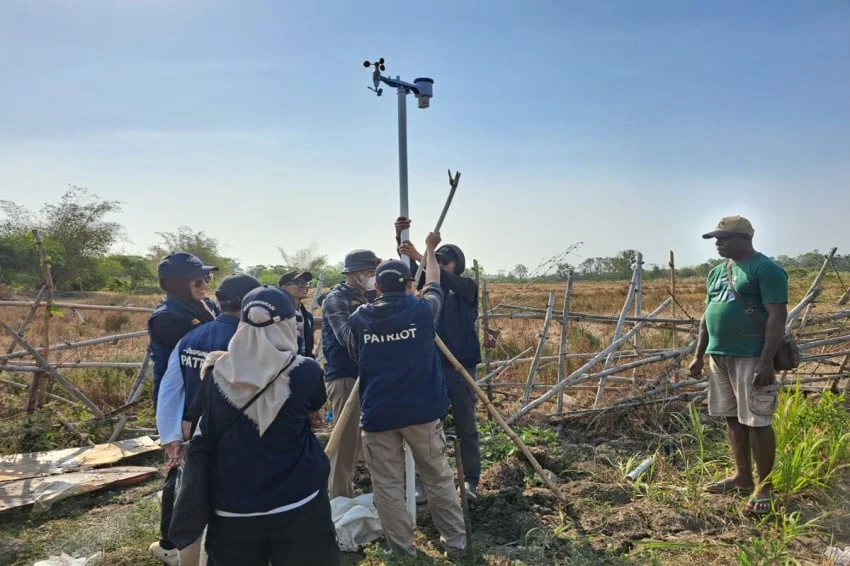
Agricultural productivity in remote regions of Indonesia continues to grapple with the escalating uncertainties of climate change, making modern technological interventions a matter of economic survival rather than mere modernization. In the southern region of Papua, particularly within the agricultural expanse of Kurik District in Merauke Regency, farmers have long faced the formidable challenge of unpredictable weather patterns. These climatic shifts frequently trigger devastating crop failures, threatening both local livelihoods and broader regional food security initiatives.
Addressing this pressing vulnerability head-on, the IPB University Patriot Expedition Team has initiated a critical technological intervention by deploying an advanced Automatic Weather Station (AWS) in Distrik Kurik. This strategic deployment is designed to map micro-climates accurately, mitigate agricultural risks, and furnish local farmers and transmigrant communities with reliable, real-time weather data accessible via digital applications. By bridging the gap between traditional farming methods and precision agriculture, this initiative marks a pivotal milestone in the agricultural development of South Papua.
Understanding the Vulnerabilities of Merauke Agriculture
Merauke has long been designated as a strategic agricultural hub, envisioned as one of Indonesia’s primary granaries to support national food independence. However, transforming vast tracts of land into productive agricultural zones comes with severe environmental hurdles. Farmers in Kampung Harapan Makmur and surrounding areas rely heavily on rain-fed irrigation and traditional seasonal indicators, which have become increasingly erratic due to global climate anomalies such as El Niño and La Niña.
Unpredictable rainfall distribution often leads to prolonged droughts during critical growing stages or sudden, heavy downpours that waterlog fields, destroying yields before harvest. Furthermore, these climatic fluctuations create ideal micro-climates for various agricultural pests and plant diseases, catching farmers off guard and resulting in massive economic losses. Historically, local and transmigrant farmers lacked access to precise meteorological data tailored to their specific micro-region, leaving them vulnerable to the whims of nature. The absence of localized forecasting tools meant that agricultural decisions—such as the timing of planting, fertilizer application, and harvesting—were largely based on guesswork.
The Mechanics and Capabilities of the Automatic Weather Station
To counteract these systemic information deficits, the IPB University Patriot Expedition Team introduced the Automatic Weather Station (AWS), a state-of-the-art meteorological monitoring device. Engineered to withstand harsh tropical conditions, the AWS unit installed in Kurik District functions as an autonomous data collection hub, continuously recording crucial atmospheric parameters.
The station measures ambient temperature, relative humidity, rainfall intensity, wind speed and direction, solar radiation, and barometric pressure. What sets this deployment apart is its integration with digital applications, which translates raw meteorological data into actionable insights for the end-user. Farmers in Kampung Harapan Makmur can now access this information in real time via their smartphones or designated community display terminals.
The system boasts a predictive capability that spans up to 15 days into the future, offering short-to-medium-range forecasts that are vital for daily farm management. Beyond general weather forecasting, the algorithm-backed platform assists farmers in anticipating potential pest outbreaks and drought risks. For instance, sustained high humidity combined with specific temperature thresholds can trigger automated warnings regarding fungal infections, allowing farmers to apply preventive treatments before infestations wipe out their crops. With an operational coverage radius of up to 40 kilometers, a single AWS unit can safeguard extensive farming tracts, optimizing resource allocation, reducing input waste, and ultimately maximizing crop yields.
Community Reception and the Transmigrant Experience

The introduction of the AWS system has been met with immense enthusiasm and relief from the local agricultural community, particularly the transmigrant population who form the backbone of Merauke’s intensive farming sector. Many of these transmigrants relocated to Papua with the hope of establishing sustainable agricultural enterprises, bringing with them diverse farming traditions from Java and other regions. However, adapting to the unique and often unforgiving tropical ecosystems of Papua presented steep learning curves.
For communities whose sole economic lifeline depends on successful harvests, the uncertainty of weather patterns has been a constant source of anxiety. Representatives from Kampung Harapan Makmur expressed profound appreciation for the IPB University Patriot Expedition Team, emphasizing that technological empowerment is crucial for the long-term viability of their settlements. With reliable data now at their fingertips, farmers report feeling a renewed sense of confidence. They are no longer operating entirely in the dark, and the capability to foresee weather trends allows them to protect their investments and secure stable incomes for their families.
Broader Implications for National Food Security
The deployment of digital weather stations in Merauke extends far beyond local benefits; it serves as a microcosm of a larger national strategy. As Indonesia intensifies its focus on developing food estates and expanding agricultural frontiers in eastern Indonesia, integrating climate-smart technology into these regions is non-negotiable.
Climate change models indicate that equatorial regions will experience increasingly volatile weather extremes, threatening staple crop production across the archipelago. Initiatives led by academic institutions like IPB University demonstrate how decentralized, tech-driven solutions can build localized resilience. By equipping farmers with IoT (Internet of Things) and digital meteorological tools, the government and academic sectors can significantly reduce post-harvest losses and mitigate the risk of widespread crop failures.
Furthermore, accurate agricultural data collection contributes to a broader repository of climate intelligence. The data gathered by the AWS in Kurik District can be integrated into national meteorological networks, enhancing the overall accuracy of regional climate predictions managed by agencies such as the Meteorology, Climatology, and Geophysical Agency (BMKG). This synergy between academic field expeditions and national meteorological infrastructure creates a robust defense mechanism against climate-induced agricultural shocks.
Looking Ahead: Scaling Technological Interventions in Papua
Following the successful installation of the AWS unit in Kurik District, agricultural experts and local stakeholders are looking toward the future. The primary challenge moving forward will be ensuring the sustainability, maintenance, and widespread adoption of the technology among all farming communities in Merauke and the wider South Papua province.
Capacity-building programs are essential to ensure that farmers not only have access to the digital applications but also possess the technical literacy to interpret the data effectively. Academic institutions and local agricultural extension services must work hand in hand to conduct continuous training workshops, translating complex meteorological metrics into practical, hands-on farming strategies.
The success of the IPB University Patriot Expedition Team in Merauke highlights the transformative power of applied science in rural development. By addressing the root cause of agricultural uncertainty—information asymmetry regarding weather and climate—this initiative lays a solid foundation for sustainable farming practices. As these technological interventions scale up, Merauke stands a much stronger chance of fulfilling its promise as a resilient, highly productive food bowl for Indonesia, safeguarding both the livelihoods of its farmers and the nutritional security of the nation.
