
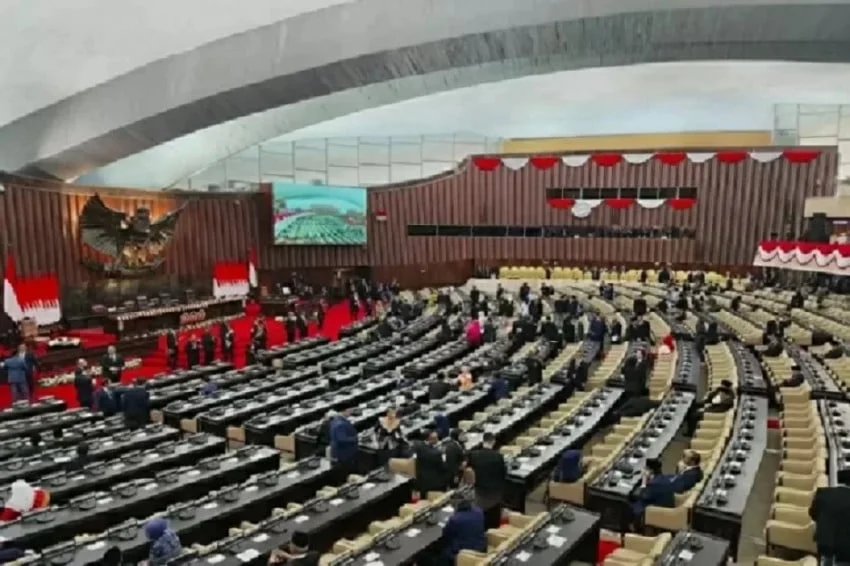
The resignation of a high-ranking state official in the Republic of Indonesia triggers a rigorous, highly structured constitutional process designed to maintain institutional stability and democratic continuity. Under the framework established by the 1945 Constitution of the Republic of Indonesia (UUD 1945), the departure of a sitting Vice President does not grant the President the unilateral authority to appoint a successor. Instead, the supreme law of the land mandates a deliberate legislative pathway through the People’s Consultative Assembly, commonly known as Majelis Permusyawaratan Rakyat (MPR), ensuring that any replacement receives broad parliamentary legitimacy.
This constitutional safeguard is detailed within Article 8, Paragraph 2 of the 1945 Constitution, which outlines the exact protocol required when the office of the Vice President experiences a vacancy. Amidst ongoing political discussions and dynamic legislative developments in Jakarta—including recent debates and parliamentary initiatives surrounding executive accountability—public interest has surged regarding the exact legal mechanics of executive succession. Examining these statutory guidelines provides a clearer understanding of how Indonesia’s democratic institutions manage sudden leadership transitions.
The Constitutional Framework of Executive Succession
The structural design of Indonesia’s presidential system places significant emphasis on checks and balances, particularly during moments of political transition. When a vacancy occurs in the executive branch—whether due to resignation, permanent incapacity, or impeachment—the transition of power is strictly regulated to prevent political deadlock or authoritarian overreach.
According to Article 8, Paragraph 2 of the 1945 Constitution, in the event that the office of the Vice President falls vacant, the President must immediately navigate a cooperative process with the legislature. The constitution dictates that the MPR must convene a special session to elect a new Vice President from candidates nominated by the executive. This foundational rule ensures that the second-highest office in the country retains democratic oversight, reflecting the collective will of the people’s representatives rather than a sole executive appointment.
Strict Timeline and Procedural Deadlines
Time is of the essence when a constitutional vacancy occurs at the highest levels of government. The 1945 Constitution does not permit prolonged vacancies in the executive leadership, as operational continuity is vital for national security, economic stability, and administrative governance.
Specifically, the statutory framework mandates that the MPR must convene a plenary session to elect and inaugurate a new Vice President no later than 60 days from the exact date the office becomes vacant. This 60-day window provides a tightly controlled operational period during which political parties, legislative factions, and the executive branch must coordinate to vet and approve a qualified candidate. Failing to meet this deadline would present a severe constitutional crisis, making adherence to the timeline an absolute priority for parliamentary leadership.
The Nomination Process: Executive Prerogative Meets Legislative Approval
While the final selection authority rests with the MPR, the initiation of the replacement process begins with the sitting President. Under the established rules of state administration, the President holds the sole constitutional prerogative to propose two candidate names to fill the vacant vice-presidential seat.
These candidates must undergo rigorous scrutiny by political parties represented within the MPR, which comprises members of both the House of Representatives (Dewan Perwakilan Rakyat – DPR) and the Regional Representative Council (Dewan Perwakilan Daerah – DPD). The President’s nominees must possess the legal, administrative, and political qualifications required to assume the responsibilities of the vice presidency, including managing bureaucratic systems, engaging in international diplomacy, and overseeing domestic policy implementation.
Once the President submits the two names, the MPR initiates a structured evaluation period. Members of the assembly review the track records, vision statements, and leadership capabilities of the nominees. The final decision is reached either through consensus or, if necessary, a democratic voting process among the MPR members. This dual-layer approach—where nomination rests with the executive and selection rests with the legislature—guarantees that the chosen Vice President enjoys both the working trust of the President and the legislative backing of parliament.
Historical Context and Precedents of Vice-Presidential Vacancies
While the mechanism outlined in Article 8 of the 1945 Constitution is robust, the actual occurrence of a vice-presidential vacancy followed by a parliamentary election is a rare event in Indonesia’s modern political history. Understanding how previous administrations handled transitions helps contextualize current legal debates.
In the post-reform era, Indonesia has experienced significant political shifts, constitutional amendments, and executive transitions. Following the amendment of the 1945 Constitution in the early 2000s, the direct election of the President and Vice President was established, moving away from the previous system where the MPR elected both figures. Consequently, the current framework under Article 8 was designed to address unforeseen departures within a democratically elected dual-executive system.
When historical vacancies occurred prior to the comprehensive constitutional reforms—such as during the early decades of the republic—the political landscape was governed by different iterations of provisional laws and presidential decrees. However, the contemporary framework ensures that any modern vacancy is handled strictly through civilian, legislative oversight, reinforcing the supremacy of constitutional law over executive convenience.
Recent Political Dynamics and Parliamentary Initiatives in Jakarta
The discussion surrounding vice-presidential succession has taken on renewed urgency in light of recent political maneuvers in Jakarta. Public discourse has intensified following reports and parliamentary maneuvers concerning executive figures, including discussions surrounding potential resignations and formal oversight motions initiated by members of the legislature.
Recent data from parliamentary secretariats indicates that a significant number of lawmakers—including a notable bloc of DPR members—have actively engaged in formal constitutional mechanisms, such as proposing Memorandum of Understanding or inquiry rights (Hak Meminta Keterangan – HMP), related to high-profile executive positions. These legislative actions highlight an active and assertive parliament exercising its constitutional oversight functions.
Political analysts note that when executive-legislative relations become dynamic, adherence to the letter of the law becomes paramount. Whether debates center on administrative performance, policy disagreements, or personal decisions by public officials, the stability of the state relies on strict adherence to institutional protocols rather than political speculation.
Official Responses and Stakeholder Reactions
As discussions regarding executive continuity circulate across media platforms, official representatives and political figures have issued measured responses to reassure the public and clarify the legal stance of the government.
Spokespersons for various political parties and governmental bodies have emphasized that any transition of power must strictly follow UUD 1945. Representatives from the executive branch have consistently maintained that institutional stability takes precedence over individual political dynamics. Meanwhile, leadership within the MPR has declared readiness to execute its constitutional duties should an official vacancy occur, confirming that administrative preparations for a potential special session can be mobilized within the legally mandated 60-day timeframe.
Civil society organizations and constitutional law experts have also weighed in, urging all political actors to prioritize transparency, legal accuracy, and public interest. Experts stress that the 60-day window, while brief, is entirely sufficient for the MPR to conduct a transparent selection process, provided that the executive branch submits qualified candidates without unnecessary delay.
Broader Economic, Social, and Political Implications
The smooth execution of constitutional protocols during executive vacancies carries profound implications for Indonesia’s national stability and international standing. In an interconnected global economy, foreign investors and international partners closely monitor the stability of political institutions in Southeast Asia’s largest economy.
A transparent, orderly, and constitutionally compliant transition of the vice-presidential office signals maturity in Indonesia’s democratic governance. It reassures markets that policy continuity will be maintained, regulatory frameworks will remain stable, and government operations will not be disrupted by internal political shifts. Conversely, any deviation from established legal pathways or prolonged political gridlock could introduce uncertainty, affecting investor confidence and domestic economic sentiment.
Furthermore, social stability relies heavily on clear public communication from state institutions. Misinformation or speculative narratives regarding executive resignations can create unnecessary public anxiety. Therefore, accurate reporting on the legal mechanics of Article 8 of the 1945 Constitution plays a vital role in educating the public and fostering trust in state administration.
Conclusion: The Resilience of Indonesia’s Constitutional Order
The rules governing the replacement of an Indonesian Vice President are explicit, structured, and legally binding. By removing the possibility of unilateral executive appointment and vesting the final selection power in the MPR, the 1945 Constitution safeguards the democratic balance of power.
Whether navigating historical transitions or addressing contemporary political developments in Jakarta, Indonesia’s state institutions continue to rely on the established legal framework to ensure continuity, accountability, and stability. As the nation moves forward, adherence to these constitutional guardrails remains the cornerstone of its democratic resilience, proving that the rule of law ultimately guides the nation through any political transition.
