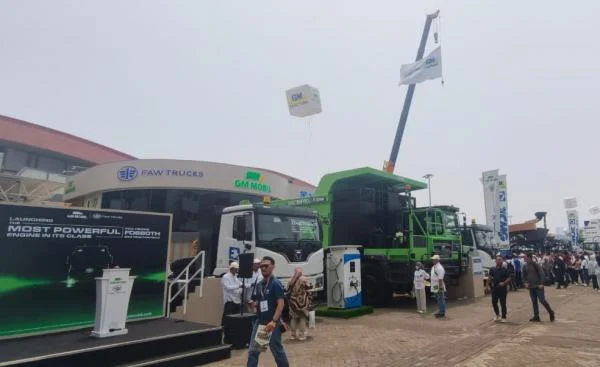
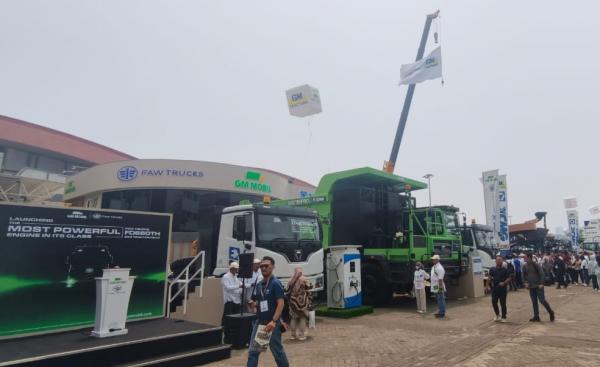
The industrial landscape of Indonesia’s heavy-duty transport sector witnessed a significant technological leap this week as GM Mobil officially unveiled the FAW FD660TH at the Mining Indonesia 2026 exhibition held at the JIExpo Kemayoran, Jakarta. Positioned as a powerhouse for the nation’s burgeoning mining, infrastructure, and logistics sectors, the new tractor head represents a major strategic move by FAW Trucks to capture a larger share of the heavy-haulage market. Engineered to manage extreme loads and navigate the challenging topographical conditions inherent to Indonesian mining sites, the FD660TH arrives at a time when the demand for high-capacity, reliable, and safe transport machinery is reaching an all-time high.
A Technical Powerhouse for Extreme Duty
At the heart of the FAW FD660TH lies a robust powertrain designed to move massive loads with precision and efficiency. The vehicle boasts a staggering 660 horsepower, underpinned by a peak torque of 3,300 Nm. This high-torque output is specifically calibrated for hauling operations where start-up power and sustained pulling force are critical. The truck is rated to support a Gross Combination Weight (GCW) of up to 270 tons, placing it among the most capable vehicles in its class currently available in the Indonesian market.
To translate this raw power into controlled motion, the FD660TH is equipped with a sophisticated ZF 12-speed transmission system. The integration of a hydraulic retarder is a particularly notable inclusion, providing essential braking support for the vehicle when navigating steep descents or operating under heavy loads. In the context of Indonesian mining environments—where long, undulating haul roads are standard—the hydraulic retarder not only enhances safety by preventing brake fade but also extends the operational lifespan of the friction-based braking components, thereby reducing long-term maintenance costs for fleet operators.
The Strategic Importance of Mining Indonesia 2026
The choice of Mining Indonesia 2026 as the launch platform for the FD660TH underscores the strategic focus of GM Mobil. As one of the largest mining exhibitions in Asia, the event attracts industry leaders, procurement heads, and heavy equipment specialists from across the globe. By debuting the unit in this venue, GM Mobil signaled its intent to cater directly to the large-scale contractors who operate in the Kalimantan and Sumatra coal and mineral belts.
The launch follows a period of sustained growth in Indonesia’s mineral extraction industry. As global demand for commodities fluctuates, local mining companies are increasingly looking to optimize their logistics chains. The introduction of the FD660TH aligns with the industry’s shift toward larger, more efficient hauling units that can reduce the number of cycles required to move product from the pit to the stockpile or port, ultimately lowering the cost-per-ton of transport operations.
Safety Standards and Engineering Rigor
Safety remains a paramount concern in the design of modern heavy vehicles, particularly those operating in high-risk environments such as mines. The FAW FD660TH features a cabin architecture that meets the stringent UNECE R29 international safety standards. The regulation, which focuses on the structural integrity of the cabin during collisions, ensures that the driver compartment can withstand significant impact forces.
This inclusion is critical for fleet operators who are under increasing pressure to adhere to Environmental, Social, and Governance (ESG) guidelines. Beyond mere mechanical capability, the ability to demonstrate a commitment to driver safety through internationally recognized standards provides a competitive advantage for logistics firms bidding for contracts with multinational mining companies. By prioritizing a reinforced, impact-resistant cabin, GM Mobil and FAW are addressing the growing industry mandate for enhanced workplace safety in remote, high-hazard zones.

Market Implications and Competitive Landscape
The Indonesian tractor head market is currently dominated by a mix of European and Chinese manufacturers. While European brands have long held a reputation for durability and advanced technology, Chinese manufacturers like FAW have rapidly closed the gap by offering competitive pricing, localized after-sales support, and vehicles that are increasingly tailored to the specific needs of the Southeast Asian terrain.
The introduction of the FD660TH signifies a shift in the competitive landscape. With a 660 HP rating, the vehicle moves into a segment previously occupied by premium-priced imports. If GM Mobil can maintain a robust supply chain for parts and provide reliable field service, the FD660TH is well-positioned to disrupt the current market hierarchy. The challenge, however, will be proving the vehicle’s longevity over thousands of hours in tropical, high-humidity, and dusty environments, where premature wear on engine and transmission components is a frequent issue for heavy-duty trucks.
Analyzing the Macroeconomic Context
The timing of this launch coincides with a broader shift in Indonesia’s economic strategy, which emphasizes the downstream processing of raw minerals. As the government continues to enforce policies that encourage value-added mining, the infrastructure supporting these mines—including transport networks—must also be modernized.
The requirement to move, at times, up to 270 tons of aggregate or raw ore requires a high level of logistical coordination. The FD660TH provides the mechanical foundation for these operations. Furthermore, the push for increased efficiency in the mining sector is not merely about volume; it is about carbon footprint management. A larger, more powerful truck that can carry more weight in a single trip is inherently more fuel-efficient per ton-kilometer than multiple smaller, underpowered units. This efficiency is a critical factor for mining firms looking to report lower emissions as part of their sustainability reporting.

Looking Ahead: The Future of Heavy Haulage in Indonesia
The official rollout of the FAW FD660TH at Mining Indonesia 2026 is expected to set the stage for a series of fleet trials across major mining concessions in the coming quarters. Industry analysts suggest that the success of the FD660TH will likely hinge on two primary factors: the effectiveness of the local support network established by GM Mobil and the real-world performance of the 660 HP engine under sustained load.
While the technical specifications are impressive on paper, the true test will be the "Total Cost of Ownership" (TCO) over the vehicle’s initial three years of operation. Indonesian operators are famously pragmatic; they value machines that are easy to repair in the field and that do not suffer from excessive downtime.
GM Mobil has expressed confidence that the FD660TH will serve as a cornerstone of its portfolio, complementing its existing range of tractor heads and offering a distinct solution for companies operating at the upper end of the hauling capacity spectrum. As the event at JIExpo Kemayoran concludes, the conversation among stakeholders has shifted from initial product specs to long-term deployment strategies. With the mining sector entering a period of modernization, the arrival of the FAW FD660TH is a testament to the ongoing evolution of Indonesia’s industrial transport infrastructure, reflecting a broader commitment to efficiency, power, and safety in one of the world’s most demanding economic sectors.
As the industry moves into the latter half of 2026, the data gathered from initial field deployments will be crucial. Should the performance metrics match the technical promises of the manufacturer, the FAW FD660TH could very well become a standard-bearer for heavy-haulage operations in Indonesia, bridging the gap between heavy-duty engineering and the rigorous demands of modern mining operations. The industry now waits to see how competitors will respond, and whether this new entrant will indeed recalibrate the expectations for what a 660-horsepower tractor head can achieve in the Indonesian archipelago.