
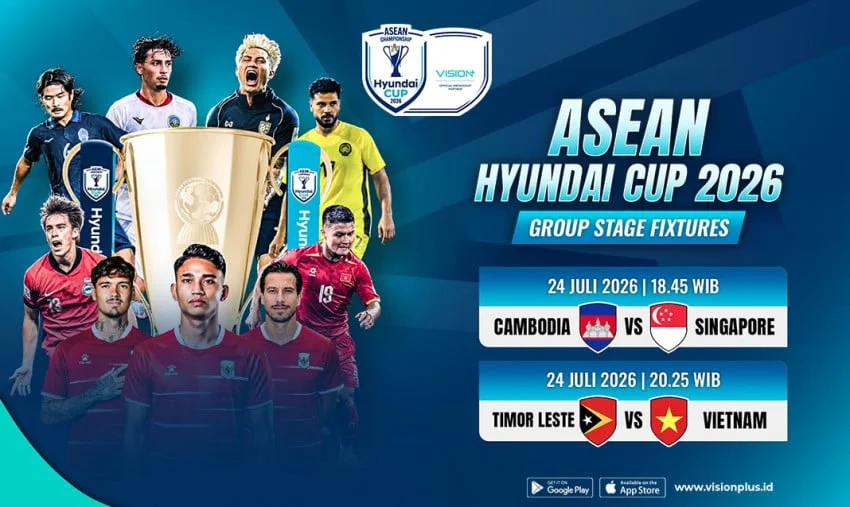
The vibrant tapestry of Southeast Asian football is once again set to be woven with intensity and national pride as the ASEAN Hyundai Cup 2026 officially kicks off, promising a month of exhilarating competition among the region’s elite footballing nations. Football enthusiasts across the continent are poised to witness every crucial moment, with live streaming available on the VISION+ platform, accessible via a dedicated link for those eager to follow the drama unfold. The tournament signifies a pivotal moment for football in the Association of Southeast Asian Nations (ASEAN), showcasing emerging talent and established stars alike in their pursuit of continental supremacy.
The opening salvo of the ASEAN Hyundai Cup 2026 is scheduled for Friday, July 24, 2026, marking the commencement of a fiercely contested group stage. The inaugural matchday will feature a compelling encounter between Cambodia and Singapore at 18:45 WIB, followed by a high-stakes clash between Timor-Leste and Vietnam at 20:25 WIB. These opening fixtures are not merely symbolic; they represent the first crucial steps in a journey where every point will be meticulously tallied, significantly influencing each nation’s trajectory towards qualification for the knockout stages. The strategic importance of these early matches cannot be overstated, as teams aim to establish momentum and secure vital early advantages.
Among the hopeful contenders is the Indonesian national team, the Garuda, who have been drawn into Group A. Their path to glory will see them navigate a challenging quartet that includes Cambodia, Singapore, Timor-Leste, and Vietnam. The draw itself has generated considerable anticipation, placing regional rivals in direct competition from the outset. Indonesia’s opening fixture, a pivotal encounter against Cambodia, is slated to be a significant opportunity for the Garuda squad to set a positive tone for the entire tournament. Securing three points in this initial outing is paramount, serving as both a psychological boost and a crucial stepping stone for the more formidable challenges that lie ahead in their group campaign. The team’s determination, tactical acumen, and sustained performance will be the linchpins in their ambition to advance to the crucial knockout rounds.
Background and Evolution of the ASEAN Hyundai Cup
The ASEAN Hyundai Cup, a biennial tournament, has established itself as the premier international football competition for men’s national teams in the ASEAN region. First conceived in 1996 as the Tiger Cup, the competition has undergone several rebranding efforts, reflecting its growing stature and commercial appeal. Sponsored by Hyundai Motor Company since 2007, the tournament has consistently provided a platform for regional footballing excellence, fostering camaraderie and healthy rivalry among member nations. Over the years, the cup has witnessed the rise of dominant forces like Thailand and Singapore, while also providing opportunities for emerging nations to make their mark on the continental stage. The evolution of the tournament mirrors the broader development of football infrastructure and talent within Southeast Asia, with each edition building upon the legacy of its predecessors. The inclusion of national teams from across the diverse ASEAN bloc ensures a rich cultural and tactical blend, making each tournament a unique spectacle.
The format of the ASEAN Hyundai Cup typically involves a group stage followed by knockout rounds, culminating in a two-legged final. This structure is designed to test teams’ consistency and resilience over a sustained period. Qualification for the tournament often involves a preliminary round or direct entry based on FIFA rankings, ensuring that the participating teams are generally of a competitive standard. The tournament’s scheduling, often held in late summer or early autumn, strategically places it within the international football calendar, allowing for maximum player availability and fan engagement. The economic impact of the tournament is also noteworthy, with host nations often experiencing a surge in tourism and related economic activities. Furthermore, the competition serves as a vital development tool for football associations, providing valuable experience in hosting international events and managing national teams at the highest level.
Group Stage Draw and Key Matchups
The draw for the ASEAN Hyundai Cup 2026 has set the stage for a captivating group stage, with Group A promising a particularly intriguing narrative. Indonesia, as one of the tournament’s perennial contenders, will face stiff competition from a resurgent Cambodia, a historically strong Singaporean side, and the determined Timor-Leste. Vietnam, a perennial powerhouse in Southeast Asian football, adds another layer of challenge to this already competitive group. The historical head-to-head records between these nations often reveal closely fought contests, with upsets not uncommon. For instance, recent editions have seen surprising results that have reshaped group standings and propelled lesser-fancied teams into contention. The dynamics within Group A are expected to be fluid, with each match carrying significant weight in determining the qualification spots.
Group B is also poised to deliver its share of drama, potentially featuring teams such as Malaysia, Thailand, the Philippines, Myanmar, and Brunei. The composition of Group B, while not explicitly detailed in the initial announcement, is anticipated to showcase a similar level of regional parity and fierce competition. The traditional giants of Southeast Asian football, like Thailand, will undoubtedly be looking to assert their dominance, while other nations will be eager to challenge the established order. The diversity of playing styles within these groups, ranging from the disciplined tactical approaches to more free-flowing offensive strategies, is a hallmark of the ASEAN Hyundai Cup and contributes to its widespread appeal.
Indonesia’s Campaign: A Detailed Look
The Indonesian national team, under the guidance of their coaching staff, has been meticulously preparing for the ASEAN Hyundai Cup 2026. The team’s recent performances in regional and international friendlies have provided valuable insights into their strengths and areas for improvement. Coach Shin Tae-yong, known for his tactical flexibility and emphasis on physical conditioning, has been working to instill a winning mentality within the squad. The opening match against Cambodia is not to be underestimated. While Cambodia may be perceived as an underdog by some, their recent performances have demonstrated a significant upward trajectory, with a focus on developing young talent and adopting a more proactive playing style. Indonesia will need to be at their best from the outset to secure the desired three points.
The subsequent group matches will test Indonesia’s depth and resilience. Facing Singapore, a nation with a rich footballing history and a reputation for disciplined defense, will require tactical ingenuity and clinical finishing. A clash with Timor-Leste presents an opportunity for Indonesia to showcase their attacking prowess, but complacency will be a dangerous adversary. The ultimate test within Group A will undoubtedly be against Vietnam, a team that has consistently performed at a high level in regional tournaments. Vietnam’s tactical discipline, combined with the individual brilliance of their key players, makes them a formidable opponent. Indonesia’s ability to secure positive results against these varied opposition styles will be a strong indicator of their championship credentials.
Supporting Data and Historical Performance
To contextualize the upcoming tournament, examining historical data provides valuable insights into the competitive landscape of ASEAN football. Thailand has historically been the most successful nation in the ASEAN Hyundai Cup, having clinched the title multiple times. Their consistent performance is a testament to their robust domestic league, strong youth development programs, and sustained investment in football infrastructure. Singapore has also enjoyed periods of dominance, securing several championships, and is known for its disciplined approach and tactical organization.
Vietnam has emerged as a significant force in recent years, demonstrating a marked improvement in both individual skill and team cohesion. Their performances in the ASEAN Hyundai Cup and other regional competitions have solidified their status as a top contender. Malaysia, another football-loving nation in the region, has also had its share of success, often showcasing passionate performances and a flair for attacking football. The tournament has also been a platform for emerging nations like the Philippines and Cambodia to make their presence felt, challenging the established order and contributing to the growing competitiveness of the region.
The average number of goals scored per match in previous editions has varied, but generally reflects an attacking brand of football, interspersed with tight defensive battles. The average attendance figures also highlight the immense popularity of the tournament, with passionate fan bases filling stadiums to support their national teams. The economic impact, measured by broadcast rights, sponsorship deals, and tourism revenue, has steadily increased, reflecting the growing commercial viability of Southeast Asian football.
Official Statements and Anticipated Reactions
While specific official statements from participating federations and the organizing committee regarding the opening matches are yet to be extensively published, it is reasonable to infer the general sentiment. National football associations are invariably expressing their commitment to fielding their strongest possible squads and are urging their respective fan bases to rally behind the teams. Coaches are expected to emphasize the importance of a strong start and the need for unwavering focus throughout the group stages.
Fan reactions are anticipated to be fervent, with social media platforms already buzzing with discussions, predictions, and passionate support for their national heroes. The availability of live streaming through VISION+ is a significant factor in amplifying fan engagement, allowing supporters who cannot attend matches in person to remain connected to the tournament’s unfolding drama. The sense of national pride and the desire to witness continental glory are potent driving forces that will undoubtedly fuel the atmosphere surrounding the ASEAN Hyundai Cup 2026.
Broader Impact and Implications
The ASEAN Hyundai Cup 2026 holds significant implications beyond just the immediate pursuit of a trophy. For the participating nations, it serves as a crucial barometer for the development of football within their respective countries. Success in the tournament can galvanize grassroots football initiatives, attract further investment, and inspire a new generation of players. The exposure gained from competing on a continental stage is invaluable for player development, providing opportunities to test their skills against diverse opposition and gain crucial international experience.
Furthermore, the tournament plays a vital role in fostering regional unity and sportsmanship. While the competition on the field is intense, the ASEAN Hyundai Cup ultimately brings nations together, celebrating shared passion for the beautiful game. The economic benefits, as previously mentioned, extend to tourism, hospitality, and media industries, contributing to the overall economic development of the host nations. The tournament’s growing popularity also signifies the increasing maturity and global recognition of Southeast Asian football, paving the way for greater participation and success in wider international competitions. As the ASEAN Hyundai Cup 2026 unfolds, it promises not only thrilling football action but also a significant contribution to the ongoing narrative of football’s growth and impact in this dynamic region.
