
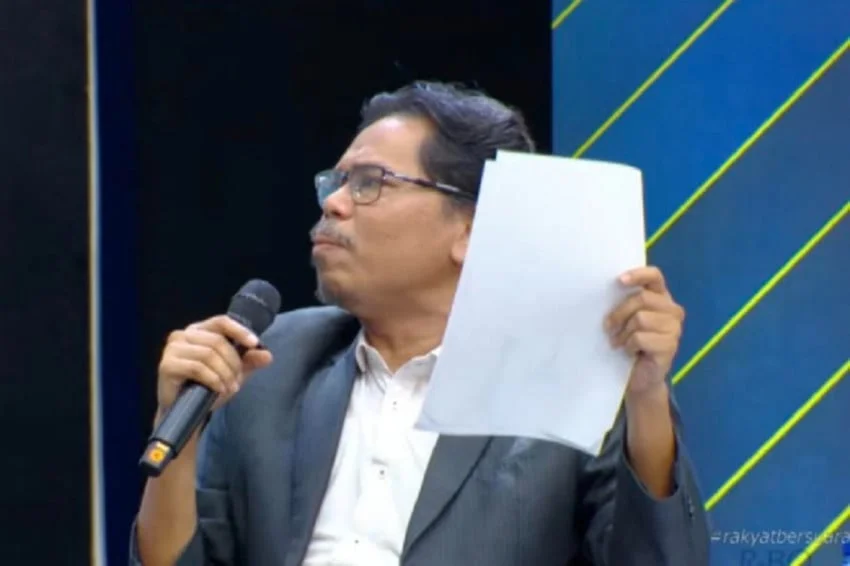
The ongoing discourse surrounding the educational credentials of Indonesia’s high-ranking public figures has taken a new turn following detailed investigative claims presented by researcher Bonatua Silalahi. Speaking during a nationally televised discussion program on iNews titled "Rakyat Bersuara," Silalahi publicly questioned the nature and administrative validity of the foreign education equivalence documents associated with Vice President Gibran Rakabuming Raka. According to Silalahi, after an extensive examination of legal frameworks and administrative regulations spanning several months—including a formal review process leading up to Constitutional Court hearings—the documentation presented does not constitute a formal academic degree or diploma, but rather functions merely as a certificate of attendance.
The debate touches upon sensitive regulatory standards concerning how international academic achievements are recognized within the Indonesian educational and political landscape. As public scrutiny intensifies over transparency in governance and credential verification for elected officials, the claims made by independent researchers and the subsequent defenses mounted by government legal teams have framed a complex legal battle playing out across multiple judicial forums, including the State Administrative Court (PTUN).
Investigation into Administrative Rules and Equivalency Standards
During his appearance on the program, Bonatua Silalahi detailed the methodology behind his investigation into the Vice President’s educational background. He noted that the inquiry has been active for a prolonged period, involving rigorous scrutiny of legal texts and regulatory compliance.
"This has been ongoing since October. I have been deliberating on his certificate documentation. Up until the recent sessions at the Constitutional Court, it has amounted to a full two semesters dedicated to studying this matter," Silalahi stated during the broadcast.
Central to Silalahi’s critique is the application of specific ministerial and directorate regulations regarding foreign credential equivalency. Specifically, he pointed to the Regulation of the Director-General of Primary and Secondary Education Number 33 of 2018. According to Silalahi’s legal interpretation, the formal process of equating international qualifications requires strict adherence to global curriculum standards, credit systems, and foundational educational milestones that align with the national education system’s benchmarks.
The researcher argued that short-term programs or non-degree courses that culminate merely in certificates of attendance or participation do not meet the legal threshold required for an official academic degree or diploma equivalency. This distinction is crucial in Indonesian administrative law, particularly when such credentials are submitted to fulfill formal educational prerequisites for public office or administrative appointments.
Background Context of the Credential Controversy
The controversy surrounding the educational background of Vice President Gibran Rakabuming Raka is not an isolated incident but rather part of a broader pattern of heightened public interest and legal challenges directed at the academic credentials of prominent Indonesian political figures. In an era where digital transparency and access to information empower citizens and civil society watchdogs to scrutinize leaders, educational verification has become a frequent battleground for political debate.
Gibran Rakabuming Raka completed portions of his education overseas before returning to Indonesia to pursue entrepreneurial ventures prior to his entry into public service. As he ascended the political ladder—first as the Mayor of Solo, and subsequently as the Vice President of the Republic of Indonesia following the 2024 general elections—his academic background has been subjected to repeated verification inquiries by various activists, legal organizations, and political opponents.
While standard vetting processes conducted by the General Elections Commission (KPU) previously cleared candidates based on submitted documents, civil society groups and independent researchers have continued to challenge the validity and equivalency of foreign certificates through administrative and legal channels. These challenges often probe the nuances of the Ministry of Education, Culture, Research, and Technology’s procedures for evaluating overseas diplomas, highlighting potential bureaucratic discrepancies or differing interpretations of educational laws.

Legal Defense and Counter-Arguments in PTUN and Constitutional Court
In direct response to the persistent allegations regarding the Vice President’s credentials, legal representatives and supporters of the administration have strongly defended the authenticity and completeness of Gibran’s educational journey. Rullyandi, a member of the legal team representing the administration in related proceedings, asserted that the educational records are thoroughly documented and verifiable across all academic levels.
In preceding statements surrounding related legal battles—particularly anticipated proceedings within the State Administrative Court (PTUN)—Rullyandi emphasized that the documentation encompasses the entirety of Gibran’s academic progression. "The educational records of Gibran will be presented in the PTUN trial. Starting from elementary school all the way to higher education, everything is complete," Rullyandi affirmed.
Legal defenders maintain that all requisite administrative steps for foreign education equivalency were duly fulfilled in accordance with the prevailing regulations at the time of application. They contend that attempts to characterize the qualifications as mere attendance certificates stem from a fundamental misinterpretation of institutional curricula and international program structures, which often combine foundational studies with specialized vocational or preparatory modules before awarding final completion statuses.
Implications for Public Office Credential Verification
The ongoing debate over Vice President Gibran Rakabuming Raka’s educational documents carries significant implications for the broader framework of public accountability and administrative law in Indonesia. The case highlights potential ambiguities in how regulatory bodies process and validate international educational qualifications, a matter of increasing relevance as more Indonesian students and public figures pursue education abroad.
-
Administrative Transparency: The public dispute underscores a growing demand for absolute transparency in the verification of credentials for individuals holding high public office. Civil society organizations argue that clear, unambiguous public disclosure of equivalency letters issued by the Ministry of Education can preemptively resolve controversies before they escalate into judicial proceedings.
-
Regulatory Clarity: The reliance on specific regulatory instruments, such as the Directorate-General of Primary and Secondary Education regulations cited by Silalahi, points to the need for modernized and harmonized guidelines governing foreign degree recognition. Discrepancies in how different legal interpreters view these rules can lead to protracted courtroom battles that consume judicial resources and polarize public opinion.
-
Judicial Precedent: As the dispute moves through forums such as the State Administrative Court and potentially other judicial bodies, the resulting rulings could establish important legal precedents regarding the burden of proof for educational credentials and the standing of independent researchers in challenging administrative decisions.
Future Outlook and Resolution Pathways
The resolution of this controversy will largely depend on the formal evaluations presented by judicial authorities and the official administrative stance of the Ministry of Education, Culture, Research, and Technology. If the courts request definitive, binding evidentiary reviews from competent government ministries, it could provide a definitive factual basis to either validate the complete equivalency of the disputed documents or highlight administrative shortcomings that require corrective action.
For now, the debate remains a focal point of intense media coverage and public discussion, illustrating the delicate balance between robust civil oversight and the defense of official administrative legitimacy in modern Indonesian democracy. As legal proceedings continue to unfold across various courts, the primary challenge for lawmakers and regulators will be to ensure that administrative processes for credential verification are robust, transparent, and impervious to political weaponization.
