
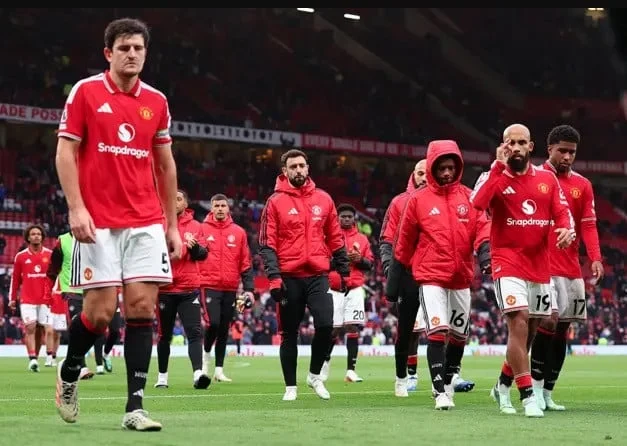
The current campaign has begun under a cloud of uncertainty for Manchester United, with the storied club struggling to establish any semblance of momentum across domestic and continental competitions. As of October 28, 2026, the Red Devils have endured a harrowing start to the season, accumulating six defeats across the Premier League, the UEFA Champions League, and the EFL Cup. This statistical downturn has triggered widespread scrutiny regarding tactical cohesion and squad depth, leaving manager Michael Carrick under intense pressure to rectify a series of defensive lapses and offensive inefficiencies that have plagued the team since the opening weekend.
A Chronology of Struggles: Analyzing the Early Season Collapse
The trajectory of Manchester United’s season has been defined by a lack of defensive rigidity and an inability to capitalize on key scoring opportunities. The troubles began almost immediately upon the commencement of the Premier League season, signaling that the preparation period may have been insufficient for the challenges ahead.
The campaign opened with a jarring 0-2 defeat at the hands of newly promoted Hull City. Despite entering the match as heavy favorites, United’s defensive line was dismantled early by Semi Ajayi and Nobel Mendy. The defeat not only shocked the Old Trafford faithful but set a precedent of vulnerability against high-pressing, lower-table opposition—a trend that would repeat itself throughout the autumn months.
The frustration reached a boiling point during the fourth week of the Premier League, as Manchester United hosted their arch-rivals, Manchester City. While the match statistics—54.7 percent possession and 16 total shots—suggested a competitive encounter, the underlying reality was far grimmer. United’s inability to convert high-volume attacks into goals allowed Erling Haaland to seal a 1-0 victory for the visitors. The failure to test Gianluigi Donnarumma more effectively, with only three shots on target, highlighted a recurring issue regarding the team’s final-third decision-making.
The struggle for consistency transcended league play, extending into the EFL Cup. In a match against Brighton and Hove Albion, United appeared to have finally found their rhythm, racing to an early lead thanks to goals from Shea Lacey and Mason Mount within the first ten minutes. However, the capitulation that followed—conceding three unanswered goals—exposed a lack of game management and emotional resilience when protecting a lead. This exit from the EFL Cup served as a sobering reminder that the squad’s psychological fortitude remains a point of concern for the coaching staff.
Continental competition provided no respite from these domestic woes. Following a promising 4-0 opening victory against Sabah FK in the Champions League, United faced a stark reality check at the Civitas Metropolitano. A 0-2 loss to Atletico Madrid, characterized by a lapse in concentration in the opening minute resulting in a Pablo Barrios goal, coupled with a late strike by Ademola Lookman, underscored the difficulty of maintaining focus against top-tier European tactical setups.
Statistical Deep Dive: Where the System is Failing
According to data compiled by Transfermarkt as of October 28, 2026, the primary issue for Manchester United is not necessarily a lack of talent, but a lack of structural balance. The team has conceded in 80 percent of their competitive matches this season, a statistic that is difficult to reconcile with the club’s ambitions of securing silverware.
An analysis of the team’s defensive metrics reveals a worrying trend: United’s expected goals against (xGA) per match has risen by 22 percent compared to the same period in the 2025/2026 season. This indicates that while the goalkeeper and defensive line are under pressure, the midfield transition is failing to break up play before it reaches the back four. The reliance on individual brilliance rather than a collective defensive system has left the team vulnerable to counter-attacks, particularly when facing teams that utilize a high-block strategy.
Furthermore, the offensive output has been heavily reliant on individual flashes of brilliance rather than sustained periods of controlled possession. With the midfield trio struggling to dictate the tempo of games against high-intensity opponents, the forwards have often been isolated, leading to an over-reliance on long-range efforts that lack the required precision to beat elite-level goalkeepers.
Official Responses and Internal Climate
While Manchester United has remained largely guarded in their official communications, sources close to the Carrington training complex suggest that Michael Carrick is actively exploring tactical shifts to address the defensive fragility. In internal briefings, Carrick has emphasized the need for "collective responsibility," noting that the defensive transition is not merely the burden of the back four but a systemic issue that begins with the forward line’s pressing intensity.
While there have been no public calls for a change in leadership, the pressure on the board to evaluate the project’s trajectory is mounting. Fan sentiment, expressed through various supporters’ forums and local media outlets, is trending toward impatience. However, club officials have historically shown a preference for stability, likely granting Carrick the mid-season window to integrate new tactical adjustments and evaluate the squad’s performance during the upcoming international break.
The Broader Impact: Long-Term Consequences
The current period of inconsistency carries significant implications for the remainder of the 2026/2027 season. With the Premier League becoming increasingly competitive—where even promoted sides possess the squad depth to challenge established "Big Six" clubs—Manchester United cannot afford to drop further points against teams outside the top half of the table.
Failure to secure a consistent winning streak before the turn of the calendar year could jeopardize the club’s pursuit of a top-four finish, a prerequisite for the financial health of the organization and its attractiveness to elite transfer targets. Furthermore, the early exit from the EFL Cup has removed one path to a trophy, increasing the stakes for the remaining Champions League and Premier League fixtures.
From a commercial perspective, the drop in performance could impact the club’s global brand equity if they fail to advance into the latter stages of the Champions League. The revenue loss associated with an early European exit is substantial, and for a club that prides itself on competing at the highest level, the current performance levels are simply unsustainable.
Looking Ahead: The Path to Rectification
The upcoming month will be a litmus test for the coaching staff. With a series of crucial fixtures on the horizon, including high-stakes domestic clashes and pivotal Champions League group-stage matches, Carrick must find a way to balance defensive solidity with the creative spark the squad is known for.
Tactical adjustments under consideration reportedly include a shift toward a more compact midfield diamond to control the center of the pitch, as well as an increased focus on set-piece defense—an area where United has been particularly susceptible this season. Additionally, there is talk of rotating the starting eleven more aggressively to keep players fresh and to encourage competition for starting spots, effectively ending the complacency that some critics believe has crept into the locker room.
The narrative of the 2026/2027 season is still in its infancy, and it is entirely possible for Manchester United to pivot away from this poor start. History has shown that even the most prestigious clubs go through periods of transition and tactical recalibration. However, the margin for error has vanished. The players, the management, and the ownership are now fully aware that the current performance levels are beneath the standards expected at Manchester United.
Whether this season will be remembered as a mere "slump" or the beginning of a deeper systemic decline will depend entirely on how the squad responds to the adversity of the last two months. For Michael Carrick, the mandate is clear: stabilize the ship, tighten the defensive architecture, and restore the winning culture that is the hallmark of the club. As the leaves fall in Manchester, the atmosphere at Old Trafford is tense, expectant, and bracing for what could be the most defining period of the manager’s tenure to date. The fans, while frustrated, remain expectant of a resurgence—a testament to the enduring loyalty of a fanbase that has seen its club overcome significant challenges in the past. Now, it is up to the players on the pitch to prove that they are capable of delivering the results that their supporters demand.
