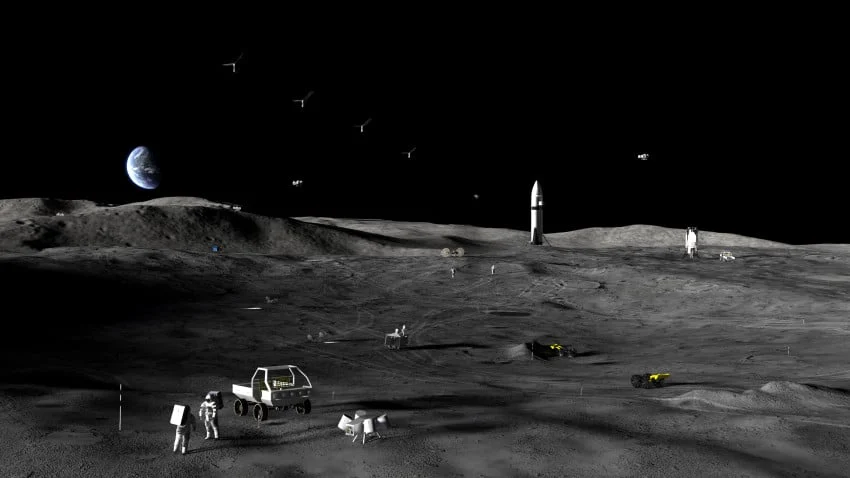
The National Aeronautics and Space Administration (NASA) has officially initiated a high-stakes recruitment campaign to expand its astronaut corps, offering qualified candidates the historic opportunity to live and work on the lunar surface. This announcement marks a pivotal shift in the agency’s strategic direction, moving from low-Earth orbit research to long-duration deep space exploration. With a salary package reaching up to $164,395, the agency is seeking a new generation of explorers to support its Artemis program, which serves as the foundational architecture for human missions to Mars.
The Strategic Vision of the Artemis Program
The recruitment drive is not merely a staffing exercise but a critical component of the Artemis program. Unlike the Apollo missions of the 1960s and 1970s, which focused on "flags and footprints," the current objective is to establish a sustainable human presence on the Moon. NASA’s long-term plan involves the construction of the Lunar Gateway—a small, modular space station orbiting the Moon—and the Artemis Base Camp on the lunar surface.
These new recruits will be tasked with operating, maintaining, and upgrading these complex systems. The professional requirements for these roles are rigorous, demanding expertise in STEM fields, including advanced engineering, biological sciences, physical sciences, computer science, or mathematics. Beyond technical proficiency, the agency emphasizes the need for individuals with exceptional psychological resilience and adaptability, as the lunar environment presents challenges such as extreme temperature fluctuations, radiation exposure, and the psychological strain of isolation.
Chronology of Modern Lunar Exploration
To understand the gravity of this recruitment, one must look at the timeline of the agency’s recent lunar initiatives:
- 2017: President Donald Trump signs Space Policy Directive 1, directing NASA to return humans to the Moon for long-term exploration.
- 2019: NASA officially unveils the Artemis program, aiming to land the first woman and the first person of color on the lunar surface.
- 2020: The Artemis Accords are established, creating a framework for international cooperation in space exploration.
- 2022: Artemis I, an uncrewed flight test, successfully orbits the Moon, proving the capabilities of the Space Launch System (SLS) and the Orion spacecraft.
- 2023-2024: NASA continues to refine the Human Landing System (HLS) in collaboration with private sector partners like SpaceX and Blue Origin.
- 2025 and Beyond: Scheduled crewed missions, including Artemis III, intended to return humans to the lunar south pole.
This timeline demonstrates a methodical transition from testing hardware to preparing the human element of the mission. The current recruitment phase is designed to ensure that when the infrastructure for the lunar base is ready, a fully trained, elite team is prepared to take residence.
Economic and Operational Implications
The salary of $164,395 is categorized within the federal General Schedule (GS) pay scale, specifically falling between GS-11 and GS-15 levels. While competitive for federal service, experts in the aerospace sector note that the real compensation lies in the unique professional development and the prestige associated with the role.
From an operational standpoint, the cost of supporting a human on the Moon is astronomical compared to the International Space Station (ISS). NASA estimates that sustaining a lunar presence requires modular life-support systems, advanced power generation through solar arrays and small modular nuclear reactors, and complex supply chain logistics. These new astronauts will be the first to test these technologies in real-time, effectively serving as both engineers and research subjects for the long-term physiological effects of living in partial gravity—specifically one-sixth of Earth’s gravity.
Perspectives from Leadership and Industry Experts
NASA Administrator Bill Nelson has frequently highlighted that the agency’s mission is no longer solitary. "We are going back to the Moon to stay," Nelson stated in recent briefings. The recruitment effort is supported by the agency’s leadership, who view the lunar base as a "proving ground" for Mars.
Jared Isaacman, a prominent figure in the commercial spaceflight sector, has echoed the importance of this recruitment. In various discussions regarding the private-public partnerships that now define modern spaceflight, Isaacman has noted that the synergy between government-led exploration and private innovation is what makes a Mars mission feasible within the next two decades. By integrating the rigorous training of the NASA astronaut corps with the agile innovation of private aerospace companies, the agency aims to reduce the "cost-per-mission" and increase the frequency of launches.
Scientific and Societal Objectives
The implications of this recruitment extend far beyond the immediate goal of lunar exploration. By establishing a permanent base, NASA intends to leverage the Moon’s resources, specifically water ice found in the permanently shadowed craters of the lunar south pole. This ice can be processed into liquid hydrogen and oxygen, providing rocket fuel for deeper space travel.
From a scientific perspective, the Moon serves as a pristine laboratory. The lack of an atmosphere and the stable environment on the far side of the Moon make it an ideal location for radio telescopes, which could look back to the origins of the universe without the interference of Earth’s ionosphere or electromagnetic noise. The astronauts recruited today will be the individuals responsible for assembling these high-precision instruments.
Challenges of Long-Duration Deep Space Living
One of the most significant hurdles for the incoming class of astronauts is the mitigation of radiation. While the ISS is shielded by Earth’s magnetic field, the Moon is not. Consequently, the habitat design and the personal equipment of these astronauts must incorporate advanced radiation shielding materials.
Furthermore, medical research conducted during the mission will be paramount. NASA’s Human Research Program is heavily invested in studying how human bone density, muscular atrophy, and cardiovascular health respond to the lunar environment over months or years. The findings from these missions will dictate the feasibility of the eventual human journey to Mars, a trip that could last as long as three years round-trip.
The Competitive Selection Process
The selection process for this recruitment cycle is notoriously rigorous. Thousands of applicants typically apply for a handful of positions. The vetting process involves multiple rounds of interviews, medical examinations, and psychological testing. Candidates must pass a physical fitness test modeled after the long-duration spaceflight requirements, including swimming and scuba diving capabilities, which are essential for underwater training that simulates the weightlessness of space.
For those who survive the selection process, the training program—conducted primarily at the Johnson Space Center in Houston, Texas—lasts approximately two years. During this time, candidates undergo training in Russian language skills (for international collaboration), robotics, flight operations, and emergency survival procedures.
Broader Impact: A New Era of Exploration
The invitation to live on the Moon signals a fundamental shift in the global space race. With countries such as China and Russia also announcing plans for lunar exploration, the United States is keen to maintain its leadership role in space. By establishing a permanent presence through its Artemis astronauts, NASA is effectively setting the "rules of the road" for lunar exploration, adhering to the principles of the Artemis Accords, which prioritize transparency, interoperability, and the peaceful use of space.
The legacy of this recruitment drive will be measured not just in the success of a single landing, but in the sustained ability to keep humans productive in a hostile, off-world environment. As these candidates prepare to leave Earth’s orbit, they are not just taking a step for national pride, but for the expansion of human civilization into the solar system. The integration of high-level talent, robust engineering, and strategic international partnerships creates a blueprint for the next century of exploration.
As NASA continues to finalize its list of candidates, the global scientific community watches with anticipation. The individuals chosen will be the stewards of a mission that will likely define the 21st century’s contribution to human history. They will occupy the frontier, performing the work that will eventually allow humanity to step foot on the Red Planet, effectively bridging the gap between Earth and the vast, unexplored reaches of the cosmos. The agency’s recruitment effort is a call to action for the most capable, dedicated, and courageous individuals to join a mission that transcends borders, time, and current technological limitations.