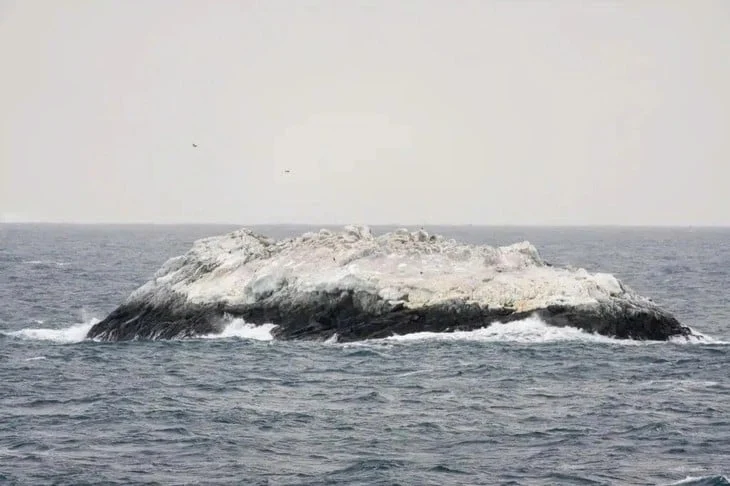
JAKARTA – During a comprehensive study of global ocean currents, a team of international scientists aboard the German research icebreaker Polarstern has stumbled upon a previously uncharted island in the treacherous Weddell Sea region of Antarctica. The discovery, made in February of this year, has ignited considerable scientific interest, particularly given the area’s long-standing reputation as a navigational hazard.
The expedition, organized by the Alfred Wegener Institute Helmholtz Centre for Polar and Marine Research (AWI), was primarily focused on understanding the profound impacts of melting ice sheets on global oceanic circulation patterns. As the Polarstern navigated the formidable ice-choked waters of the Weddell Sea, researchers initially observed an unusual geological feature. Their first assessment identified it as an iceberg, distinguished by an atypical coloration. However, closer scrutiny revealed a startling truth: the structure was composed of rock, not ice, leading to the definitive conclusion that they had encountered a newly discovered island.
A Serendipitous Encounter in a Perilous Landscape
The serendipitous discovery underscores the persistent mysteries that Antarctica, the Earth’s most remote and least explored continent, continues to hold. For decades, the Weddell Sea has been recognized by mariners and scientists alike as a particularly dangerous area. Its reputation stems from a confluence of factors, including exceptionally harsh weather conditions, unpredictable and powerful currents, and a landscape dominated by vast, shifting ice shelves and formidable icebergs. Historically, this region has been marked on nautical charts with a broad designation of "danger zone," a cautionary label that, until now, lacked specific detail regarding its geological topography beyond the ice cover.
Simon Dreutter, a researcher involved in the expedition, elaborated on the significance of this classification. "The Weddell Sea is characterized by complex current dynamics and historically inadequate surveying," he stated, as reported by local media outlets. "It has long been known as a region posing significant risks to navigation, but the precise reasons for this inherent danger, particularly concerning submerged or ice-covered landmasses, remained largely undefined." This very ambiguity, Dreutter highlighted, makes the discovery of a new island all the more crucial. It offers tangible evidence of the incomplete understanding of this critical polar region and provides a concrete element to the perceived hazards.
Chronology of Discovery and Initial Assessment
The expedition of the Polarstern commenced in early February 2023, with its primary objective to deploy and retrieve oceanographic instruments designed to monitor the flow and properties of water masses influenced by glacial melt. These instruments are vital for calibrating climate models and predicting future sea-level rise.
- Early February 2023: The research vessel Polarstern begins its survey operations in the Weddell Sea.
- Mid-February 2023: While traversing the region, researchers aboard the Polarstern observe a large, unusual formation. Initial observations suggest it might be an iceberg with distinct coloration.
- Late February 2023: Upon closer visual inspection using advanced onboard equipment, including high-resolution cameras and potentially sonar, the team determines the formation is terrestrial in origin, composed of rock. The presence of a significant landmass, previously absent from any known maps, is confirmed.
- Post-Discovery: The scientists meticulously record the island’s location, approximate dimensions, and geological characteristics. The significance of the find in a poorly charted and hazardous area is immediately recognized.
The researchers are currently working to georeference the island’s precise coordinates. This will involve integrating data from the ship’s navigation systems with the visual and instrumental observations made during the encounter. The preliminary findings are being prepared for publication in peer-reviewed scientific journals, a process that will involve rigorous verification and peer scrutiny.
Supporting Data and Scientific Context
The discovery of new landmasses, even in the 21st century, is a testament to the vastness and enduring mystery of our planet. While satellite technology has dramatically enhanced our mapping capabilities, certain regions, particularly those characterized by extreme environments like Antarctica, remain challenging to survey comprehensively. The ice cover in Antarctica, which can reach thicknesses of several kilometers, often obscures the underlying topography. Furthermore, the dynamic nature of ice shelves, which are constantly calving icebergs and shifting, can make satellite imagery outdated very quickly.
The Weddell Sea is particularly notable for its role in Antarctic ice dynamics. It is home to the Filchner-Ronne Ice Shelf, one of the largest ice shelves in the world, and its waters are a crucial area for the formation of Antarctic Bottom Water, a significant component of the global thermohaline circulation. Changes in this region are therefore considered bellwethers for broader climate trends. The presence of a previously unmapped island in such a dynamic and scientifically important area suggests that our understanding of the Antarctic seafloor and its geological features is far from complete.
The research conducted by the Alfred Wegener Institute is at the forefront of polar science. The institute utilizes state-of-the-art research vessels like the Polarstern, equipped with advanced laboratories and scientific instrumentation, to conduct expeditions that yield critical data on climate change, oceanography, glaciology, and marine biology. Discoveries like this island underscore the importance of continued investment in polar research and exploration.
Potential Implications and Future Research
The immediate implication of this discovery is the need to update navigational charts and geological surveys of the Weddell Sea. The presence of an unmapped island introduces a new physical obstacle, requiring careful consideration for any future maritime activities in the region. This is especially pertinent as scientific research and potentially even resource exploration in Antarctica become more prevalent.
From a scientific perspective, the island represents a new opportunity for geological and biological research. Scientists will be keen to determine the island’s geological origins, its age, and whether it supports any unique or endemic life forms. Samples of rock and potential soil will be crucial in understanding the geological history of the Antarctic continent and the processes that led to the formation of this landmass. The island’s proximity to the ice shelves could also offer insights into the interaction between land and ice in a rapidly changing polar environment.
The discovery could also prompt renewed interest in conducting more detailed bathymetric surveys of the Weddell Sea. Such surveys aim to map the underwater topography, revealing not only islands but also seamounts, trenches, and other geological features that are currently unknown. This could lead to a more comprehensive understanding of the ocean floor and its influence on ocean currents and marine ecosystems.
Official Responses and Broader Impact
While specific official statements from governmental bodies or international organizations regarding this particular discovery are still emerging as the scientific community digests the findings, the general sentiment within the polar research community is one of excitement and renewed focus. The International Hydrographic Organization (IHO), responsible for standardizing nautical charts worldwide, will undoubtedly be notified and will initiate processes to incorporate this new data into official charts.
The discovery serves as a potent reminder that despite our technological advancements, significant portions of our planet remain unexplored. Antarctica, with its formidable environmental challenges, continues to be a frontier of scientific discovery. Each new finding, whether it be a new species, a geological formation, or a previously unknown landmass, contributes to our collective understanding of Earth’s complex systems and the ongoing changes it is undergoing. The "mysterious island" found in the Weddell Sea is not just a geographical anomaly; it is a symbol of the vast unknowns that still lie hidden within our planet’s most extreme environments, urging continued exploration and scientific endeavor.
The long-term implications of this discovery will unfold as further research is conducted. It highlights the critical need for sustained international collaboration in polar science and underscores the importance of organizations like the Alfred Wegener Institute in pushing the boundaries of human knowledge. As climate change continues to reshape polar landscapes, discoveries like this serve as both a reminder of what we are losing and a testament to the enduring power of scientific inquiry to reveal the Earth’s hidden wonders.