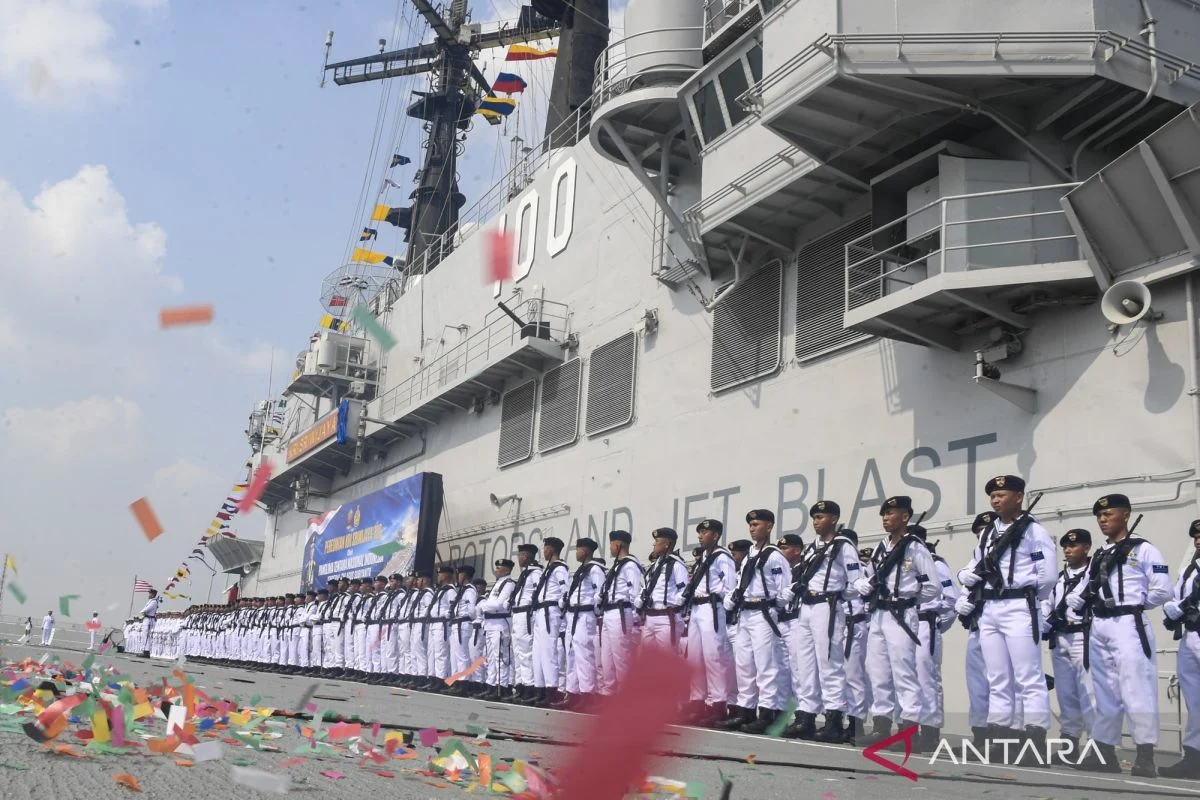
The arrival of the former ITS Giuseppe Garibaldi at Pier 107 of Tanjung Priok Port in North Jakarta on Friday, September 18, 2026, represents a transformative moment for the Indonesian Navy (TNI Angkatan Laut). As the vessel, formerly designated C551 under the Italian Navy, makes its presence known in Indonesian waters, it signals the birth of the nation’s first aircraft carrier capability. While the formal handover and the symbolic changing of the flag are slated for September 24, 2026, the vessel has already begun to shift the discourse surrounding Indonesia’s maritime defense architecture and its role as a regional power.
A New Chapter for the Indonesian Navy
The vessel, which will be commissioned as KRI Sriwijaya, is a significant acquisition for the TNI AL. By incorporating a platform capable of operating both rotary-wing aircraft and unmanned aerial vehicles (UAVs), Indonesia is expanding its power projection capabilities significantly. The acquisition is not merely a purchase but a strategic partnership with Italy, reflecting deepening defense ties between Jakarta and Rome.
Chief of Staff of the Indonesian Navy (Kasal) Admiral Muhammad Ali has emphasized that the integration of the KRI Sriwijaya into the fleet will be a measured process. Following its arrival, the ship will undergo extensive technical evaluations, maintenance of its propulsion systems, and physical refits to align with the specific operational requirements of the Indonesian maritime environment. Unlike the offensive-oriented carrier strike groups seen in the United States Navy, the Indonesian approach is expected to prioritize regional stability, humanitarian assistance, and maritime domain awareness.
Defining the Aircraft Carrier: Function Over Size
The public fascination with the arrival of KRI Sriwijaya stems from the common misconception that an aircraft carrier is defined primarily by its sheer scale. In military architecture, the designation of a "carrier" is fundamentally a function of its design philosophy rather than its tonnage.
A true aircraft carrier is distinguished by its flight deck, which serves as a mobile maritime airbase. While standard warships—such as frigates and destroyers—are equipped with helipads and limited hangar space, they function as surface combatants. In contrast, an aircraft carrier is engineered to serve as a hub for air operations, featuring specialized facilities for aircraft maintenance, aviation fuel storage, command and control of aerial assets, and the logistics necessary to sustain flight sorties in the middle of the ocean.
As an "airfield at sea," the KRI Sriwijaya provides the Indonesian military with the ability to operate aircraft far beyond the reach of fixed-base runways. This capability is particularly critical for a vast archipelago like Indonesia, where traditional airbases may be thousands of kilometers apart. By extending the reach of helicopters and surveillance drones, the KRI Sriwijaya effectively closes the "maritime gap" in the country’s defense coverage.
Strategic Rationale: OMSP and Humanitarian Operations
A significant aspect of the KRI Sriwijaya’s intended usage is within the scope of Military Operations Other Than War (OMSP). Indonesia, located within the volatile "Ring of Fire," is frequently prone to natural disasters. In such scenarios, the KRI Sriwijaya will serve as a premier asset for disaster relief and humanitarian assistance.
During a disaster, land-based infrastructure—such as airports and roads—is often destroyed, rendering conventional aid delivery impossible. A vessel with a flight deck and the capacity to carry large numbers of personnel and medical supplies allows the military to establish a floating command center. From this platform, helicopters can conduct medical evacuations, transport food and water, and deploy search-and-rescue teams directly into isolated islands.
This humanitarian utility aligns with the strategic doctrine of the Indonesian government to maintain a "defensive-active" posture, where military assets serve dual purposes: safeguarding the nation’s sovereignty and providing stability in the broader Indo-Pacific region.
The Evolution of the Giuseppe Garibaldi
The ship’s history provides context for its current capability. Commissioned in 1985, the ITS Giuseppe Garibaldi served as the flagship of the Italian Navy for decades. It was originally designed to accommodate V/STOL (Vertical/Short Take-Off and Landing) aircraft, such as the AV-8B Harrier II, alongside a diverse array of anti-submarine and utility helicopters.
For the Italian Navy, the vessel was a versatile platform capable of projecting power across the Mediterranean. For Indonesia, the vessel represents a platform that has been battle-tested and proven in various NATO-led missions. While the TNI AL has indicated a preference for integrating modern UAVs and potentially VTOL-capable aircraft, the hull and flight deck of the former Italian vessel remain robust enough to serve the Indonesian Navy for years to come.
Comparative Analysis: Indonesia’s Regional Context
In the broader context of Southeast Asia, the introduction of a carrier-capable vessel by Indonesia alters the regional naval balance. While countries like Thailand have operated smaller helicopter carriers (such as the HTMS Chakri Naruebet), the KRI Sriwijaya brings a different level of operational history and systemic integration.
It is important to note that the KRI Sriwijaya will not operate in a vacuum. Modern naval doctrine dictates that such a vessel must be protected by a "carrier strike group" or a task force consisting of frigates, destroyers, and submarines. This collective approach ensures that the carrier can focus on its primary aviation mission while being shielded from subsurface and surface threats. Admiral Ali has noted that the inclusion of the KRI Sriwijaya into the fleet will necessitate the development of new training doctrines for the Indonesian Navy, particularly regarding the coordination between naval vessels and aerial assets.
Addressing Logistical and Operational Challenges
The transition of the vessel from Italian service to Indonesian service is not without challenges. The technical complexity of maintaining a flight deck, the specialized aviation fuel requirements, and the training of personnel to manage complex flight operations are significant undertakings.
The Indonesian government has expressed a clear interest in localized training and potential partnerships with Italian shipyards to ensure a smooth transition. The focus on drone technology, in particular, suggests that Indonesia intends to leapfrog older, fuel-intensive manned flight models in favor of more efficient, persistent surveillance platforms. This strategy would maximize the vessel’s utility for territorial monitoring, combatting illegal, unreported, and unregulated (IUU) fishing, and patrolling the busy shipping lanes of the Malacca Strait.
A Chronology of the Acquisition
- Mid-2025: Initial discussions between the Indonesian Ministry of Defense and Italian naval authorities regarding the transfer of surplus naval assets.
- Early 2026: Formal agreement reached for the transfer of the ITS Giuseppe Garibaldi to Indonesia.
- August 2026: The ship departs Italy, embarking on a voyage to Jakarta, manned by a combined crew to facilitate training and technology transfer.
- September 18, 2026: Arrival at Tanjung Priok, marking the first time the ship touches Indonesian soil.
- September 24, 2026: Scheduled date for the official handover ceremony and the symbolic raising of the Indonesian Red and White flag.
The Broader Impact on Maritime Security
The presence of the KRI Sriwijaya is expected to boost Indonesia’s confidence in maritime security. With the world’s largest archipelago, Indonesia’s reliance on the sea for economic prosperity and national security is absolute. The ship serves as a symbol of the country’s growing naval maturity.
Furthermore, the acquisition reflects a shift in Indonesia’s defense procurement strategy. By acquiring high-quality, pre-owned naval platforms, Indonesia is able to rapidly scale its capabilities while investing the savings into the modernization of its domestic shipbuilding industry. This dual approach—incorporating existing advanced platforms while fostering local expertise—is seen as the most sustainable pathway for Indonesia to achieve its goal of becoming a "Global Maritime Fulcrum."
As the KRI Sriwijaya settles into its new home in Jakarta, the eyes of regional observers will remain fixed on how the Indonesian Navy adapts to this new class of vessel. Whether it is used for high-seas patrols or providing relief in the wake of a disaster, the ship stands as a testament to the modernization of the TNI AL and a significant upgrade to Indonesia’s ability to protect its vast, blue-water interests in an increasingly complex geopolitical environment.