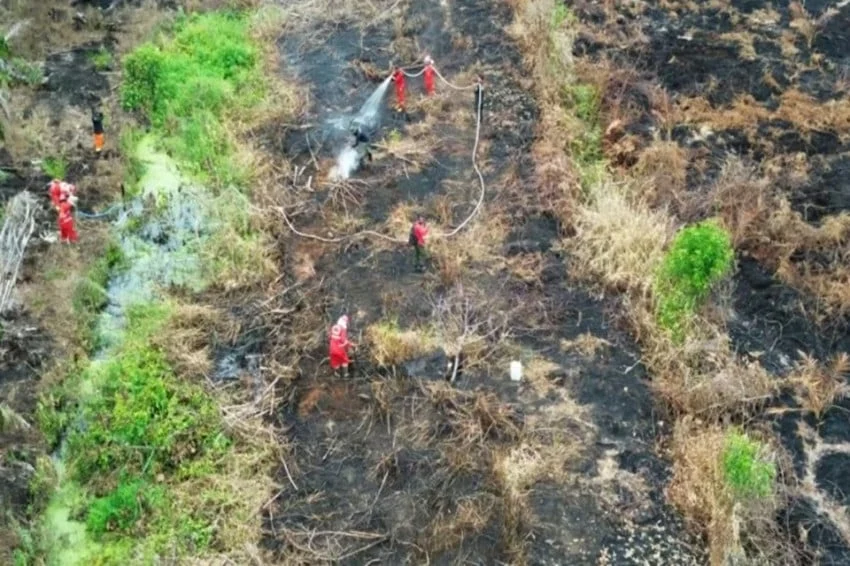
The ongoing ecological and humanitarian crisis posed by forest and land fires (kebakaran hutan dan lahan, or karhutla) in Indonesia has prompted a strong legislative response regarding corporate accountability. Wakil Ketua Komisi IV DPR RI (Vice Chairman of Commission IV of the House of Representatives), Alex Indra Lukman, has publicly recommended that law enforcement agencies aggressively pursue the confiscation of economic profits gained by corporations involved in repeated forest and land fires. This aggressive punitive approach aims to create a severe deterrent effect against entities that repeatedly violate environmental regulations for commercial gain.
During a legislative review on Friday, October 30, 2026, Alex emphasized that traditional fines and administrative sanctions have proven insufficient in stopping the recurring cycle of deliberate land clearing through burning. By targeting the financial core of these enterprises—namely, the profits generated from illegally cleared land—authorities can fundamentally alter the cost-benefit analysis that currently favors reckless environmental destruction. The recommendation comes amid heightened national scrutiny following the identification of multiple corporate suspects linked to recent widespread fires across several provinces.
The Legislative Push for Cumulative Charges and Asset Seizure
The core of the proposal presented by the House leadership involves the application of cumulative charges combined with additional criminal penalties. Under Indonesian environmental and criminal frameworks, prosecutors possess the legal mechanisms to not only seek imprisonment for responsible corporate officers and fines for the corporate entities themselves, but also to seize assets and financial gains tied directly to the illicit activity.
Alex pointed out that intelligence and field reports indicate a disturbing trend: specific corporate entities continue to appear as repeat offenders in successive fire seasons. For these recidivist corporations, standard administrative penalties or minimal fines are simply absorbed as operational costs of doing business. Therefore, imposing maximum cumulative indictments that explicitly include the confiscation of economic profits is viewed as a vital legal escalation.
"There are reports revealing that certain corporations suspected of being perpetrators of forest and land fires are repeat offenders," Alex stated. "In truth, these corporations deserve to be charged with cumulative indictments and maximum aggravated penalties accompanied by additional criminal penalties involving the confiscation of the corporation’s economic profits."
To operationalize this strategy, the House of Representatives has called upon the Ministry of Forestry (Kemenhut) to forge closer operational synergy with investigators from the Indonesian National Police (Mabes Polri). This collaborative task force is expected to meticulously trace corporate ownership, financial flows, and land-use permits to identify entities with historical records of environmental infractions.
Background Context: The Chronic Threat of Karhutla in Indonesia
Forest and land fires have long presented one of Indonesia’s most complex environmental, economic, and public health challenges. Characterized by severe seasonal outbreaks—often exacerbated by prolonged dry spells and climate phenomena such as El Niño—fires frequently ravage vast tracts of peatlands and forest ecosystems, particularly on the islands of Sumatra and Kalimantan.

Historically, a significant portion of these fires has been linked to land-clearing practices for agricultural expansions, most notably for palm oil plantations and industrial timber estates. Slash-and-burn techniques remain an inexpensive, albeit illegal, method for preparing land for cultivation. When these fires spiral out of control, they transcend local boundaries, generating massive transboundary haze crises that severely impact air quality, disrupt regional aviation, strain public healthcare systems, and release staggering volumes of greenhouse gases into the atmosphere.
Over the past decade, successive Indonesian administrations have intensified efforts to combat karhutla through improved satellite monitoring, rapid-response firefighting task forces, and stricter law enforcement. The establishment of the Peatland and Mangrove Restoration Agency (BRGM) and enhanced oversight by the Ministry of Environment and Forestry (now reorganized under the Ministry of Forestry) marked significant steps toward ecological restoration and preventative governance. However, corporate compliance remains a persistent hurdle, particularly within remote concessions where monitoring is logistically challenging.
Chronology of Recent Regulatory and Enforcement Actions
The discourse surrounding corporate accountability for karhutla has evolved significantly through successive phases of legal reform and enforcement milestones:
- Pre-2015 Crisis Turning Point: Following the catastrophic nationwide fires of 2015, which burned an estimated 2.6 million hectares and caused billions of dollars in economic losses, the Indonesian government instituted a strict moratorium on new palm oil permits on primary forests and peatlands, alongside a strengthened commitment to prosecute negligent corporations.
- Civil and Administrative Litigation (2016–2020): Courts began ruling in favor of the state in massive civil lawsuits filed by the Ministry of Environment and Forestry against plantation companies, resulting in multi-trillion rupiah liability orders for environmental restoration. Despite these judgments, actual collection rates remained sluggish due to protracted legal appeals and corporate restructuring.
- The 2023–2024 El Niño Resurgence: A resurgence of severe dry conditions tested Indonesia’s fire prevention infrastructure, leading to renewed crackdowns, temporary suspensions of corporate operating licenses, and a growing consensus among lawmakers that civil fines were inadequate deterrents.
- Late 2026 Legislative Intervention: The recent release of investigative data highlighting a roster of approximately 20 corporate suspects in ongoing karhutla cases prompted high-level legislative interventions. The October 2026 proposal by Vice Chairman Alex Indra Lukman shifted the policy debate from mere deterrence to direct economic deprivation through profit confiscation.
Official Responses and Inter-Agency Coordination
The implementation of the DPR’s recommendation requires seamless institutional coordination between the Ministry of Forestry, the Indonesian National Police, the Attorney General’s Office, and the financial intelligence sector, notably the Indonesian Financial Transaction Reports and Analysis Center (PPATK).
While the Ministry of Forestry holds the authority to review, suspend, or revoke administrative forestry and plantation concessions, criminal investigations and asset tracing fall under the purview of law enforcement and prosecuting authorities. Tracing the economic profits of a parent corporation often involves untangling complex corporate networks, offshore holding companies, and subsidiary structures designed to obscure ultimate beneficial ownership.
Legal experts have noted that while the criminal confiscation of corporate assets is legally permissible under existing statutes—such as the Law on Corruption Eradication (which includes asset forfeiture principles) and specific articles within environmental laws—its application in environmental crimes remains relatively novel and legally complex. Prosecutors must definitively prove the direct causal link between the illegal act (starting or allowing fires to clear land) and the specific economic gains realized by the corporate entity.
Economic, Ecological, and Social Implications
The enforcement of profit confiscation as suggested by the legislature carries profound implications for Indonesia’s agricultural and industrial sectors:
- Strengthened Corporate Governance: The looming threat of losing all commercial profits derived from a contested concession will force corporations to implement rigorous internal compliance, invest in advanced zero-burn land clearing technologies, and exercise tighter supervision over local management and third-party contractors.
- Environmental Restoration Financing: Confiscated corporate profits, if successfully funneled back into state coffers earmarked for environmental recovery, could provide immediate, substantial funding for the rehabilitation of degraded peatlands and carbon-rich forests.
- Investor Sentiment and Sustainability Standards: International markets, particularly the European Union with its stringent Deforestation Regulation (EUDR), closely monitor Indonesia’s environmental governance. Demonstrating aggressive, unsparing prosecution of corporate offenders enhances the international credibility of Indonesian agricultural commodities, ensuring long-term market access for compliant producers while penalizing rogue operators.
- Mitigation of Public Health and Climate Crises: By effectively deterring intentional land fires, the policy indirectly protects millions of citizens from respiratory illnesses associated with haze, preserves biodiversity hotspots, and supports Indonesia’s international climate commitments under its Nationally Determined Contributions (NDC) to reduce carbon emissions.
As the Ministry of Forestry and the National Police review these legislative recommendations, public and parliamentary watchdogs will closely monitor how subsequent indictments are formulated against the identified corporate suspects. The successful execution of profit confiscation in upcoming trials could establish a watershed legal precedent in the global fight against corporate environmental crime.