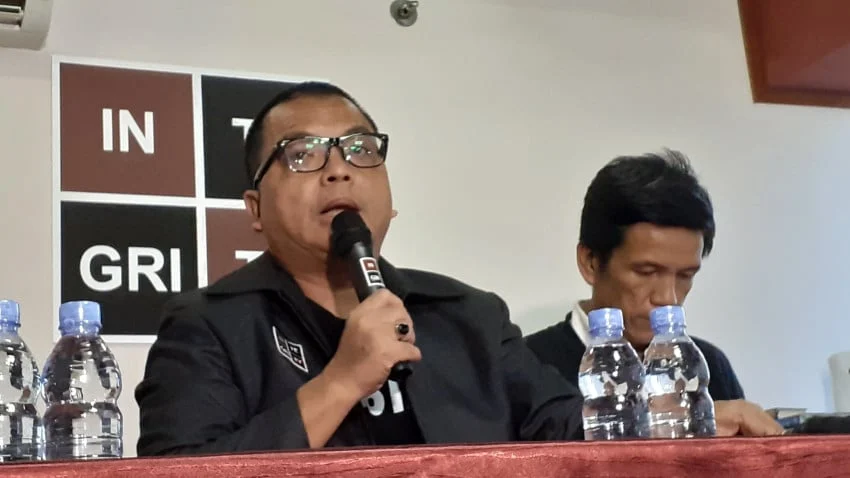
Constitutional law expert Denny Indrayana has formally urged the House of Representatives (DPR RI) of the Republic of Indonesia to initiate the Hak Menyatakan Pendapat (Right to Express an Opinion, or HMP) procedure regarding the eligibility and ongoing status of Vice President Gibran Rakabuming Raka. Speaking at the Integrity Law Firm offices in Central Jakarta, Denny emphasized that recent judicial reviews and rulings issued by both the Constitutional Court (Mahkamah Konstitusi – MK) and the Supreme Court (Mahkamah Agung – MA) provide a concrete, legally binding foundation for the legislature to take immediate constitutional action.
The core of Denny’s argument rests on the assertion that the highest judicial bodies in Indonesia have rendered consistent rulings establishing that Gibran Rakabuming Raka allegedly fails to meet essential educational qualifications and statutory candidacy criteria mandated by the prevailing Election Law. According to the constitutional scholar, these cumulative judicial decisions eliminate the need for protracted preliminary investigations, empowering the DPR RI to bypass secondary legislative delays and immediately move forward with the HMP mechanism as a precursor to potential impeachment proceedings under Article 7A of the 1945 Constitution of the Republic of Indonesia (UUD 1945).
Legal Foundation and Constitutional Framework
The debate surrounding the legitimacy of Vice President Gibran Rakabuming Raka’s tenure has intensified constitutional discourse across Indonesia. At the center of the legal architecture governing executive accountability is Article 7A of the 1945 Constitution. The article stipulates that the President and/or Vice President may be dismissed from office by the People’s Consultative Assembly (MPR) upon a proposal from the House of Representatives, provided that the DPR first proves through judicial or legislative processes that the official has committed treason, corruption, bribery, other severe criminal offenses, or disgraceful acts, or that the official no longer meets the constitutional requirements to hold office.
Denny Indrayana argues that the phrase "no longer meets the requirements to serve" directly applies to the current situation, given the interpretations and determinations stemming from the Constitutional Court and the Supreme Court. In Indonesia’s tripartite separation of powers, the legislature holds oversight mechanisms designed to maintain executive compliance with statutory laws. Among these instruments, the Hak Menyatakan Pendapat stands as a powerful supervisory tool. It enables the DPR to evaluate critical national policies or situations involving alleged violations of law by high-ranking state officials and formally declare the institutional stance of the parliament.
While the HMP itself is an expression of legislative judgment, it carries profound political and legal consequences. If successfully invoked and passed through the plenary mechanisms of the DPR, an HMP can serve as the formal political gateway to transmit an impeachment inquiry to the Constitutional Court for judicial review and subsequently to the MPR for a final decision. Denny maintains that because the substantive legal predicates—namely the evaluations of educational qualifications—have already been addressed by judicial authorities, the legislative branch has ample justification to activate this constitutional instrument without hesitation.
Background and Chronology of the Controversy
The controversy surrounding Gibran Rakabuming Raka’s candidacy and subsequent occupancy of the vice-presidency traces its roots back to the turbulent legal maneuvers leading up to the 2024 general elections. The initial spark was ignited when the Constitutional Court issued Decision Number 90/PUU-XXI/2023, which altered the age requirements for presidential and vice-presidential candidates, carving out an exception for individuals who had been or were currently elected to regional leadership positions. This ruling allowed Gibran, then the Mayor of Surakarta and the eldest son of former President Joko Widodo, to secure a spot on the presidential ticket alongside Prabowo Subianto.
Despite that initial hurdle being cleared, challenges regarding administrative compliance, formal requirements, and educational credentials persisted throughout the campaign cycle and into the post-election period. Various civil society organizations, legal advocacy groups, and individual petitioners continued to file formal complaints and requests for judicial review regarding the strict interpretation of election laws and administrative prerequisites.
Over the subsequent months, subsequent reviews and administrative petitions made their way through the judicial system. Landmark determinations by panels within the Supreme Court and further clarifications from the Constitutional Court scrutinized the documentary evidence pertaining to academic backgrounds and statutory qualifications. Critics and legal scholars argue that these subsequent findings highlighted discrepancies between the mandatory educational thresholds stipulated in the Election Law and the credentials submitted during the registration process.
By late 2026, the accumulation of these judicial opinions reached a critical mass. Civil society figures, including prominent political analyst Ray Rangkuti, joined legal experts in publicly calling for political accountability. Rangkuti publicly urged major political parties—specifically targeting the core coalition parties that backed the Prabowo administration—to spearhead the initiative within the parliament, transforming legal debates into concrete parliamentary oversight.

Political Repercussions and Inter-Party Dynamics
The call for utilizing the Hak Menyatakan Pendapat to challenge the Vice President’s legitimacy introduces significant tension into the broader political landscape. The administration of President Prabowo Subianto relies on a broad legislative coalition within the DPR RI, encompassing political parties that span a diverse ideological and transactional spectrum. For an HMP to gain traction, it requires substantial political will, floor coordination, and debate among factions that supported the executive branch during the general election.
Political analysts note that initiating an HMP is rarely a purely legal exercise; it is profoundly political. While legal experts like Denny Indrayana frame the argument strictly around constitutional compliance and the enforcement of judicial consistency, political parties must weigh the stability of the governing coalition against the pressure to uphold strict legal interpretations. Opponents of the impeachment push argue that destabilizing the executive leadership could undermine national economic recovery programs, erode investor confidence, and fracture the legislative consensus required to pass critical state budgets.
Conversely, proponents of the initiative argue that ignoring judicial determinations regarding candidate eligibility undermines the rule of law and sets a dangerous precedent where executive power supersedes statutory limitations. They contend that addressing the issue transparently within the halls of parliament through constitutional mechanisms like the HMP prevents extra-parliamentary unrest and reinforces the supremacy of the constitution.
Fact-Based Analysis of Implications
The pursuit of an impeachment process via the Hak Menyatakan Pendapat carries multifaceted implications for Indonesia’s constitutional democracy:
-
Jurisprudential Precedent: If the DPR proceeds with an HMP based on administrative and educational qualifications evaluated by the MK and MA, it will establish a profound precedent regarding the enforcement of judicial mandates over executive officeholders. It clarifies the operational boundaries of Article 7A of the 1945 Constitution, transforming a largely theoretical article into an active accountability tool.
-
Legislative-Executive Relations: The formal introduction of an HMP targeting the Vice President would severely strain relations between the legislative factions and the executive branch. Even if the motion fails to secure the necessary parliamentary majority, the debate itself would force political parties to declare their positions publicly, altering alignment dynamics ahead of subsequent legislative cycles.
-
Institutional Stability: A protracted constitutional crisis involving the legitimacy of the Vice President introduces an element of institutional uncertainty. Markets and international partners closely monitor political stability in Southeast Asia’s largest economy. Consequently, how political elites manage this debate will heavily influence perceptions of Indonesia’s democratic resilience and governance maturity.
Outlook and Next Steps
As the debate moves from legal seminars and civil society forums into the public consciousness, all eyes remain fixed on the leadership and faction heads within the DPR RI. Whether individual legislators will heed the calls of constitutional scholars like Denny Indrayana and political analysts like Ray Rangkuti remains uncertain. The threshold for initiating an HMP requires formal backing from a designated number of members and must navigate rigorous parliamentary procedures, committee hearings, and plenary votes.
Ultimately, the unfolding situation regarding Gibran Rakabuming Raka tests the robustness of Indonesia’s post-reformasi constitutional mechanisms. It forces a direct confrontation between political expediency and strict constitutionalism, ensuring that the boundaries of executive legitimacy will remain a dominant fixture of national discourse in the foreseeable future.