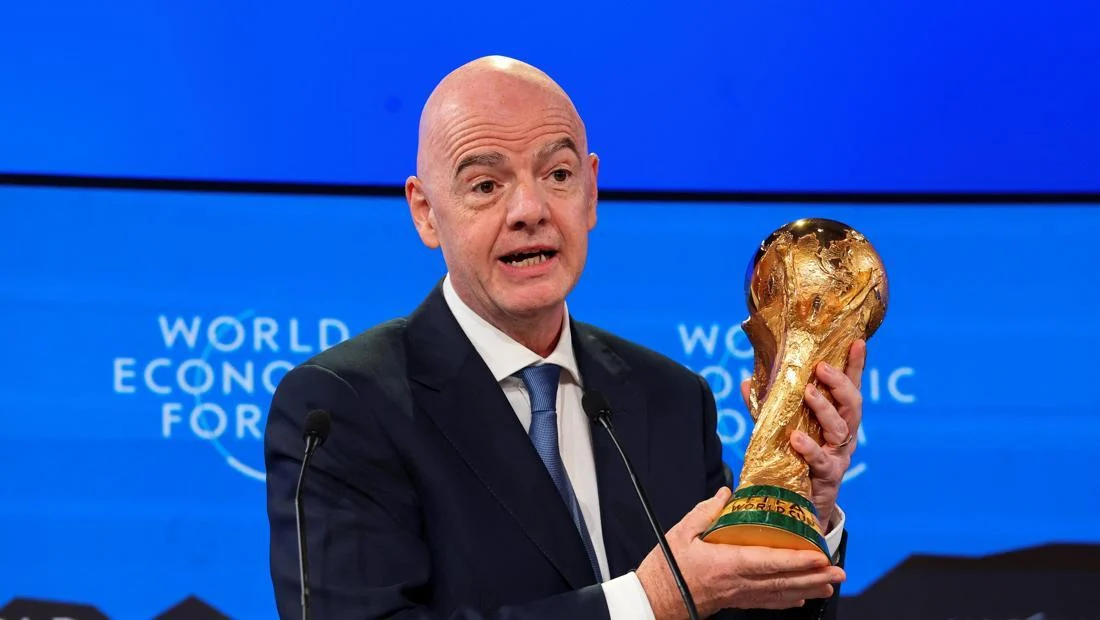
The 2026 FIFA World Cup has already secured its place in the annals of sporting history as the largest and most geographically ambitious tournament ever conceived. Spanning three sovereign nations—the United States, Canada, and Mexico—the tournament features an unprecedented 104 matches. However, beyond the pitch, the event has also become a record-breaking logistical undertaking for FIFA’s leadership. FIFA President Gianni Infantino has personalizing this scale through a staggering display of aerial mobility, logging nearly 60,000 miles (approximately 96,500 kilometers) in private jet travel throughout the duration of the tournament. This distance, which is equivalent to circling the Earth nearly two and a half times, underscores both the immense scale of the North American event and the controversial carbon footprint associated with modern sports administration.
According to a comprehensive analysis of flight data, social media documentation, and official FIFA itineraries, Infantino spent more than 100 hours in the air. His primary mode of transport was a Gulfstream G650, a pinnacle of long-range business aviation. The aircraft, which belongs to the Qatari government’s fleet and is operated by the private charter division of Qatar Airways—a primary FIFA sponsor—served as a mobile office and residence for the President. This level of travel allowed Infantino to maintain a near-daily presence at various venues, meetings, and official functions across the continent, highlighting a relentless schedule that few executives could match.
The Logistics of a Continental Tournament
The 2026 World Cup represents a significant departure from previous iterations. While the 2022 tournament in Qatar was notable for its extreme geographic compactness—allowing fans and officials to attend multiple matches in a single day via a short subway ride—the 2026 edition is the exact opposite. With host cities ranging from Vancouver in the northwest to Mexico City in the south and Miami in the southeast, the "footprint" of the tournament covers millions of square miles.
To manage this, Infantino utilized a strategy of high-frequency private aviation. The Gulfstream G650’s capabilities were essential; the jet is capable of near-supersonic speeds and has a range that connects almost any two points on the globe non-stop. Throughout the tournament, Infantino successfully visited all 16 host stadiums, a feat of diplomacy and oversight intended to demonstrate FIFA’s commitment to every host city.
Hard Rock Stadium in Miami emerged as a central hub for the FIFA President. Records indicate he attended five matches at this venue alone, likely due to its strategic location and its role as a primary operations base for FIFA’s North American staff. To maximize efficiency, the flight operations frequently bypassed major international hubs, which are often prone to congestion. Instead, the jet utilized executive and regional airports, such as Fulton County Executive Airport in Atlanta and Opa-locka Executive Airport in Miami. These facilities allowed for faster boarding and departure times, enabling Infantino to arrive at a stadium shortly before kickoff and depart almost immediately after the final whistle.
A Chronology of High-Speed Diplomacy
The sheer intensity of Infantino’s schedule is best illustrated by specific windows of time during the tournament where his travel surpassed the limits of conventional commercial aviation. On several occasions, the FIFA President attended two matches in a single day, despite the venues being separated by thousands of miles.
One of the most grueling stretches occurred on June 26. The day began with an early morning departure from Miami, heading to Dallas for administrative meetings and site inspections. From Texas, the Gulfstream G650 flew northwest to Seattle, where Infantino attended a high-stakes match between Egypt and Iran. Not content to remain in the Pacific Northwest, the aircraft departed Seattle late that same night, crossing several time zones to land back in Miami the following morning. This allowed Infantino to be present for a match between Colombia and Portugal. This single-day itinerary alone covered more distance than many travelers cover in a year.
Another notable journey took place on June 15. Infantino traveled from Miami to Seattle to witness the Belgium-Egypt fixture. The flight lasted 344 minutes—nearly six hours. To put this in perspective, the time spent in the air for this single leg was equivalent to the duration of three full football matches, including injury time.
Conversely, the efficiency of private travel was highlighted on July 6. After attending the United States versus Belgium match in Seattle, Infantino took a short 28-minute "hop" to Vancouver. This flight, roughly the length of a television sitcom, allowed him to transition from a U.S.-hosted match to a Canadian-hosted match in time for Switzerland’s encounter with Colombia the next day. Without the use of a private jet and dedicated executive airports, such a transition would have been nearly impossible given the requirements of commercial check-ins and security.
Supporting Data and Comparative Analysis
The data regarding Infantino’s travel provides a startling look at the requirements of modern global sports governance. The 60,000 miles logged during the tournament (excluding the initial positioning flights from Qatar) exceeds the combined distance of some of the world’s longest commercial flight routes. For example, a trip from New York to Singapore, followed by Los Angeles to Doha, and then London to Perth, would still fall short of the total mileage accumulated by the FIFA President during the World Cup.
The time spent in the air—exceeding 100 hours—is equivalent to more than four full days of flight. For a commercial passenger, this would be the equivalent of flying between New York and Los Angeles 20 times.
The choice of aircraft, the Gulfstream G650, is also significant. With a list price of approximately $65 million to $70 million, it is one of the fastest and most luxurious business jets in existence. Its operation is costly, often exceeding $5,000 to $10,000 per flight hour in fuel and maintenance alone. While the partnership with Qatar Airways likely offsets these costs for FIFA, the optics of using a state-owned jet from a former host nation while traversing the current host nations have drawn the attention of industry observers.
Environmental Implications and Official Responses
The revelation of Infantino’s extensive private jet usage comes at a time when FIFA is under increasing pressure to address its environmental impact. FIFA has publicly committed to the United Nations Sports for Climate Action Framework, pledging to reduce its carbon emissions by 50% by 2030 and reach net-zero by 2040.
Critics argue that the use of a heavy private jet for nearly 100 hours of flight stands in direct contradiction to these sustainability goals. Private jets are significantly more carbon-intensive per passenger than commercial flights or rail travel. Environmental advocacy groups have pointed out that while FIFA encourages fans to use public transport and "green" travel options, its top leadership utilizes the most carbon-heavy method available.
In response to inquiries regarding the President’s travel, FIFA representatives have historically emphasized the operational necessity of such arrangements. The organization maintains that the President’s role requires him to be present at as many venues as possible to ensure the smooth running of the tournament, meet with heads of state, and engage with local organizing committees. "The scale of the 2026 FIFA World Cup is unprecedented," a source close to the organization noted. "The President’s schedule is designed to ensure that FIFA’s presence is felt in every host city, acknowledging the massive investment and effort made by the United States, Canada, and Mexico."
Furthermore, FIFA often points to its carbon offset programs, where the organization invests in environmental projects to "balance out" the emissions generated by tournament travel. However, climate scientists frequently argue that offsetting is not a substitute for actual emission reductions, especially in the high-altitude aviation sector.
The Broader Impact on Global Sports
Gianni Infantino’s 60,000-mile odyssey is more than just a travel log; it is a reflection of the "Imperial Presidency" model of sports governance. By being everywhere at once, Infantino projects an image of total oversight and personal investment in the tournament’s success. This is particularly important for the 2026 World Cup, which serves as a massive commercial engine for FIFA, expected to generate record-breaking revenues in excess of $11 billion for the 2023-2026 cycle.
However, the logistical demands of the 2026 tournament raise questions about the future of the World Cup. As FIFA moves toward even more expansive hosting models—such as the 2030 tournament, which is slated to be held across six countries on three continents (Morocco, Spain, Portugal, Argentina, Paraguay, and Uruguay)—the travel requirements for officials, teams, and fans will only increase.
Infantino’s travel patterns during the North American tour may set a precedent for how global sporting events are managed in an era of geographic decentralization. While the efficiency of private aviation allows for a high level of executive "touchpoints" across a continent, it also highlights a growing divide between the lived experience of the average fan—navigating crowded airports and expensive commercial flights—and the elite tier of sports administration.
As the final whistle blows on the 2026 World Cup, the legacy of the tournament will be measured not just by the goals scored on the pitch, but by the logistical blueprint it leaves behind. Gianni Infantino’s 96,500-kilometer journey serves as a powerful testament to the sheer size of the modern game, while simultaneously fueling a necessary debate about the environmental and ethical costs of global sporting spectacles in the 21st century.