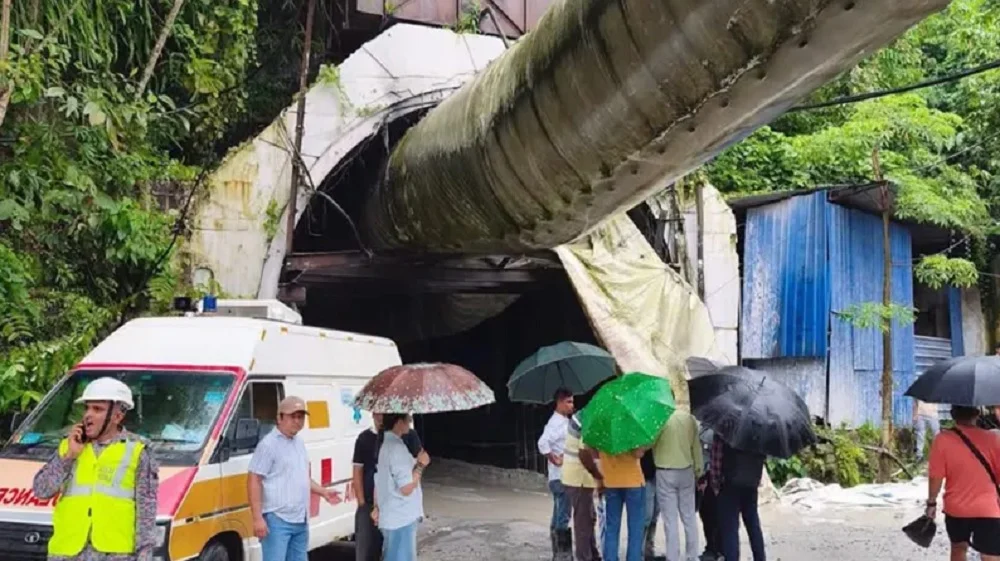
NEW DELHI, India – A catastrophic tunnel collapse, triggered by a sudden and powerful methane gas explosion, has claimed the lives of at least 12 construction workers and left 13 others trapped deep within the earth in the northeastern Indian state of Sikkim. The tragic incident, which occurred approximately 1.5 kilometers (0.9 miles) inside a crucial diversion tunnel for a major hydroelectric power project, has prompted a massive and perilous rescue operation by the National Disaster Response Force (NDRF) amidst challenging conditions. The collapse, reported on Monday, July 20, 2026, has cast a somber shadow over India’s ambitious infrastructure drive, particularly in the geologically complex Himalayan region, raising urgent questions about worker safety and the inherent risks of such large-scale projects.
The Immediate Aftermath and Initial Response
The explosion, described by officials as a "sudden combustion of methane gas," ripped through the tunnel with devastating force, causing a significant section of the newly excavated passage to cave in. Of the 27 individuals working across various points within the tunnel at the time of the blast, two workers miraculously managed to escape the immediate inferno and collapsing debris, alerting authorities to the unfolding disaster. Their harrowing accounts provided the first glimpse into the severity of the incident. Rescue teams, spearheaded by the NDRF, were mobilized swiftly, but the remote location, the instability of the tunnel, and the presence of toxic gases, including residual methane and carbon monoxide, severely hampered initial efforts. The primary objective became the desperate search for the 13 individuals still unaccounted for, believed to be trapped amidst the rubble and within isolated pockets deep inside the tunnel. The initial phase of the rescue operation focused on stabilizing the tunnel entrance, clearing immediate debris, and establishing ventilation to disperse the dangerous gases, a critical prerequisite before personnel could safely advance further into the collapsed sections. Medical teams were also deployed on standby, prepared to provide immediate assistance to any survivors brought out from the tunnel.
Chronology of Disaster and Rescue Efforts (Inferred Timeline for July 2026)
- Monday, July 20, 2026 (Day 0):
- Evening (approx. 6:00 PM – 8:00 PM IST): A sudden, powerful explosion attributed to trapped methane gas occurs approximately 1.5 km inside the tunnel.
- Immediately After: Two workers manage to escape and raise the alarm.
- Late Evening: Local emergency services and project staff initiate preliminary rescue efforts. NDRF units from nearby bases are alerted and begin mobilization.
- Night: First responders confirm multiple fatalities and a significant number of trapped workers. Rescue operations officially commence, facing immediate challenges from debris, smoke, and unstable ground.
- Tuesday, July 21, 2026 (Day 1):
- Early Morning: NDRF teams, equipped with specialized search and rescue gear, reach the site. Initial efforts focus on clearing the immediate entrance, assessing the extent of the collapse, and establishing communication with potential survivors.
- Daytime: Engineers from the National Hydroelectric Power Corporation (NHPC) and geological experts arrive to provide technical guidance. Oxygen supply lines and ventilation systems are pushed into the accessible sections.
- Afternoon/Evening: The grim task of recovering bodies begins. Initial reports confirm 12 fatalities. The focus shifts to locating the 13 trapped individuals, with hopes dwindling as the hours pass.
- Wednesday, July 22, 2026 (Day 2):
- Morning: Rescue operations continue around the clock. Challenges include unstable rock formations, the risk of secondary collapses, and the persistent presence of toxic gases, necessitating careful monitoring and specialized breathing apparatus for rescuers.
- Daytime: Heavy machinery is brought in to assist with debris removal at the tunnel’s entrance, while smaller teams manually clear paths deeper inside. Families of the trapped workers gather near the site, anxiously awaiting news.
- Evening: Officials from the Sikkim state government and the Union Ministry of Power issue statements, confirming the incident’s cause as methane combustion and pledging a thorough investigation.
- Thursday, July 23, 2026 (Day 3) and Beyond:
- Rescue efforts intensify, but the nature of the collapse and the prolonged time frame reduce the chances of finding survivors. The operation transitions into a complex recovery mission, emphasizing the safety of the rescue personnel.
- Investigations are formally initiated, with multiple agencies tasked with examining safety protocols, geological surveys, and operational procedures leading up to the disaster.
Background: Sikkim’s Hydropower Ambitions and the Teesta Project
The ill-fated tunnel is an integral component of a larger hydroelectric power project situated in Sikkim, a small, landlocked state nestled in the eastern Himalayas. Sikkim is renowned for its rugged mountainous terrain, fast-flowing rivers, and abundant rainfall, making it a prime candidate for hydropower development. India, a rapidly developing nation, has a voracious appetite for energy, and hydroelectric power is viewed as a clean, renewable, and crucial source to meet its growing demands and reduce reliance on fossil fuels.
The project in question is being developed by the state-owned National Hydroelectric Power Corporation (NHPC), India’s premier hydropower generation company. NHPC has a mandate to plan, promote, and organize an integrated and efficient development of hydroelectric power in India. The specific tunnel was designed to divert water from the mighty Teesta River – a lifeline for Sikkim and a significant trans-boundary river flowing into Bangladesh – to the turbines of a power generation facility. Such diversion tunnels are critical in run-of-the-river hydropower projects, where water is channeled through tunnels and penstocks to create the necessary head (vertical drop) for electricity generation, minimizing the need for large reservoirs. The Teesta basin itself is a hotbed for multiple hydropower projects, both operational and under construction, highlighting its immense potential but also the inherent geological challenges.
Challenges of Himalayan Tunneling: A Perilous Endeavor
Tunneling in the Himalayas is arguably one of the most challenging feats of civil engineering. The region is geologically young, tectonically active, and characterized by highly fractured, unstable rock formations, steep slopes, and unpredictable groundwater conditions. These factors present a myriad of risks that include:
- Geological Instability: The constant movement of tectonic plates makes the Himalayan range prone to earthquakes and landslides. Rock strata are often highly folded, faulted, and sheared, leading to unpredictable ground behavior during excavation.
- Unforeseen Water Ingress: High hydrostatic pressures and unexpected aquifers can lead to sudden water bursts, flooding, and destabilization of tunnel faces, posing risks to workers and equipment.
- Trapped Gas Pockets: As tragically demonstrated in this incident, the geological formations in the Himalayas can contain pockets of combustible gases, most notably methane. Methane is a colorless, odorless gas that forms naturally from the decomposition of organic matter under anaerobic conditions. When trapped under pressure within rock strata, it can be released during drilling or blasting. If it accumulates in a confined space like a tunnel and encounters an ignition source (e.g., sparks from machinery, electrical short circuits, static electricity, or even a localized hot spot from friction), it can ignite or explode with devastating force. The NHPC’s statement explicitly mentioned "sudden explosion of methane gas which is suspected to be entrapped/embedded within the rock strata," underscoring this particular risk.
- Logistical Difficulties: The remote and rugged terrain of Sikkim makes transportation of heavy machinery, materials, and personnel arduous. Extreme weather conditions, including heavy monsoon rains and winter snowfalls, further complicate construction and rescue operations.
- Seismic Activity: The entire Himalayan belt is seismically active. Even minor tremors can affect the stability of excavated tunnels, potentially leading to rockfalls or collapses.
Mitigating these risks requires meticulous geological surveys, advanced tunneling techniques (such as the New Austrian Tunneling Method – NATM), robust ground support systems, continuous gas monitoring, and stringent safety protocols. However, even with the best precautions, the unpredictable nature of the Himalayas can still present unforeseen hazards.
Official Reactions and Investigations
Following the tragedy, both the NHPC and the Sikkim state government issued statements acknowledging the incident and initiating investigations.
The NHPC, in its official communication, expressed deep regret over the loss of lives and confirmed the preliminary cause: "The accident occurred after a sudden explosion of methane gas which is suspected to be entrapped/embedded within the rock strata, leading to an explosion that generated thick smoke and toxic gases." The corporation affirmed its commitment to cooperating fully with all investigative agencies and providing all necessary support to the affected workers and their families. It is expected that NHPC will also launch an internal high-level inquiry to review safety protocols, geological assessments conducted prior to and during construction, and the operational procedures that were in place.
The Sikkim government, in a separate statement, corroborated the cause, attributing the accident to "the combustion of methane gas." State officials have emphasized the need for a comprehensive and impartial inquiry to ascertain the exact sequence of events, identify any lapses in safety measures, and recommend preventative actions for future projects. Chief Minister of Sikkim is expected to visit the site and offer condolences to the victims’ families, pledging state government support, including ex-gratia payments and rehabilitation assistance.
The Union Ministry of Power, under whose purview NHPC operates, is also likely to monitor the situation closely and may constitute an expert committee to examine safety standards across all ongoing hydropower projects in the country, particularly those in seismically active and geologically challenging regions. Labor unions and workers’ rights organizations across India have voiced concerns about worker safety in large infrastructure projects, calling for stricter enforcement of safety regulations, regular safety audits, and adequate compensation for the victims’ families. They highlight that such incidents, while tragic, often underscore systemic issues in worker protection and risk management.
The Human Cost and Worker Safety Concerns
Beyond the technical and logistical challenges, the most profound impact of this disaster is the immense human cost. Twelve lives have been lost, and 13 families are agonizing over the fate of their loved ones trapped beneath tons of rock and debris. Most of the workers involved in such projects are migrant laborers from various parts of India, often working in arduous conditions away from their homes to support their families. Their deaths or injuries not only devastate their immediate families but also ripple through their communities, often depriving dependents of their primary source of income.
This incident reignites a critical national conversation about worker safety in India’s booming infrastructure sector. While India has labor laws and safety regulations, their enforcement can sometimes be inconsistent, particularly in remote construction sites. The complexities of tunneling, especially in high-risk geological zones, demand the highest standards of safety training, equipment, and emergency preparedness. Questions are likely to arise regarding:
- Adequacy of Gas Monitoring Systems: Were continuous methane gas detectors in place and fully operational? Were alarms properly configured and heeded?
- Ventilation Protocols: Were ventilation systems sufficient to prevent the accumulation of hazardous gases?
- Emergency Escape Routes and Procedures: Were workers adequately trained in emergency evacuation procedures?
- Geological Surveys: Were the initial geological surveys comprehensive enough to identify potential gas pockets? Were real-time geological assessments performed as tunneling progressed?
- Safety Audits: Were regular and rigorous safety audits conducted by independent bodies?
- Compensation and Welfare: What provisions are in place for the welfare of the workers and their families in case of such accidents?
Broader Implications for Infrastructure Development
The Sikkim tunnel collapse carries broader implications for India’s ambitious infrastructure development agenda, particularly its thrust towards hydropower in the Himalayas.
- Review of Safety Protocols: The incident will undoubtedly lead to a rigorous review of safety standards and operating procedures for all tunneling and underground construction projects, especially those in geologically sensitive areas. This could involve revised guidelines, more stringent regulatory oversight, and increased penalties for non-compliance.
- Project Delays and Cost Overruns: Such catastrophic events inevitably cause significant delays in project timelines. The Teesta Hydropower Project, already a massive undertaking, will likely face further setbacks as rescue operations transition to recovery, investigations unfold, and remedial measures are implemented. These delays often translate into substantial cost overruns, impacting the financial viability of the project.
- Technological Advancements: The need for enhanced safety might spur greater investment in advanced geological sensing technologies, automated tunneling machines that reduce human exposure to risk, and sophisticated real-time monitoring systems for gas detection and ground stability.
- Public Scrutiny and Environmental Concerns: While the immediate focus is on human lives, such incidents can also draw renewed public scrutiny on the environmental impact and safety records of large-scale infrastructure projects, potentially fueling protests from local communities and environmental groups.
- Insurance and Liability: The incident will also bring into focus the insurance coverage for workers and the liability of the contracting companies and the project developer (NHPC). Adequate insurance and swift processing of claims are crucial for supporting the affected families.
Conclusion
The tunnel collapse in Sikkim stands as a stark and tragic reminder of the immense risks inherent in large-scale infrastructure development, particularly in challenging terrains like the Himalayas. As rescue operations continue, albeit with diminishing hopes of finding survivors, the focus will inevitably shift towards a thorough investigation to uncover the precise causes and identify any systemic failures. This disaster underscores the critical imperative for unwavering commitment to worker safety, robust geological assessment, and stringent enforcement of regulations. The lives lost demand that lessons be learned, and concrete actions be taken to ensure that India’s march towards progress does not come at the cost of its workers’ lives, making future infrastructure projects safer and more resilient against the unpredictable forces of nature. The nation watches anxiously as the recovery efforts unfold, hoping for closure for the grieving families and for a renewed resolve to prevent such tragedies in the future.