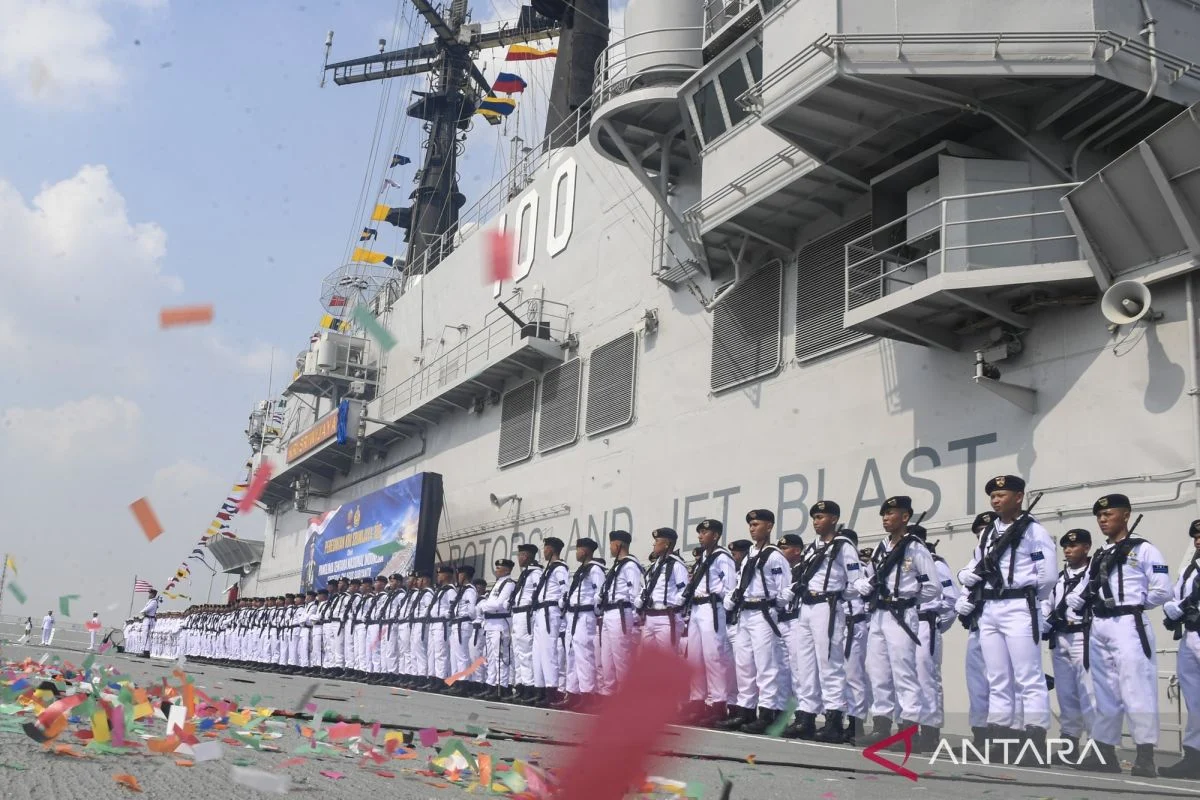
The arrival of the former Italian aircraft carrier ITS Giuseppe Garibaldi at Pier 107 of Tanjung Priok Port, North Jakarta, on Friday, September 18, 2026, marks a historic milestone in the evolution of the Indonesian Navy (TNI AL). As the vessel docked under the watchful eyes of maritime observers and defense officials, it signaled the beginning of a new era for Indonesia’s blue-water aspirations. This vessel, which will be formally commissioned as KRI Sriwijaya, represents more than just a logistical acquisition; it is the first true aircraft carrier to enter the Indonesian fleet, fundamentally altering the nation’s maritime power projection capabilities.
Chronology of the Acquisition
The transition of the vessel from the Italian Navy (Marina Militare) to the Indonesian Navy has been a meticulous diplomatic and technical endeavor. The Giuseppe Garibaldi, designated with the hull number C551, was a stalwart of the Italian fleet for decades. Following a series of bilateral discussions between the governments of Indonesia and Italy, a deal was reached to transfer the ship as a strategic grant.
Preparations for the transfer began in early 2025, involving extensive inspections, training for Indonesian naval personnel in Italy, and the complex logistics of relocating the vessel to the Java Sea. The vessel arrived in Jakarta on September 18, 2026, setting the stage for the formal handover ceremony scheduled for September 24, 2026. This ceremony will witness the lowering of the Italian flag and the hoisting of the Indonesian Merah Putih, officially transitioning the ship from C551 to KRI Sriwijaya.
Defining the Aircraft Carrier: A Mobile Maritime Hub
The classification of the Giuseppe Garibaldi as an aircraft carrier has sparked widespread discussion regarding the definition and utility of such vessels. In modern naval parlance, an aircraft carrier is not merely a "large ship." It is a sophisticated, self-sustaining, floating airbase designed to extend the reach of air power into areas where land-based runways are absent or inaccessible.
While traditional warships such as frigates, destroyers, and corvettes utilize surface-to-surface missiles and deck-mounted cannons as their primary offensive assets, the aircraft carrier’s primary weapon system is the aviation wing. The architecture of the ship includes a specialized flight deck, extensive hangar bays for maintenance and storage, and critical infrastructure for aviation fuel, munitions, and command-and-control systems. This configuration allows the carrier to project power, conduct surveillance, and perform rapid-response operations across vast maritime theaters.
Strategic Implications for Indonesia
Indonesia’s archipelagic geography, consisting of over 17,000 islands, presents unique challenges for national security and disaster response. The introduction of KRI Sriwijaya addresses these challenges by serving as a mobile platform for rapid deployment.
Chief of the Indonesian Navy (Kasal) Admiral Muhammad Ali has emphasized that while the vessel is technically an aircraft carrier, its operational doctrine within the Indonesian context will prioritize "Military Operations Other Than War" (MOOTW). Given Indonesia’s vulnerability to seismic activity and natural disasters, KRI Sriwijaya is expected to become a cornerstone of the nation’s humanitarian assistance and disaster relief (HADR) capabilities. By deploying helicopters and unmanned aerial vehicles (UAVs) from the ship’s flight deck, the Navy can deliver critical supplies, medical aid, and search-and-rescue teams to remote regions where traditional port infrastructure may have been destroyed or rendered inaccessible.
Technical Specifications and Operational Utility
The Giuseppe Garibaldi (C551) was originally commissioned in 1985 and has undergone multiple upgrades throughout its service life. With a displacement of approximately 13,850 tons, it is classified as a light aircraft carrier. Historically, the ship was designed to operate STOVL (Short Take-Off and Vertical Landing) aircraft, such as the AV-8B Harrier II, as well as a variety of maritime helicopters.
For the Indonesian Navy, the focus will likely shift toward maintaining a robust helicopter detachment and potentially integrating advanced drone technology. Admiral Ali noted that the Navy is currently evaluating the feasibility of equipping the ship with aircraft capable of vertical takeoff, which would maximize the utility of the existing flight deck configuration. The ship’s ability to act as a command-and-control center also allows it to serve as a floating base for regional security patrols, anti-piracy operations, and surveillance of Indonesia’s exclusive economic zone (EEZ).
Official Responses and Strategic Rationale
The decision to accept the grant of the vessel has been met with both domestic excitement and international curiosity. Government officials, including the Minister of State Secretary, have confirmed that the administration is actively engaging with Italian naval counterparts to ensure a smooth transfer of technical expertise.
The rationale behind the name "KRI Sriwijaya" is deeply symbolic, honoring the maritime legacy of the Srivijaya Empire, which dominated the Indonesian archipelago and international trade routes in the 7th to 13th centuries. By choosing this name, the Indonesian government aims to signal a return to its historical roots as a formidable maritime power, while simultaneously modernizing its defensive capabilities to meet 21st-century threats.
Comparative Analysis: Carrier vs. Conventional Warship
It is essential to distinguish KRI Sriwijaya from the existing vessels in the TNI AL fleet. While modern frigates like the Martadinata-class or the upcoming Arrowhead-class frigates are equipped with hangars for a single helicopter, they function as multi-role combatants. KRI Sriwijaya, by contrast, is a dedicated aviation platform. Its design is centered entirely around the sustainment of air operations.
The presence of dedicated hangars, automated weapons handling systems, and advanced air traffic control radars makes the vessel fundamentally distinct. It represents a "force multiplier," meaning that when deployed as part of a task force, it increases the total defensive and offensive capabilities of every other ship in the group by providing an "eye in the sky" and the ability to strike beyond the horizon.
Looking Ahead: The Future of KRI Sriwijaya
Following the official handover on September 24, 2026, KRI Sriwijaya will undergo a period of refitting and integration. This will involve updating communication systems, tailoring the internal layout to support Indonesian naval doctrines, and ensuring the propulsion and mechanical systems are optimized for the tropical environment of the Indonesian archipelago.
This acquisition is not an end in itself but a significant step in the long-term modernization plan of the Indonesian military. The integration of a vessel of this size and complexity into the Navy will require substantial training for the crew and the development of new tactical protocols. As the ship enters service, it will serve as a training ground for the next generation of Indonesian naval aviators and command staff, building a foundation of knowledge that will inform future procurement and operational decisions.
Ultimately, the arrival of KRI Sriwijaya serves as a reminder that maritime security is the bedrock of Indonesia’s national sovereignty. In a region marked by complex geopolitical dynamics and increasing focus on the Indo-Pacific, the ability to project power, provide humanitarian aid, and maintain persistent surveillance is vital. By repurposing the Italian-built carrier for the specific needs of the archipelago, Indonesia is making a clear statement about its commitment to securing its vast maritime territory and protecting its interests in the global commons. As the flag is raised at Tanjung Priok, the nation watches with anticipation to see how KRI Sriwijaya will shape the future of the Indonesian Navy.