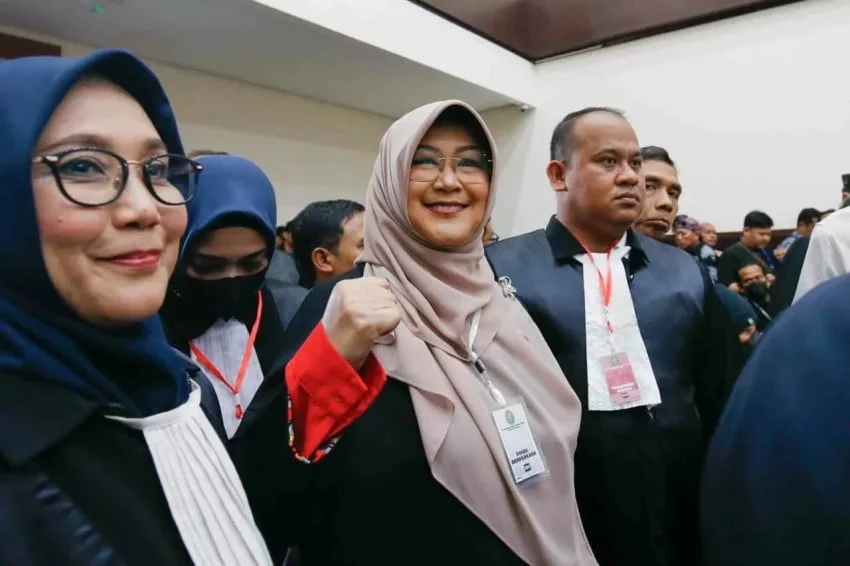
JAKARTA – The legal team representing Tifauzia Tyassuma, widely known as Dokter Tifa, has expressed strong conviction that state prosecutors will refrain from re-indicting their client in the high-profile alleged defamation case concerning the academic credentials of Indonesia’s 7th President, Joko Widodo (Jokowi). This confidence stems directly from the Jakarta Timur District Court’s decision to uphold and grant the preliminary objection (eksepsi) filed by Dokter Tifa’s defense, effectively halting the initial legal proceedings. The successful eksepsi signifies a significant procedural victory for the defense, challenging the admissibility or procedural correctness of the charges brought by the prosecution.
Abdullah Alkatiri, the lead counsel for Dokter Tifa, articulated this belief during an interview on the iNews program "Interupsi" on Thursday, July 23, 2026. Alkatiri indicated that the prosecution had witnessed the extensive and vigorous defense mounted by Dokter Tifa’s legal team throughout every stage of the legal process. He suggested that any attempt to re-file the case would likely carry negative repercussions for the plaintiff, implying that the defense’s robust strategy and the procedural shortcomings identified could undermine future prosecution efforts. "In my opinion, they will not repeat it, because the previous facts — there were several documents not provided and so on — they might, well, because of our persistent resistance, it is feared this would have negative consequences for our opponent," Alkatiri stated, underscoring the perceived weakness in the prosecution’s initial submission.
Background of the Jokowi Diploma Controversy
The controversy surrounding President Joko Widodo’s academic qualifications has intermittently surfaced in Indonesian public discourse, particularly during contentious political periods such as general elections. Allegations questioning the authenticity or validity of President Jokowi’s diploma from Gadjah Mada University (UGM) first gained significant traction in the lead-up to the 2019 presidential election. These claims, often amplified through social media and various online platforms, have been repeatedly refuted by UGM itself, which has consistently affirmed the authenticity of President Widodo’s engineering degree, awarded in 1985. The university has presented official records and documentation to support its statements, including graduation photos and academic transcripts. Despite these official clarifications, a segment of the public, and certain public figures, have continued to voice skepticism, demanding further scrutiny and independent verification. This persistent questioning forms the backdrop against which Dokter Tifa’s statements emerged, eventually leading to the defamation charges. The issue transcends a mere academic dispute, often intertwining with broader political narratives and criticisms leveled against the incumbent president.
Dokter Tifa: A Prominent Critic and Her Statements
Tifauzia Tyassuma, known to the public as Dokter Tifa, is a figure who has gained prominence through her vocal criticisms on social and political issues, often disseminated via her extensive social media presence. Her public commentary frequently touches on topics that resonate with conservative and opposition-leaning segments of Indonesian society. Dokter Tifa entered the spotlight in the context of the Jokowi diploma controversy by publicly questioning the authenticity of the President’s academic degree. Her statements, made primarily through social media posts, suggested irregularities in Jokowi’s educational background, implying that his stated diploma might not be genuine or was obtained under questionable circumstances. These assertions were interpreted by the President’s legal representatives as defamatory, leading to the initiation of legal proceedings against her. Her willingness to challenge official narratives and her assertive communication style have made her a controversial but influential voice among certain demographics, particularly those critical of the current administration.
The Legal Battle and the Significance of the Eksepsi
The legal journey for Dokter Tifa began when a formal complaint was lodged against her, accusing her of disseminating false information and defaming President Jokowi under Indonesia’s stringent Information and Electronic Transactions (ITE) Law. This law, enacted in 2008 and revised in 2016, criminalizes various online activities, including defamation, hate speech, and the spread of false news. Critics argue that the ITE Law is often used to stifle dissent and criticism, while proponents maintain its necessity in combating cybercrime and maintaining public order.
Following the initial investigation by law enforcement agencies, the case proceeded to the prosecution phase, culminating in the submission of an indictment to the Jakarta Timur District Court. Dokter Tifa’s legal team, led by Abdullah Alkatiri, responded by filing an eksepsi, or preliminary objection. In Indonesian legal procedure, an eksepsi is a defense plea submitted by the defendant’s counsel at the initial stage of a trial, challenging the formal requirements or procedural validity of the indictment, rather than the substantive merits of the case itself. Common grounds for an eksepsi include:
- Jurisdictional issues: Arguing that the court lacks the authority to hear the case.
- Indictment flaws: Pointing out ambiguities, incompleteness, or procedural errors in the prosecutor’s charges.
- Ne bis in idem: Claiming that the defendant has already been tried for the same offense.
- Expiry of the statute of limitations.
- Lack of legal standing for the plaintiff.
In Dokter Tifa’s case, the court’s decision to grant the eksepsi indicates that the judges found merit in the defense’s arguments regarding procedural deficiencies or formal flaws in the prosecution’s indictment. This ruling does not necessarily declare Dokter Tifa innocent of the substantive charges but rather signifies that the current indictment is legally untenable and cannot proceed as formulated. It effectively brings a halt to the trial at that stage, forcing the prosecution to either rectify the identified errors and resubmit an amended indictment or drop the case entirely. Alkatiri’s confidence suggests that the identified flaws were significant enough to deter the prosecution from attempting a re-filing.
Defense’s Stance: Allegations of Withheld Evidence and Procedural Unfairness
A cornerstone of Dokter Tifa’s defense strategy, as highlighted by Alkatiri, was the consistent objection to the prosecution’s alleged failure to provide complete and fair access to crucial evidence. Alkatiri specifically cited the non-disclosure of the Berita Acara Pemeriksaan (BAP), or Official Investigation Report, from 26 expert witnesses. In any criminal proceeding, the BAP contains detailed records of witness testimonies, expert opinions, and other investigative findings, forming the bedrock of the prosecution’s case. Access to these documents is considered fundamental for the defense to adequately prepare its counter-arguments, scrutinize the evidence, and ensure a fair trial.
"Because what the prosecutor provides to the judge and to us must be the same, to be fair. If we don’t know, and they know, then we’re battered. That’s what we argued about yesterday," Alkatiri emphatically stated. This points to a core principle of due process: equality of arms, where both the prosecution and defense have equal access to information and resources to present their cases. The defense argued that without access to the BAPs of these 26 experts, they were at a severe disadvantage, unable to cross-examine or challenge the expert opinions effectively.
Furthermore, Dokter Tifa herself pointed out a critical omission in the list of evidence presented by the prosecution: the results of a forensic laboratory examination related to President Jokowi’s diploma. She contended that such forensic analysis would be the most pivotal piece of evidence in a case centered on the authenticity of a document. The absence of these lab results, according to the defense, undermined the prosecution’s ability to conclusively prove the authenticity of the diploma and, by extension, to refute Dokter Tifa’s claims. This lack of transparency or completeness in evidence presentation became a powerful argument for the defense’s eksepsi, suggesting that the prosecution’s case was built on an incomplete or procedurally flawed foundation.
Dokter Tifa’s Preparedness: The "2,000 Questions" for Jokowi
Adding another layer to the narrative of robust defense and unwavering stance, Dokter Tifa’s legal team had publicly announced her readiness to directly confront President Jokowi in court, should the trial proceed to the stage of witness examination. In a statement that garnered considerable public attention, it was revealed that Dokter Tifa had meticulously prepared an astonishing 2,000 questions specifically for President Jokowi. This revelation, mentioned in a related news report, was intended to demonstrate her commitment to uncovering the truth and her preparedness for a prolonged and detailed legal battle.
The sheer volume of questions signaled a strategy of exhaustive inquiry, aiming to challenge every aspect of the President’s academic claims and related documentation. While the feasibility of asking 2,000 questions in a single court session is debatable, the statement served as a powerful declaration of intent, positioning Dokter Tifa as a determined litigant unafraid to pursue her claims against a powerful figure. It also underscored her belief that there were indeed many unanswered questions surrounding the diploma issue, which she was ready to systematically address in a judicial setting. This proactive stance likely contributed to Alkatiri’s assessment of their "maximal resistance," potentially influencing the prosecution’s hesitation to continue.
Chronology of Key Events
While specific dates for every procedural step are not detailed in the original article, a plausible chronology based on typical legal processes and public knowledge of the controversy can be inferred:
- Pre-2019 Elections: Initial public questioning of President Jokowi’s diploma emerges.
- Post-2019 Elections (and intermittently thereafter): Dokter Tifa begins making public statements on social media questioning the authenticity of President Jokowi’s diploma.
- Mid-to-Late 2023 / Early 2024 (Estimated): A formal complaint of defamation is filed against Dokter Tifa by representatives of President Jokowi.
- Late 2023 / Early 2024 (Estimated): Police investigation, followed by the case being handed over to prosecutors.
- Early-to-Mid 2024 (Estimated): Prosecutors submit the indictment against Dokter Tifa to the Jakarta Timur District Court.
- Mid-2024 (Estimated): The first trial session (sidang perdana) takes place, during which Dokter Tifa’s legal team submits their eksepsi (preliminary objection).
- Mid-2024 (Estimated): The Jakarta Timur District Court deliberates and subsequently grants the defense’s eksepsi.
- Thursday, July 23, 2026: Abdullah Alkatiri makes a public statement on the iNews program "Interupsi," expressing confidence that the prosecution will not re-file charges following the successful eksepsi. (Note: The 2026 date for the interview, while stated in the source, appears to be a forward-looking anomaly for a report about a concluded court action. For context, the court action and subsequent lawyer statement would typically occur closer in time.)
Potential Reactions and Next Steps
The court’s decision to grant the eksepsi presents several avenues for the involved parties:
-
Prosecution:
- Drop the Case: Given Alkatiri’s confidence, the most likely scenario is that the prosecution decides not to pursue the case further. This could be due to the perceived difficulty in overcoming the procedural flaws identified by the court or a calculation that continued prosecution would be counterproductive, potentially drawing more negative attention to the plaintiff.
- Revise and Re-file: Theoretically, the prosecution could amend its indictment to address the court’s objections and re-submit the case. However, this would require significant effort and a strong belief that the case is winnable despite the initial setback and the defense’s "maximal resistance." Alkatiri’s statements suggest this is unlikely.
-
Plaintiff (President Jokowi’s Representatives):
- The plaintiff’s role in criminal defamation cases is primarily as the reporting party. While they cannot directly appeal the court’s decision on the eksepsi, they can urge the prosecution to continue the case or explore other legal avenues if they feel the defamation has not been adequately addressed. However, the decision to prosecute or not rests with the public prosecutor.
-
Dokter Tifa:
- A successful eksepsi grants Dokter Tifa a significant reprieve. If the prosecution does not re-file, she effectively walks free from these specific charges. This outcome could embolden her and her supporters, reinforcing her image as a steadfast critic.
Broader Implications: Freedom of Speech vs. Defamation in Indonesia
This case, regardless of its ultimate outcome, carries significant implications for the delicate balance between freedom of expression and the prevention of defamation in Indonesia, particularly under the shadow of the ITE Law.
- Chilling Effect on Dissent: The very act of filing a defamation lawsuit against a public critic, especially one involving the President, often creates a "chilling effect." It can deter other individuals from expressing critical opinions for fear of legal repercussions, regardless of the veracity of their claims.
- Scrutiny of the ITE Law: The procedural challenges raised by Dokter Tifa’s defense, particularly concerning evidence disclosure, highlight ongoing concerns about the implementation of the ITE Law. Critics argue that the law is often applied without sufficient regard for due process and transparency, leading to unfair trials.
- Accountability of Public Officials: While public officials deserve protection from malicious falsehoods, robust public discourse often requires the ability to scrutinize and question. Cases like this test the boundaries of what constitutes legitimate criticism versus outright defamation, particularly when it concerns the academic credentials of the head of state.
- Role of Social Media: The case underscores the pervasive influence of social media in contemporary Indonesian politics. Platforms like X (formerly Twitter) and Facebook serve as arenas for rapid information dissemination, but also for the spread of unverified claims, making the enforcement of defamation laws complex and challenging.
- Precedent for Future Cases: The granting of the eksepsi could set a procedural precedent, encouraging other defendants in similar ITE Law cases to meticulously scrutinize the prosecution’s indictment for formal and procedural flaws. It reinforces the importance of due process and proper evidentiary procedures.
Conclusion
The Jakarta Timur District Court’s decision to grant the eksepsi in the defamation case against Dokter Tifa represents a notable procedural victory for the defense. Attorney Abdullah Alkatiri’s confidence that the prosecution will not re-file charges indicates a belief in the fundamental weaknesses of the initial indictment and the compelling arguments put forth by Dokter Tifa’s legal team, particularly regarding the alleged withholding of crucial expert testimonies and forensic evidence. While this decision does not address the substantive truth of Dokter Tifa’s claims about President Jokowi’s diploma, it signifies a significant hurdle for the prosecution and potentially a definitive halt to these specific legal proceedings. The case continues to resonate within Indonesia’s broader discourse on freedom of speech, the application of the ITE Law, and the accountability of public figures, underscoring the ongoing tensions inherent in a dynamic democratic society.