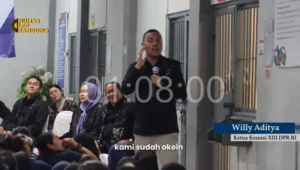
The landscape of modern industrial relations in Indonesia faces a critical paradigm shift, underscored by high-level calls for a transformation in how corporate entities view their workforce. Chief of the Indonesian National Police (Polri), General Listyo Sigit Prabowo, has publicly urged companies nationwide to fundamentally alter their perspective on labor. Speaking directly to thousands of workers and labor union representatives, the nation’s top law enforcement official emphasized that laborers must no longer be viewed merely as expendable production tools. Instead, they should be elevated to the status of invaluable corporate assets, strategic business partners, and integral members of the corporate family.
This profound statement was delivered during the Grand Consolidation event hosted by the Federation of Indonesian Metal Workers Unions (FSPMI) at the MM2100 Industrial Town in Cikarang, West Java. The event drew massive crowds of industrial workers, regional labor leaders, and stakeholders from various manufacturing sectors. General Sigit’s remarks arrive at a pivotal juncture for Indonesia’s labor ecosystem, as the country navigates post-pandemic economic recovery, global supply chain volatility, and ongoing legislative debates concerning minimum wage policies, job security, and worker welfare.
Reimagining Industrial Harmony: The Core Philosophy
At the heart of General Sigit’s address is the principle that a healthy industrial ecosystem relies on mutual interdependence rather than adversarial dynamics. For decades, traditional labor-management relations in many developing manufacturing hubs have been characterized by tension, periodic strikes, protracted wage negotiations, and mutual distrust. Corporate management has frequently prioritized short-term profit margins and cost minimization, sometimes at the expense of labor rights and workplace safety. Conversely, labor unions have often perceived management as exploitative, leading to an inherently defensive posture among workers.
General Sigit argued that this dichotomous mindset is obsolete and counterproductive. By reframing laborers as foundational assets, companies acknowledge that human capital is the primary driver of innovation, operational efficiency, and long-term sustainability. Furthermore, treating workers as strategic partners implies that they have a legitimate stake in the strategic trajectory and operational success of the enterprise. When workers are embraced as part of the corporate family, institutional loyalty deepens, turnover rates decline, and the psychological contract between employer and employee is significantly strengthened.
The Kapolri elaborated that the sustainability of a business enterprise and the welfare of its labor force are not mutually exclusive interests that must constantly compete for dominance. On the contrary, these two objectives must run parallel and reinforce one another. A thriving, profitable company provides the economic foundation necessary to offer competitive wages, comprehensive benefits, and robust job security. Simultaneously, a highly motivated, healthy, and productive workforce generates the high-quality output required for a company to remain competitive in both domestic and international markets.
Background and Context of the FSPMI Grand Consolidation
The setting for this significant address—the MM2100 Industrial Town in Bekasi—holds profound symbolic and economic weight. As one of the largest and most concentrated industrial zones in Southeast Asia, Bekasi hosts thousands of domestic and multinational manufacturing corporations, ranging from automotive and electronics to heavy machinery and textile industries. It is also a historic stronghold for organized labor in Indonesia, frequently serving as the epicenter for nationwide labor mobilizations, minimum wage advocacy, and collective bargaining campaigns.
The FSPMI, one of the most influential labor confederations in the country, organized this grand consolidation to evaluate labor conditions, strategize for upcoming policy advocacy, and reinforce solidarity among its members. The presence of the Kapolri at such a high-profile labor gathering is part of a broader, sustained effort by the Indonesian National Police to engage directly with labor unions, maintain public order through proactive communication, and position law enforcement as an impartial mediator rather than a coercive force during industrial disputes.
In recent years, the relationship between police authorities and labor organizations has undergone a noticeable transformation. Historically, large-scale labor demonstrations were frequently met with heavy-duty security deployment, barricades, and, in severe cases, physical confrontations. However, under General Sigit’s leadership, Polri has increasingly adopted a humanistic and communicative approach to managing public assemblies and labor demonstrations. This strategy involves open dialogue, early coordination with union leaders, and the facilitation of peaceful expressions of grievance, thereby minimizing the potential for civil unrest while protecting critical national infrastructure and economic activities.
Data and Economic Realities of Indonesia’s Labor Sector
To fully comprehend the weight of the Kapolri’s assertions, one must examine the broader economic and demographic data defining Indonesia’s labor landscape. According to data from Statistics Indonesia (BPS), the nation’s labor force participation rate remains high, with tens of millions of individuals engaged in the formal and informal sectors. The manufacturing sector alone absorbs a massive share of formal wage earners, contributing significantly to the national Gross Domestic Product (GDP).
However, structural challenges persist. Despite consistent economic growth averaging around 5 percent annually, issues concerning wage stagnation, the proliferation of outsourcing arrangements, and vulnerabilities related to contract labor continue to fuel anxiety among workers. The cost of living in major industrial clusters such as Greater Jakarta (Jabodetabek)—which includes Bekasi, Karawang, and Tangerang—frequently outpaces minimum wage adjustments, generating continuous friction between labor unions and the Indonesian Employers Association (Apindo).
Economic analysts note that shifting corporate culture toward treating workers as family and partners can yield measurable macroeconomic benefits. Companies that invest heavily in vocational training, workplace safety, fair compensation, and employee well-being consistently report lower absenteeism, reduced recruitment costs due to lower employee turnover, and higher productivity indices. In an era where global investors increasingly scrutinize Environmental, Social, and Governance (ESG) criteria, labor practices have become a critical metric. Multinational corporations sourcing from Indonesian industrial zones are under mounting pressure from international consumers and institutional investors to ensure fair labor standards throughout their supply chains. Consequently, General Sigit’s call aligns closely with global best practices in corporate governance and ethical business conduct.
Reactions and Stakeholder Perspectives
The discourse initiated by General Sigit at the MM2100 Industrial Town has elicited varied responses from key stakeholders across the industrial spectrum, including labor union representatives, corporate management associations, and labor rights observers.
Labor leaders have cautiously welcomed the Kapolri’s remarks, viewing them as a powerful endorsement of their long-standing demands for dignity, fair treatment, and industrial democracy. FSPMI representatives expressed appreciation for the high-level recognition of workers’ vital contributions to the national economy. However, union officials emphasized that philosophical encouragement must be translated into concrete, enforceable policies. They pointed out that while executive rhetoric is encouraging, many workers continue to face structural hurdles, including resistance from certain employers regarding unionization rights, fair overtime compensation, and the arbitrary termination of fixed-term contracts. Unions have called upon the government to strengthen labor inspections and penalize corporate actors who violate statutory labor regulations.
On the employer side, representatives from business associations acknowledged the validity of viewing workers as valuable assets, noting that progressive companies have already adopted human-centric management models. Modern manufacturing increasingly relies on advanced technology, robotics, and automation, which requires a highly skilled, engaged, and technologically literate workforce. Consequently, treating workers as mere interchangeable cogs is no longer viable in high-tech manufacturing environments. Nevertheless, corporate representatives also highlighted the economic pressures businesses face, including fluctuating global demand, inflation, rising energy costs, and complex regulatory compliance burdens. Business leaders argued that achieving the ideal balance between worker welfare and corporate profitability requires a collaborative regulatory environment where the government provides fiscal incentives, infrastructure support, and legal certainty.
Implications for the Future of Indonesian Industrial Relations
The broader implications of General Sigit’s address extend far beyond a single union gathering in West Java. By framing labor relations through the lens of national stability and economic partnership, the National Police leadership is actively reinforcing the nexus between security, social justice, and economic development.
When industrial disputes are handled through constructive dialogue, mutual respect, and the recognition of workers’ fundamental rights, the likelihood of disruptive strikes and economic paralysis diminishes significantly. This stability is vital for maintaining investor confidence. Foreign Direct Investment (FDI) depends heavily on predictability, legal certainty, and social harmony. If international investors perceive that Indonesia possesses a mature industrial relations system where disputes are resolved amicably and labor is treated as a strategic asset rather than a liability, the nation’s attractiveness as a premier manufacturing hub will be substantially enhanced.
Furthermore, this policy stance complements recent international recognitions. It is noteworthy that General Sigit Prabowo and the Indonesian National Police have previously received accolades from international labor organizations for their progressive approach to managing labor affairs and safeguarding workers’ rights during public mobilizations. These international acknowledgments reflect a growing global awareness of Indonesia’s efforts to harmonize economic growth with labor protection.
Conclusion
In conclusion, General Listyo Sigit Prabowo’s address at the FSPMI Grand Consolidation serves as a timely reminder that the economic future of Indonesia depends profoundly on the dignity and well-being of its workforce. By challenging companies to transition from traditional, hierarchical labor management to a partnership model built on mutual respect and familial integration, the Kapolri has outlined a strategic roadmap for sustainable industrial relations.
As Indonesia strives toward its long-term economic development targets, bridging the gap between corporate profitability and labor welfare will remain an indispensable imperative. The challenge moving forward will lie in the effective implementation of these ideals across all levels of enterprise management, supported by consistent government oversight, robust legal protections, and an unwavering commitment to industrial justice.