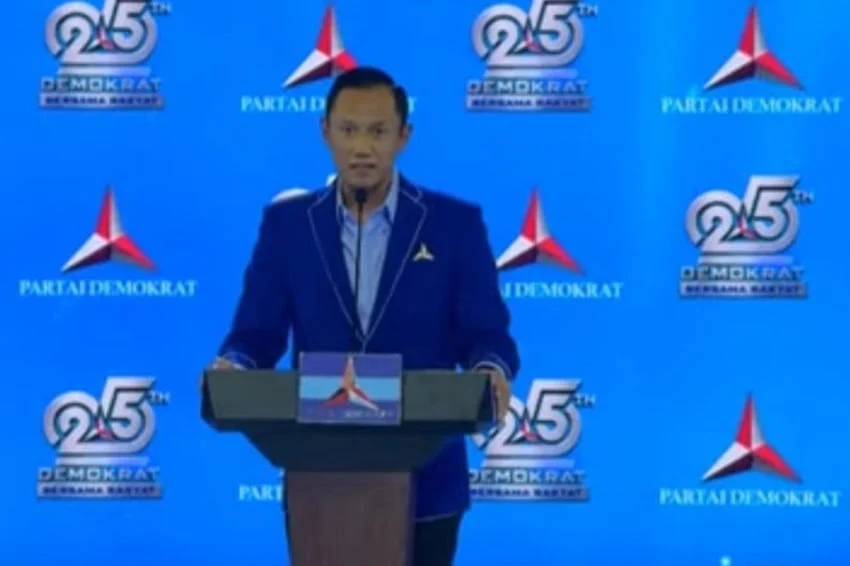
JAKARTA — In a striking display of political reconciliation and strategic alignment, Democratic Party (Partai Demokrat) Chairman Agus Harimurti Yudhoyono delivered a landmark keynote address during the grand celebration marking the 25th anniversary of the party’s founding. The high-profile event, held at the sprawling Indonesia Arena in Central Jakarta on Wednesday, September 9, 2026, brought together key figures from across Indonesia’s diverse political landscape, most notably President Prabowo Subianto.
Against the backdrop of a dynamic and frequently polarized political ecosystem, Yudhoyono used the silver jubilee platform to emphasize that while political parties naturally maintain distinct ideological colors and identities, all political entities ultimately share a singular, overriding commitment to the Red and White flag of the Indonesian republic. His address served as both a reflection on a quarter-century of the party’s journey and a forward-looking appeal for sustained national cohesion following competitive electoral cycles.
The silver jubilee celebration drew heavyweights from nearly every major political faction in the country, symbolizing a concerted push toward national stability and collaborative governance under the current administration. The presence of President Prabowo Subianto underscored the strengthening ties between the ruling coalition and the Democratic Party, which has transitioned from a formidable opposition force into a core stakeholder in the nation’s legislative and executive agenda.
Main Facts of the Silver Jubilee Gathering
The 25th-anniversary celebration of the Democratic Party was meticulously organized to project an image of maturity, resilience, and unity. The Indonesia Arena was packed with thousands of party loyalists, regional cadres, lawmakers, and invited dignitaries, all gathered to commemorate the party’s formal establishment on September 9, 2001, by former President Susilo Bambang Yudhoyono.
At the heart of the proceedings was Chairman Agus Harimurti Yudhoyono’s address, which pivoted heavily on the themes of democratic maturity, political tolerance, and collective national interest. Addressing the audience directly in the presence of President Prabowo, AHY remarked on the kaleidoscope of political colors represented within the arena and across the nation.
"Tentu kita punya warna masing-masing," AHY stated during his speech, acknowledging the multicolored spectrum of Indonesia’s political parties. "Ada warna merah, ada warna hijau, ada warna kuning, ada juga warna biru, oranye, putih, birunya pun ada yang muda ada yang tua. Dan saya kira Bapak Presiden adalah orang yang sangat ahli untuk membuat semua warna itu bisa duduk bersama."
Translated into the context of modern Indonesian statecraft, AHY’s metaphor highlighted the coexistence of diverse political platforms—spanning nationalist, Islamic, and secular ideologies—while arguing that partisanship must yield to statecraft when addressing national challenges. He specifically pointed out that regardless of whether a party identifies with red, green, yellow, orange, or various shades of blue, the ultimate loyalty of every political actor must be anchored in the red and white of Indonesia.
Furthermore, AHY used the international and domestic platform to elaborate on the true meaning of democratic consolidation. He asserted that safeguarding democracy extends far beyond the mechanics of holding periodic elections. True democracy, according to the Democratic Party leader, requires continuous stewardship of institutional norms, mutual respect for ideological differences, the preservation of societal fraternity, and, crucially, the capacity of political rivals to work together after the ballots have been counted and the competition has concluded.
Chronology and Historical Context of the Democratic Party
To fully understand the significance of the Democratic Party’s 25th anniversary, it is necessary to examine the trajectory of the party since its inception in the early reform era. Founded in late 2001 by a group of intellectuals, retired military officers, and reform-minded politicians centered around Susilo Bambang Yudhoyono, the party was officially registered ahead of the 2004 general elections.
The chronology of the Democratic Party is defined by distinct political eras:
- 2001–2004 (Inception and Rise): Formed as a vehicle for Susilo Bambang Yudhoyono’s presidential aspirations, the party capitalized on public desire for stability, clean governance, and moderate leadership amid the post-Suharto transition period.
- 2004–2014 (The Golden Decade): Following SBY’s historic victory in the 2004 presidential election—and his subsequent landslide re-election in 2009—the Democratic Party enjoyed a decade at the apex of Indonesian politics, controlling the presidency and securing a significant plurality in the House of Representatives (DPR) during the 2009 legislative elections.
- 2014–2024 (The Opposition and Reconstruction Years): Following the conclusion of SBY’s constitutional two terms, the party entered a period of political recalibration. Transitioning into an opposition role during the administration of President Joko Widodo, the party focused on grassroots rebuilding, generational leadership transition, and positioning itself as a constructive critic on economic and social policies. Under the leadership of AHY, who assumed the chairmanship in 2020, the party navigated internal restructuring and prepared for a return to national prominence.
- 2024–2026 (Return to Executive Power): The alignment with Prabowo Subianto’s presidential campaign marked a major turning point. By joining the winning coalition in the 2024 elections, the Democratic Party successfully reintegrated into the central architecture of executive governance, culminating in this milestone 25th-anniversary celebration attended by the sitting head of state.
Supporting Data and Political Dynamics
The convergence of political elites at the Indonesia Arena reflects broader structural shifts in Indonesia’s contemporary legislative environment. Coalition politics has long defined the archipelago’s governance model, requiring broad-based consensus among disparate parties to ensure legislative stability.
Data from the General Elections Commission (KPU) and the People’s Consultative Assembly (MPR) underscore the fragmentation of the Indonesian party system. With multiple parties consistently crossing the parliamentary threshold, no single political organization commands an absolute majority. Consequently, appeals for cross-party cooperation, such as those articulated by AHY, are not merely rhetorical flourishes but functional necessities for effective governance.
During the same event, mutual appreciation between the current administration and the Democratic Party hierarchy was prominently on display. Observers noted the symbolic weight of President Prabowo Subianto’s prior remarks praising SBY and the Democratic Party for their statesmanship during their years outside the ruling coalition. Prabowo publicly lauded the party for maintaining a constructive approach to opposition, refraining from destructive rhetoric or personal vitriol even when holding views divergent from the government of the day. This historical context reinforces the narrative of institutional continuity and mutual respect that both political camps are eager to project.
Official Responses and Allied Perspectives
Reactions from various political factions represented at the anniversary event highlighted a growing consensus regarding the need for national unity in the face of global economic uncertainties and geopolitical shifts. Senior representatives from coalition-partner parties—spanning nationalist and religious platforms—praised AHY’s emphasis on the Red and White ideology.
Legislative analysts and political scientists observing the event noted that AHY’s speech was carefully calibrated to position the Democratic Party as a stabilizing centrist force. By emphasizing that partisan competition must have a definitive endpoint, the Democratic leadership aims to appeal to an increasingly pragmatic electorate that prioritizes economic development, social welfare, and bureaucratic efficiency over prolonged ideological confrontation.
Furthermore, party insiders indicated that the silver jubilee served as a strategic launching pad for the party’s preparations for the upcoming electoral cycles, signaling to both domestic constituents and international observers that the Democratic Party is unified, disciplined, and deeply embedded in the nation’s governance structure.
Broader Impact and Strategic Implications
The implications of the 25th-anniversary gathering extend far beyond the pomp of a milestone celebration. As Indonesia navigates complex domestic reforms and positions itself as a major economic player in the Indo-Pacific region, political stability remains a primary prerequisite for sustained foreign investment and economic growth.
By publicly championing a philosophy of inclusive governance where "all political colors" can sit together at the table of national development, leaders like AHY and President Prabowo are signaling to the international community that Indonesia’s democracy remains resilient, mature, and capable of managing internal diversity without descending into destabilizing polarization.
The emphasis on putting national interests above partisan affiliations addresses long-standing concerns regarding political factionalism. If the spirit of cooperation highlighted during the Democratic Party’s silver jubilee successfully translates into legislative harmony and policy execution, Indonesia may well experience a period of heightened institutional effectiveness.
Ultimately, the event at the Indonesia Arena on September 9, 2026, will be remembered not only as a celebration of a political party’s silver anniversary but as a reaffirmation of the core principles binding the Indonesian state: a recognition of diversity encapsulated in the national motto, anchored firmly beneath the shared banner of the Red and White.