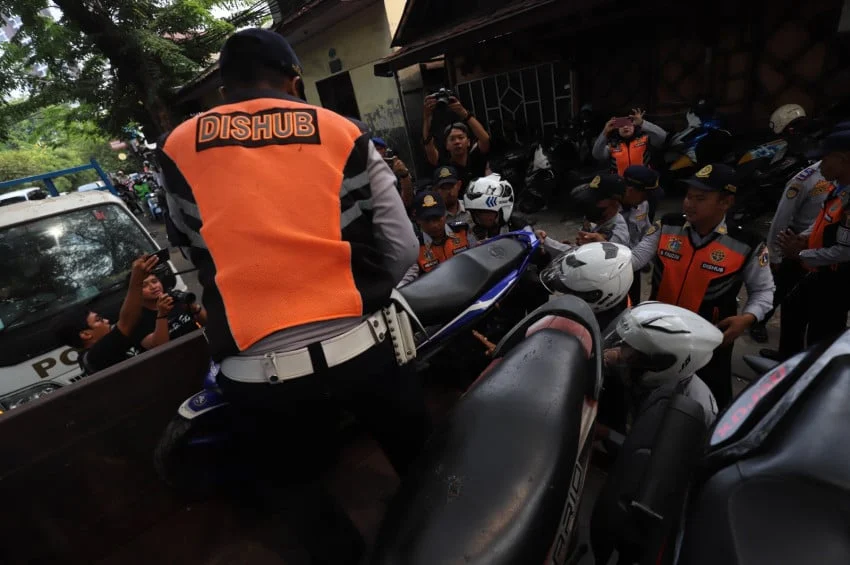
The relentless pursuit of urban order and traffic fluidity in the Indonesian capital reached a localized peak on Monday, October 26, 2026, as the South Jakarta Transportation Department (Suku Dinas Perhubungan Jakarta Selatan) executed a sweeping enforcement operation against illegal parking. Focusing primarily on chronic bottlenecks and heavily congested commercial corridors, municipal authorities clamped down on motorists who flagrantly disregarded traffic regulations by abandoning their two-wheeled vehicles on pedestrian walkways and public thoroughfares. A total of 13 motorcycles were impounded during the midday sweep, underscoring the ongoing struggle of metropolitan authorities to maintain public space integrity against persistent parking violations.
The operation, which commenced at approximately 1:30 PM local time, was not merely a routine patrol but a direct response to mounting civic frustration. Municipal officials deployed a robust, multi-agency task force equipped with specialized transport vehicles to purge unauthorized parking from two distinct hotspots: Jalan KH Muhammad Syafi’i Hadzami—adjacent to the bustling Gandaria City commercial complex—and the vibrant commercial strip of Jalan Melawai Raya. By the conclusion of the targeted sweep, 11 motorcycles had been hauled away from the Gandaria area, while an additional two vehicles were confiscated along Melawai Raya. All impounded units were subsequently transported to the South Jakarta Transportation Department’s operational headquarters located at Kavling 45–46 Jalan MT Haryono, where owners must complete formal administrative procedures and potentially settle fines to retrieve their property.
Chronology of the Operation and Tactical Deployment
Planning for Monday’s intervention began days in advance, synthesized from a continuous stream of digital grievances logged by local residents. The execution phase was meticulously organized to maximize efficiency and minimize localized traffic disruption while catching violators off guard.
At 1:30 PM, a combined force of 22 personnel assembled for the deployment. The operation was characterized by a high degree of inter-agency cooperation, integrating officers from the South Jakarta Transportation Department, the Kebayoran Lama District Transportation Implementation Unit (Satpelhub), the Military Police (POM TNI), and the Jakarta Satpol PP (Municipal Police). This collaborative framework was deemed necessary to deter potential confrontation and ensure the smooth execution of the law.
The task force arrived unannounced at the first target zone, Jalan KH Muhammad Syafi’i Hadzami. This road, flanked by high-density retail developments and commercial hubs, frequently experiences severe vehicular slowdowns exacerbated by motorists seeking to bypass official parking structures by leaving their motorcycles haphazardly on sidewalks. Within a relatively short operational window, enforcement teams systematically documented, lifted, and loaded 11 non-compliant motorcycles onto transport trucks.
Following the clearance of the Gandaria sector, the mobile unit redeud to Jalan Melawai Raya, a legacy commercial district known for its narrow lanes and heavy pedestrian foot traffic. Despite the presence of clear signage prohibiting stopping and parking, motorists had left vehicles directly obstructing pedestrian pathways. Two additional motorcycles were hoisted onto operational trucks before the task force wrapped up its fieldwork and returned to the MT Haryono facility.
The Catalyst: Citizen Engagement through Digital Governance
The genesis of this targeted crackdown highlights a broader evolution in Jakarta’s urban governance model, which increasingly relies on citizen-sourced intelligence to prioritize municipal interventions. Ebenezer L. Tobing, the Control Section Head for the South Jakarta Transportation Department, revealed that the operation was directly initiated in response to numerous complaints submitted by the public via official digital channels.
Specifically, citizens utilized the Jakarta Kini (JAKI) super-app and the Cepat Respons Masyarakat (CRM)—a unified rapid response system designed to channel public grievances directly to relevant government agencies. The digitalization of complaint filing has transformed how municipal departments allocate their limited resources, shifting enforcement from arbitrary patrols to data-driven, demand-led operations.
"This enforcement action is our rapid response to the complaints voiced by local residents through the JAKI application," Ebenezer stated when confirming the details of the operation. He emphasized that the unauthorized occupation of public spaces by parked vehicles extends beyond mere administrative infraction. "The presence of illegal parking not only disrupts overall traffic order but actively triggers severe congestion and strips pedestrians and other road users of their fundamental rights to safe, unhindered passage."
By leveraging citizen reports, the transportation department can identify micro-locations experiencing chronic violations that might otherwise escape the notice of routine patrols. This feedback loop between the populace and local government serves as an essential mechanism for accountability in a sprawling megacity where municipal oversight resources are perpetually stretched.
Multi-Agency Logistics and Enforcement Assets
Executing a successful parking enforcement operation in a congested urban environment requires specialized logistical support and coordinated manpower. The South Jakarta Transportation Department deployed a comprehensive array of assets to ensure the operation could proceed swiftly and securely without paralyzing surrounding traffic.
The 22-person joint task force relied on a diverse fleet of operational vehicles designed for extraction and traffic management. The deployment included:
- Two heavy-duty towing trucks (kendaraan derek) capable of removing larger obstructions if necessary, though the primary focus remained on two-wheeled transport.
- Two mobile patrol cars (mobil patroli) used for site scouting, perimeter security, and coordinating movements between sectors.
- Two transport trucks (truk angkut) specifically outfitted with secure holding beds to safely haul multiple impounded motorcycles back to the headquarters without causing damage.
- One patrol motorcycle (motor patroli) utilized for rapid navigation through dense traffic jams to scout ahead and secure staging areas.
The inclusion of Military Police (POM TNI) personnel alongside municipal enforcers is a standard protocol in high-density Indonesian urban operations designed to deter resistance and underscore the legal authority of the state. Meanwhile, Satpol PP officers provided crucial ground-level crowd control, managing curious onlookers and ensuring that local vendors or motorists did not interfere with the towing process.
Broader Context and Urban Implications
The crackdown in Gandaria and Melawai reflects a chronic, city-wide battle against structural indiscipline in Jakarta’s transportation ecosystem. Despite the expansion of mass rapid transit systems and the construction of dedicated parking facilities across the capital, illegal street parking remains a persistent systemic challenge.
Motorists frequently resort to impromptu street parking to avoid the hourly tariffs charged by commercial parking structures, or simply to secure a proximity advantage when visiting retail establishments, street vendors, or office buildings. This behavior carries profound externalities for the broader urban populace. When sidewalks—designed to offer safe, elevated refuge for non-motorized commuters—are converted into makeshift parking lots, pedestrians are forced onto active vehicular roadways, dramatically increasing the risk of traffic accidents and pedestrian fatalities.
Furthermore, illegal parking acts as a severe bottleneck on road capacity. On corridors like Jalan KH Muhammad Syafi’i Hadzami and Jalan Melawai Raya, the unauthorized occupation of even a single traffic lane effectively reduces the road’s throughput by 30 to 50 percent during peak hours. This reduction generates a cascading accordion effect, where slowing vehicles cause tailbacks that ripple through connecting arterial networks, ultimately compounding the city’s macro-level congestion crisis and elevating urban carbon emissions from idling engines.
Economic and Administrative Penalties
For motorists whose vehicles are hauled away by the South Jakarta Transportation Department, the consequences extend far beyond the inconvenience of retrieving their property. The impoundment process involves navigating a bureaucratic procedure designed to impose a deterrent financial and temporal cost.
Vehicles taken to the Department’s headquarters on Jalan MT Haryono are subjected to administrative processing under regional transportation bylaws. Owners must present proof of ownership—such as the vehicle registration certificate (STNK)—and settle administrative fines. In Jakarta, the legal framework governing illegal parking permits authorities to levy maximum administrative storage and towing fees for vehicles impounded from public roads and sidewalks.
Transport analysts and urban planners generally view these punitive measures as necessary, albeit reactive, tools in managing urban mobility. However, experts continuously debate whether sporadic crackdowns alone can fundamentally alter commuter behavior. Long-term solutions often require a multi-pronged approach that combines aggressive enforcement with infrastructure enhancements, such as increasing the availability of affordable, secure vertical parking for motorcycles, improving last-mile connectivity to public transit hubs, and implementing smart-parking sensor technologies that allow automated ticketing without requiring physical towing assets.
Future Outlook for Traffic Enforcement in South Jakarta
Following the success of Monday’s operation, officials from the South Jakarta Transportation Department have signaled that similar targeted interventions will continue indefinitely across other known infraction zones. Neighborhoods housing entertainment districts, traditional markets, and commercial complexes remain under heightened surveillance.
The integration of the JAKI and CRM platforms into everyday enforcement workflows ensures that the public will play an ongoing, active role in dictating municipal patrol priorities. As long as citizens continue to document and report spatial violations through digital channels, transportation authorities will be compelled to respond with visible, on-the-ground interventions.
Ultimately, the enforcement action in Gandaria and Melawai serves as a stark reminder of the delicate balance between urban commerce, individual convenience, and collective public order. Until a cultural shift toward absolute respect for public space takes root among all road users, municipal towing operations will remain an indispensable fixture of daily life in the Indonesian capital, preserving the fragile equilibrium of Jakarta’s congested streets and sidewalks.