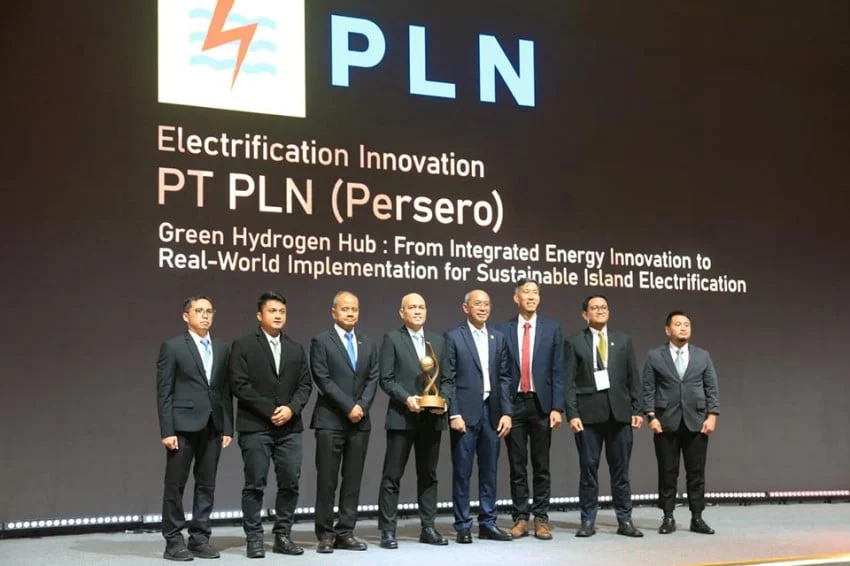
PT PLN (Persero) has officially solidified its position as a frontrunner in national energy innovation by securing a prestigious accolade at the Danantara Technology Innovation Investment Forum (DTIIF) 2026. The forum, which took place in Jakarta from October 26 to October 28, 2026, served as a global stage to showcase Indonesia’s advancements in sustainable energy infrastructure. The state-owned electricity provider was specifically recognized for its pioneering dual-track success: the sophisticated implementation of the Green Hydrogen Hub by its Research and Development division (PLN Puslitbang) and the successful deployment of the Green Energy Ecosystem Technopark (GEET) in the remote Pulau Rengit.
The recognition highlights a critical pivot in Indonesia’s energy strategy, moving from conventional grid reliance to a decentralized, technology-driven model capable of meeting the unique geographical challenges of an archipelago. By integrating cutting-edge research with grassroots infrastructure deployment, PLN has demonstrated that sustainable energy is not merely a theoretical goal but a practical solution for regional development.
The Significance of the DTIIF 2026
The Danantara Technology Innovation Investment Forum is a high-level event designed to bridge the gap between technological research and investment viability. As global energy markets transition toward decarbonization, DTIIF 2026 focused on how state-owned enterprises could lead the "green transition" without compromising grid stability or economic accessibility.
For PLN, the forum provided a platform to present the tangible outcomes of its research-to-market pipeline. The jury and industry observers praised the company for its ability to scale complex laboratory concepts—such as hydrogen production and micro-grid management—into operational utilities that serve actual households. This success reflects a broader policy shift in Indonesia, which emphasizes "energy self-reliance" (Energi Berdikari) as a core pillar of the national agenda.
Green Hydrogen: Paving the Way for Future Energy
At the core of PLN’s award-winning portfolio is the Green Hydrogen Hub developed by PLN Puslitbang. In the context of the global energy transition, hydrogen is increasingly viewed as the "missing link" for decarbonizing heavy industries and providing long-term energy storage.
The PLN Puslitbang facility functions as a comprehensive ecosystem for research, testing, and development. It is designed to act as a catalyst for hydrogen technology adoption in Indonesia, providing the necessary infrastructure to test electrolysis efficiency, storage safety, and grid integration. By developing this hub, PLN is essentially future-proofing the national power grid, ensuring that as solar and wind energy become more prevalent, the intermittency of these sources can be mitigated through hydrogen-based energy storage solutions.

Industry experts note that PLN’s investment in this research facility is not merely an academic exercise; it is a strategic move to lower the cost of green hydrogen production in Indonesia. By fostering local technical expertise, PLN is reducing dependence on foreign technology, thereby improving the nation’s energy sovereignty.
Transforming Pulau Rengit: A Model for Archipelago Electrification
While the Green Hydrogen Hub represents the "future" of PLN’s portfolio, the Green Energy Ecosystem Technopark (GEET) in Pulau Rengit represents the "present" reality of inclusive growth. Pulau Rengit, like many of Indonesia’s thousands of islands, historically struggled with the limitations of geography. Before the intervention of the GEET program, residents were limited to a mere 12 hours of electricity per day, typically reliant on expensive and carbon-intensive diesel generators.
The deployment of the GEET system has effectively doubled the availability of electricity to 24 hours a day. This is a monumental shift for the local community. Reliable, around-the-clock power is the foundational requirement for economic development. With 24-hour electricity, small-scale businesses—such as cold storage for local fishermen, digital communication hubs, and micro-processing units—can now operate throughout the day.
The technopark approach involves integrating local renewable resources—likely a hybrid combination of solar, battery energy storage systems (BESS), and perhaps wind—into a centralized management system. This ensures that the energy supply is not only reliable but also environmentally sustainable. By moving away from diesel-based generation, PLN is also significantly lowering the operational costs and logistics burdens associated with transporting fuel to remote island outposts.
Chronology of Implementation
The success in Pulau Rengit was not an overnight achievement but the result of a deliberate, multi-phased strategy:
- Initial Assessment (2024): Identification of Pulau Rengit as a candidate for the GEET pilot program based on its high dependency on limited-hour diesel power.
- Infrastructure Design (2025): Engineering the micro-grid integration, balancing renewable generation against local load requirements.
- Deployment and Testing (Early 2026): Installation of the smart grid and renewable energy assets, followed by rigorous performance testing to ensure grid stability.
- Operational Launch (Mid-2026): Full transition to 24-hour service, marking the end of the trial phase and the beginning of consistent, sustainable power delivery.
- Recognition (October 2026): Awarding of the DTIIF honor, confirming the model’s viability for wider rollout.
Implications for the National Energy Landscape
The dual successes recognized at DTIIF 2026 suggest that PLN is successfully balancing its dual mandates: acting as a commercial entity that requires efficiency, and a public service provider that must ensure universal access to electricity.
The implications of the Pulau Rengit model are particularly significant for Indonesia’s 3T regions (Terdepan, Terluar, Tertinggal—Frontier, Outermost, and Underdeveloped). If the GEET model can be successfully replicated across other islands, it would solve one of the most stubborn challenges in Indonesian development: how to provide high-quality, sustainable electricity to communities that are geographically isolated from the main national grids.

Furthermore, the integration of Green Hydrogen research into the PLN roadmap provides a roadmap for Indonesia to become a regional leader in the hydrogen economy. As the global demand for green hydrogen increases, Indonesia’s ability to leverage its renewable energy potential to produce this "fuel of the future" could turn the nation into an energy exporter, shifting the current energy balance.
Official Perspective and Future Outlook
While specific statements from individual executives were not released at the forum, the consensus among industry analysts is that PLN’s strategy is shifting toward "decentralized innovation." By empowering its research and development arm to work in tandem with regional field operations, the company is shortening the feedback loop between innovation and implementation.
"The award at DTIIF 2026 serves as validation that the technological investments made by PLN are beginning to yield tangible dividends," said an industry analyst familiar with the forum’s proceedings. "The shift from 12-hour to 24-hour electricity in a remote area like Pulau Rengit is a powerful metric of success that goes beyond the balance sheet. It is a direct measure of improved quality of life and expanded economic potential."
Looking forward, the focus for PLN will likely remain on scaling these solutions. With the success of the Pulau Rengit technopark, the pressure will be on to identify the next set of islands for similar upgrades. Simultaneously, the Green Hydrogen Hub will likely face the challenge of moving from pilot-scale research to industrial-scale production.
Conclusion
The recognition of PT PLN (Persero) at the DTIIF 2026 marks a significant milestone in Indonesia’s energy history. By prioritizing innovative, sustainable, and inclusive energy solutions, the company has proven that it can address the complex needs of a vast archipelago. The transition from limited, fossil-fuel-dependent power to a 24-hour green energy model in Pulau Rengit, combined with forward-looking investments in hydrogen technology, positions PLN as a key player in the global energy transition. As the nation continues to move toward its net-zero goals, the lessons learned from these projects will undoubtedly form the blueprint for a cleaner, more resilient, and more equitable energy future for all Indonesians.