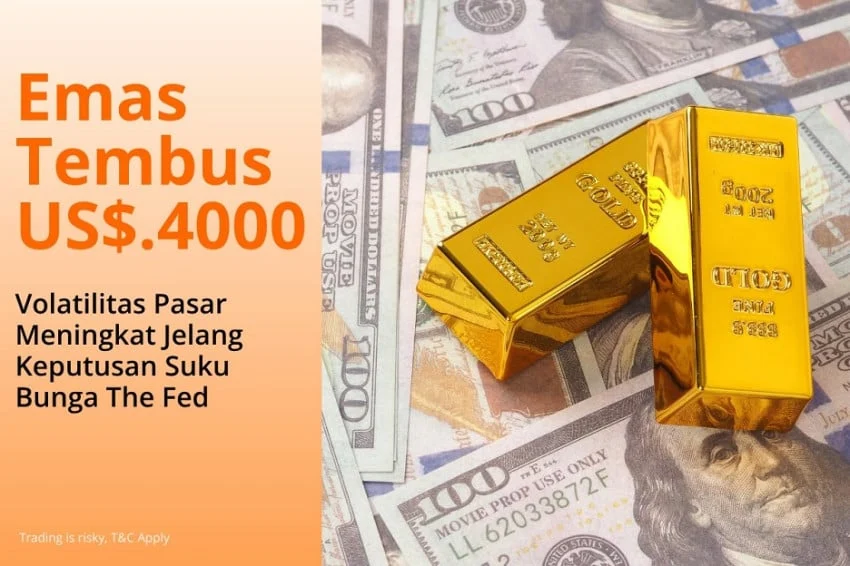
The global financial markets are currently bracing for a pivotal week as investors closely monitor the upcoming Federal Open Market Committee (FOMC) meeting scheduled for October 27–28, 2026. In the days leading up to this critical policy decision, gold prices—often regarded as the ultimate safe-haven asset—experienced a notable dip, briefly breaking below the significant psychological threshold of USD 4,000 per troy ounce. This fluctuation has drawn intense scrutiny from market analysts and institutional observers, including Firewoodfunded, who have highlighted the heightened volatility currently permeating the global financial landscape.
The Anatomy of Recent Gold Market Volatility
Gold has long served as a hedge against inflation and economic uncertainty. However, its recent performance reflects a complex interplay between macroeconomic data and shifting investor sentiment. The breach of the USD 4,000 level was not merely a technical movement; it was a manifestation of the "wait-and-see" approach adopted by global traders.
As of late October 2026, the precious metal has faced downward pressure due to several concurrent factors. First, the resilience of the United States economy has forced market participants to recalibrate their expectations regarding the trajectory of interest rates. Second, the strength of the US Dollar, often inversely correlated with gold, has kept the metal under consistent pressure throughout the week. When the dollar appreciates, gold—priced in that currency—becomes more expensive for holders of foreign currencies, thereby dampening demand.
CBOE Volatility Index (VIX) and Market Sentiment
Adding to the complexity of the current market environment is the performance of the CBOE Volatility Index, commonly known as the "fear gauge." On Friday, October 23, 2026, the VIX index climbed above the level of 20. In financial markets, a VIX reading above 20 is historically interpreted as an indication of elevated market anxiety and an expectation of significant turbulence in the S&P 500.
The rise in the VIX suggests that investors are not only concerned about interest rate decisions but are also hedging against broader systemic risks. For gold, the VIX surge is a double-edged sword. While gold typically benefits from market fear, the current environment has seen liquidity preferences shift toward the US Dollar and short-term Treasury securities, which are currently offering competitive yields that compete with non-yielding assets like gold.
Chronology of the 2026 Monetary Policy Landscape
The lead-up to the October 2026 FOMC meeting did not occur in a vacuum. Throughout the third quarter of 2026, the Federal Reserve maintained a stance of "data-dependent" policy, emphasizing that decisions would be made based on incoming labor market reports and inflation metrics.
- Early Q3 2026: Markets anticipated a steady transition toward monetary easing; however, persistent consumer price index (CPI) figures caused the Federal Reserve to adopt a more hawkish tone.
- September 2026: Initial discussions regarding the "neutral rate" surfaced, causing fluctuations in the bond market.
- Mid-October 2026: Geopolitical tensions in secondary markets contributed to a temporary surge in gold prices, pushing them toward the USD 4,000 mark.
- Late October 2026: The market began pricing in the possibility that the Fed might maintain higher rates for longer, triggering the recent dip in gold prices.
This timeline underscores the sensitivity of precious metals to the communication strategies employed by the Federal Reserve’s leadership.
Institutional Perspectives and Market Analysis
Analysts at Firewoodfunded and other financial institutions have noted that the current volatility is likely to persist until the FOMC statement is released on October 28. The primary focus for institutional investors is the "dot plot" and the commentary from Federal Reserve Chair regarding the outlook for 2027.
"The current movement in gold is a reflection of the market’s struggle to find a equilibrium in an environment of high-interest rates and economic uncertainty," noted one senior market analyst. "While the long-term fundamentals for gold remain strong—driven by central bank demand and structural debt concerns—the short-term price action is dominated by the search for yield."

Indeed, recent reports indicate that several nations have been actively diversifying their foreign exchange reserves, with many central banks increasing their physical gold holdings. This strategic shift serves as a structural floor for gold prices, preventing more drastic declines even during periods of high interest rate expectations.
The Impact of U.S. Treasury Yields
The relationship between the 10-year U.S. Treasury yield and gold cannot be overstated. As the U.S. economy shows signs of continued growth, Treasury yields have remained elevated. For gold, which does not pay interest or dividends, high Treasury yields represent an "opportunity cost." Investors are forced to decide between the safety of gold and the guaranteed return provided by government-backed securities.
The recent dip below USD 4,000 was largely triggered by a move in the 10-year yield, which enticed institutional capital to move out of commodities and into fixed-income assets. However, market observers warn that this trend is reversible. Should the upcoming Fed meeting suggest even a slight softening of the monetary stance, gold could see a rapid recovery.
Broader Economic Implications
Beyond the immediate price of gold, the current market climate has broader implications for global finance. The trend of central banks "repatriating" or increasing their gold reserves—a topic that has gained significant traction in 2026—suggests a growing skepticism regarding the long-term stability of fiat-dominated reserve systems.
The trend of nations pulling gold back from U.S. custody, which has been observed as being at roughly half the level of the historic peaks seen in the 1970s, indicates a shift in global monetary strategy. This movement is not merely symbolic; it represents a tactical move to mitigate the risks associated with the weaponization of financial systems and currency devaluation.
What to Watch for in the FOMC Announcement
As the October 27–28 meeting approaches, market participants are looking for three key indicators:
- The Interest Rate Decision: Whether the committee opts for a hold or a surprise adjustment.
- The Forward Guidance: Clearer communication regarding the pace of policy normalization in the coming fiscal year.
- Inflation Assessments: Whether the Fed believes the current disinflationary trend is sustainable or if they remain concerned about "sticky" inflation components.
Should the Fed signal that inflation is being successfully contained, we may see a decline in bond yields, which would theoretically act as a catalyst for gold to reclaim its position above the USD 4,000 level. Conversely, if the Fed emphasizes that the "job is not done," gold could face further pressure as investors pivot toward the dollar.
Conclusion: Navigating the Uncertainty
The volatility in gold prices observed this week is a quintessential example of how macroeconomic policy dictates market behavior. For the average investor, the fluctuation serves as a reminder of the inherent risks in the financial markets and the necessity of portfolio diversification.
As we move through the final days of October 2026, the eyes of the financial world remain fixed on Washington. Whether gold settles into a new, higher range or faces a sustained correction will largely depend on the clarity and decisiveness of the Federal Reserve’s forthcoming policy update. Until then, market participants should expect continued price swings, influenced by both technical trading and the psychological weight of an uncertain economic future. With the VIX hovering at elevated levels, the message to investors is clear: volatility is the new baseline, and caution remains the most prudent strategy in the face of imminent central bank action.