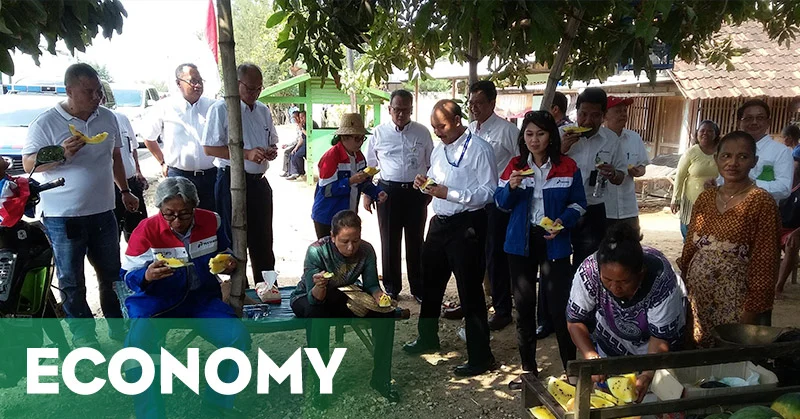
The strategic revival of Indonesia’s domestic energy infrastructure often involves high-stakes inspections, strict protocol, and dense technical evaluations. However, a high-profile working visit to East Java in November 2015 offered a brief window of local cultural engagement before diving into heavy industrial matters. State-Owned Enterprises (SOE) Minister Rini Soemarno, alongside key energy executives and government officials, paused their itinerary to sample local produce from Tuban regency prior to reviewing the long-dormant PT Trans Pacific Petrochemical Indotama (TPPI) refinery.
The lighter moment preceded a critical national inspection led by President Joko Widodo. The facility, which held immense strategic value for Indonesia’s fuel self-sufficiency and petrochemical balance, had spent years struggling with operational inactivity, financial restructuring, and ownership complexities. While the primary objective of the presidential entourage was to assess the operational readiness of the revived plant, the impromptu stop at a local roadside fruit vendor highlighted the human element of high-level state visits to regional industrial hubs.
High-Level Delegation and Strategic Context
The presidential delegation visiting the Tuban facility on Wednesday, November 11, 2015, comprised some of the most influential figures in Indonesia’s economic and energy sectors. Alongside President Joko Widodo—commonly known as Jokowi—were SOE Minister Rini Soemarno, Pertamina President Director Dwi Soetijpto, Pertamina Vice President of Corporate Communication Wianda Pusponegoro, and the Director General of Oil and Gas at the Ministry of Energy and Mineral Resources, IGN Wiratmaja Puja.
The presence of these key decision-makers underscored the gravity of the TPPI inspection. The refinery, located in Tuban, East Java, was viewed by the administration as a critical asset capable of significantly reducing Indonesia’s reliance on imported fuel and petrochemical products. Years of administrative hurdles, debt restructuring complications, and global market volatility had left the facility operating well below capacity or completely idle.
For the administration under President Jokowi, revitalizing stalled strategic infrastructure was a cornerstone economic policy. The TPPI plant represented billions of dollars in sunk capital that, if successfully reintegrated into the state energy supply chain, could save the country substantial foreign exchange reserves and stabilize domestic fuel distribution. Consequently, the visit was not merely ceremonial; it served as a definitive checkpoint to ensure that state-owned energy giant Pertamina had successfully taken operational control and was steering the facility toward full commercial productivity.
A Local Interlude: Sampling Tuban Watermelon
Before entering the heavily guarded gates of the industrial complex, the entourage experienced an unexpected encounter with local residents. As the officials walked through the neighborhood surrounding the industrial perimeter, crowds of local townspeople gathered to catch a glimpse of the president and his ministers, with many seizing the opportunity to take photographs with the high-ranking officials and corporate executives.
Amidst the warm reception from the local community, the delegation made an unplanned stop at a small local roadside stall owned by a resident who sold fresh fruit, notably locally grown watermelons harvested from nearby agricultural fields in Tuban. Rather than rushing past the vendor to adhere to a rigid ministerial schedule, the officials paused to interact with the merchant and examine the produce.
State-Owned Enterprises Minister Rini Soemarno took the lead in engaging the local vendor, enthusiastically inviting her fellow travelers to taste the regional harvest.
"Ayo-ayo coba dulu semangkanya. Enak ini semangkanya," remarking on the high quality and refreshing taste of the local fruit directly to the delegation and surrounding onlookers, as noted during the field visit in Tuban on Wednesday, November 11, 2015.
Other members of the entourage, including Pertamina executives, joined in sampling the sweet, locally grown watermelons. The brief interlude provided a stark contrast to the sterile, high-tech environment of the petrochemical plant awaiting them just down the road. After finishing several slices of the fresh fruit and exchanging pleasantries with the vendor and local residents, the delegation resumed its journey toward the TPPI facility gates.
Chronology of the TPPI Revitalization
The background of the PT Trans Pacific Petrochemical Indotama facility is marked by a complex history of financial distress, legal entanglements, and eventual state intervention. Understanding the timeline of events leading up to the November 2015 presidential inspection clarifies why the revival of the Tuban plant was treated as a matter of national economic urgency.
Established in the mid-1990s, the TPPI project was envisioned as a massive integrated petrochemical and refining complex designed to produce paraxylene, benzene, high-octane mogas component (HOMC), and diesel fuel. However, construction and subsequent commercial operations were severely disrupted by the 1997–1998 Asian Financial Crisis. The project faced mounting debts, shareholder disputes, and prolonged delays in securing a steady feedstock of condensate.

By the late 2000s and early 2010s, the plant operated sporadically under various private and quasi-state management structures, frequently halting production due to cash flow problems and unpaid debts to upstream suppliers, particularly state-owned oil and gas company Pertamina. The impasse created a severe domestic supply bottleneck, forcing Indonesia to import large volumes of refined fuels and petrochemical feedstocks that TPPI was originally designed to supply locally.
A major turning point occurred in 2015 under the administration of President Joko Widodo. Recognizing the drain that the idle facility placed on the national trade balance, the government orchestrated a rescue plan centered around Pertamina. Through a series of corporate actions, debt-to-equity swaps, and court-supervised restructuring agreements, Pertamina gradually assumed control of the facility’s management and financial obligations.
By late 2015, the plant was undergoing a critical operational restart. The November 11 inspection led by President Jokowi and Minister Rini Soemarno served as a physical verification that condensate processing had resumed and that the complex was on track to re-enter commercial supply chains.
Economic Implications and Strategic Value
The resumption of operations at the Tuban petrochemical complex carried profound economic implications for Indonesia. At the macro level, the successful restart of the facility directly impacted the country’s current account deficit by curbing reliance on costly refined product imports.
Prior to Pertamina’s takeover and the subsequent restart, Indonesia imported significant quantities of fuel and petrochemical raw materials to feed downstream industries. By bringing the TPPI refinery back online, the state expected to secure a steady domestic supply of aromatic products and automotive fuels, insulating the national economy from international price shocks and exchange rate fluctuations.
Furthermore, the integration of TPPI into Pertamina’s downstream portfolio created operational synergies with the nearby Tuban refining assets. The facility was capable of processing tens of thousands of barrels of condensate per day, translating into millions of liters of finished gasoline and diesel for the domestic market.
Energy analysts noted that the successful turnaround of TPPI also served as a litmus test for the government’s broader strategy of utilizing state-owned enterprises to rescue distressed strategic assets. Rather than allowing critical national infrastructure to remain paralyzed by legal and financial deadlocks, the state leveraged its corporate arm to enforce a pragmatic solution that prioritized energy security over prolonged litigation.
Official Responses and Stakeholder Perspectives
Reactions from government officials, corporate leaders, and industry observers following the inspection reflected cautious optimism regarding the plant’s future.
President Jokowi emphasized during the visit that strategic assets built with national capital must be fully operationalized to serve the public interest rather than sitting idle due to bureaucratic or administrative negligence. The directive signaled a zero-tolerance policy toward stalled state projects, pushing ministries and state-owned enterprises to resolve legacy disputes swiftly.
Minister Rini Soemarno continually championed the operational integration of energy infrastructure under SOE management, arguing that unified control between upstream supply and downstream refining was essential for national energy independence. Her lighthearted interaction with local residents in Tuban mirrored the administration’s broader messaging of accessibility and connection with the grassroots economy, even during heavy industrial inspections.
Pertamina leadership, represented during the tour by President Director Dwi Soetijpto and Vice President of Corporate Communication Wianda Pusponegoro, outlined the technical milestones achieved during the restart phase. Executives noted that rehabilitating the complex required extensive safety checks, mechanical overhauls, and the securing of long-term condensate supply agreements. Despite initial skepticism from financial markets regarding the sheer volume of legacy debt associated with TPPI, Pertamina’s management expressed confidence that the plant would achieve positive cash flow within its initial operational cycles.
Energy economists and industry associations generally praised the intervention, viewing the revival of the Tuban refinery as a necessary step toward achieving long-term fuel self-sufficiency. However, experts also cautioned that sustained success would depend heavily on transparent corporate governance, stable global oil prices, and consistent feedstock supply from both domestic and international sources.
Conclusion
The presidential inspection of the TPPI refinery in Tuban on November 11, 2015, remains a memorable snapshot of Indonesian executive governance—bridging high-stakes national economic policy with simple, localized human moments like sharing fresh regional fruit. Beyond the roadside interlude with Tuban watermelons, the visit marked a pivotal milestone in the resurrection of one of Indonesia’s most troubled yet strategically vital petrochemical facilities. Through decisive state intervention and the operational muscle of Pertamina, the long-dormant plant transitioned from an emblem of stalled potential into a functioning cornerstone of domestic energy security, ultimately reshaping the country’s refining landscape for years to come.