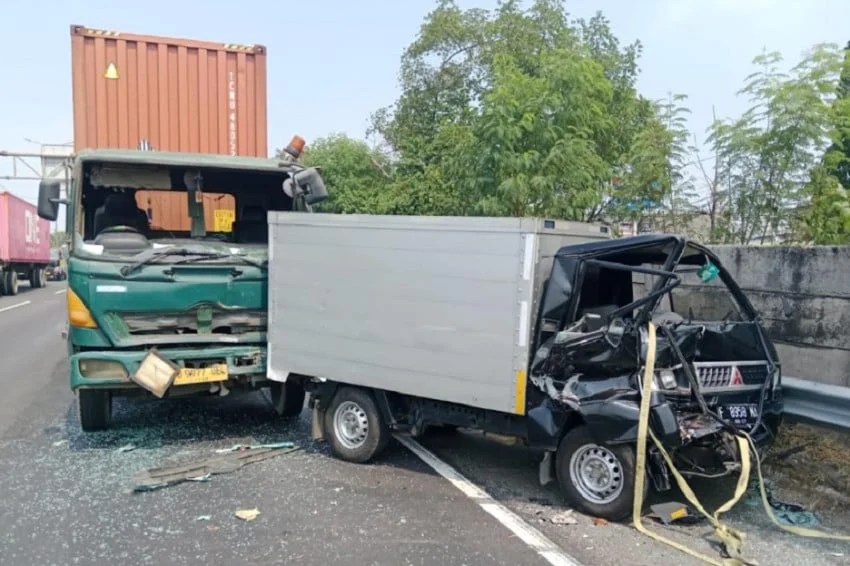
A devastating multi-vehicle collision involving six vehicles on the Bintara-Cakung Toll Road at KM 54.600 A resulted in one fatality and two injuries, highlighting persistent concerns regarding road safety on Indonesia’s heavily trafficked expressways. The incident, which occurred on Saturday, July 18, 2026, at approximately 11:45 AM Western Indonesian Time (WIB), brought traffic to a standstill and initiated a swift emergency response from various agencies. The deceased has been identified as Gandi Sugandi, 59, the driver of one of the involved container trucks. This tragic event underscores the critical need for continuous vigilance, stringent enforcement of traffic regulations, and robust infrastructure maintenance to mitigate the risks associated with high-volume transportation corridors.
The collision involved a complex array of commercial vehicles: a pickup truck, a box truck, two conventional trucks, and two large trailer trucks. The sheer number and varying sizes of the vehicles contributed to the severity of the impact and the challenges faced by first responders. Kasat PJR Polda Metro Jaya, AKBP Rieki Indra Bratamanggala, confirmed the details of the incident and the identities of the victims, emphasizing the immediate focus on victim evacuation and accident investigation. The incident has not only resulted in personal tragedy but also caused significant disruption to a vital transportation artery connecting key industrial and residential areas within greater Jakarta, prompting broader discussions on the multifaceted challenges of ensuring safety on Indonesia’s expanding toll road network.
Chronology of the Tragic Event
The sequence of events leading to the fatal pile-up began shortly before 11:45 WIB on the Bintara-Cakung Toll Road, a segment known for its high traffic volume, particularly from commercial vehicles. Initial reports suggest that the collision originated in the fast lane, though the exact trigger remains under investigation. It is hypothesized that a sudden deceleration by one vehicle, possibly due to a mechanical issue, driver inattention, or an unforeseen obstruction, may have initiated a chain reaction. Given the heavy nature of the vehicles involved—trucks and trailers carrying substantial loads—their longer braking distances and momentum would have made it exceedingly difficult for following vehicles to react in time, especially if safe following distances were not maintained.
At approximately 11:45 WIB, the collision sequence began, rapidly involving the six vehicles. The initial impact likely caused a domino effect, with subsequent vehicles unable to stop or maneuver away from the developing hazard. The significant force generated by the multiple impacts, particularly between the heavy trucks and trailers, caused extensive damage to all vehicles involved. Eyewitness accounts, which are crucial for the ongoing investigation, reportedly described a sudden screech of tires followed by a series of loud crashes.
Emergency services, including the Traffic Unit of Polda Metro Jaya, Jasa Marga (the toll road operator), and local medical teams, were immediately notified. Within minutes, traffic patrols from the PJR (Patroli Jalan Raya) unit were on the scene, securing the area and initiating preliminary assessments. The severity of the collision, particularly the involvement of large commercial vehicles, necessitated a comprehensive response. The initial priority was to extricate any trapped victims and provide immediate medical attention. Tragically, Gandi Sugandi, the 59-year-old driver of one of the container trucks, was pronounced deceased at the scene due to the severe injuries sustained during the impact.
The scene quickly became a focal point for emergency operations. Medical personnel attended to the two injured victims: Hamdan Hidayat, 28, the driver of the pickup truck, who sustained severe injuries, and Jajang Irawan, 28, a truck driver, who suffered minor injuries. Hamdan and Jajang were swiftly transported to RS Mitra Keluarga Jati Asih for urgent medical care. Meanwhile, the body of the deceased, Gandi Sugandi, was carefully recovered and subsequently transported to RS Polri Kramatjati, Jakarta Timur, for further procedures, including post-mortem examination as part of the official investigation. The process of clearing the mangled vehicles and debris from the highway was a complex and time-consuming operation, requiring heavy-duty towing equipment and specialized personnel, causing significant traffic congestion for several hours on the already busy toll road.
Victim Information and Medical Response
The human toll of the collision is significant, with one life lost and two others sustaining injuries of varying degrees. Gandi Sugandi, a 59-year-old container truck driver, tragically succumbed to his injuries at the scene. His passing represents not only a profound loss for his family and loved ones but also highlights the inherent dangers faced by professional drivers who spend countless hours on the road, often under demanding conditions. The immediate priority of the emergency responders was to ensure the respectful handling of the deceased and to provide support to his family through official channels.
The two injured survivors, Hamdan Hidayat (28) and Jajang Irawan (28), received prompt medical attention. Hamdan Hidayat, the driver of the pickup truck, was reported to have sustained severe injuries. Such injuries often require extensive medical treatment, including potential surgeries, rehabilitation, and a long recovery period, which can have significant long-term physical, emotional, and financial impacts. Jajang Irawan, a truck driver, fortunately sustained only minor injuries, indicating that he might have been better protected or positioned within his vehicle during the collision. Both were transported to RS Mitra Keluarga Jati Asih, a medical facility equipped to handle trauma cases. The rapid deployment of medical teams to the accident site and their efficient transfer of the injured to specialized care facilities were crucial in managing the immediate health consequences of the collision. The medical teams at RS Mitra Keluarga Jati Asih are expected to provide detailed updates on the conditions of Hamdan Hidayat and Jajang Irawan as their treatment progresses.
Investigation and Preliminary Findings
The investigation into the precise cause of the multi-vehicle collision is being spearheaded by the Traffic Unit of Polda Metro Jaya, under the supervision of Kasat PJR AKBP Rieki Indra Bratamanggala. This comprehensive inquiry will involve several critical steps to reconstruct the accident and identify contributing factors. Investigators will meticulously examine the accident scene, analyze vehicle damage patterns, and collect physical evidence such as skid marks, debris distribution, and impact points. The condition of the road surface, visibility at the time of the incident, and environmental factors will also be assessed.
A crucial component of the investigation will be the technical inspection of all six vehicles involved. This will ascertain if mechanical failures, such as brake malfunctions, tire blowouts, or steering issues, played a role. Black box data, if available on the commercial vehicles, could provide invaluable information regarding vehicle speed, braking, and driver inputs leading up to the collision. Furthermore, witness testimonies from other drivers on the toll road at the time are being gathered to corroborate initial hypotheses and provide different perspectives on the incident’s dynamics.
Driver behavior is often a significant factor in such multi-vehicle accidents. Investigators will explore possibilities such as speeding, aggressive driving, distracted driving (e.g., mobile phone use), driver fatigue, or failure to maintain a safe following distance (tailgating). Given the involvement of multiple commercial vehicles, adherence to regulations regarding vehicle load limits, driver rest periods, and vehicle maintenance schedules will also come under scrutiny. The findings of this investigation will be critical not only for determining liability but also for informing future policy decisions aimed at preventing similar tragedies.
The Bintara-Cakung Toll Road: A Critical Artery
The Bintara-Cakung segment of the Jakarta Outer Ring Road (JORR) system is one of the most vital and heavily utilized transportation corridors in the greater Jakarta area. It serves as a crucial link for logistics and commuter traffic, connecting various industrial estates, residential areas, and major transportation hubs. The toll road facilitates the movement of goods from ports and industrial zones to distribution centers and consumer markets, making it indispensable for the region’s economy. Consequently, it experiences exceptionally high traffic volumes throughout the day, with a significant proportion comprising heavy commercial vehicles like those involved in this collision.
The characteristics of the Bintara-Cakung Toll Road, including its design, number of lanes, and specific traffic patterns, contribute to its unique safety challenges. While modern toll roads are designed to international safety standards, the sheer density of vehicles, coupled with the varied driving habits of motorists, creates an environment where even minor errors can escalate rapidly into major incidents. The presence of numerous entry and exit points, combined with varying speed limits for different vehicle types, adds further complexity to traffic flow management. Maintaining consistent speeds and safe distances becomes a constant challenge for drivers navigating this bustling expressway. The incident at KM 54.600 A underscores the inherent risks on such high-volume routes and calls for continuous evaluation of road design, traffic management strategies, and driver education initiatives specific to these critical arteries.
Broader Road Safety Landscape in Indonesia
Indonesia consistently faces significant challenges in road safety, with accident rates among the highest in Southeast Asia. According to data from the National Police (Polri) and the Ministry of Transportation, thousands of fatalities and hundreds of thousands of injuries occur annually on Indonesian roads. While there have been efforts to improve road safety through various campaigns and infrastructure development, the growing number of vehicles, particularly motorcycles and commercial trucks, continues to pose substantial risks.
Several factors contribute to Indonesia’s challenging road safety record:
- Driver Behavior: A lack of discipline among drivers, including speeding, aggressive driving, failure to obey traffic signals, and pervasive use of mobile phones while driving, is a primary cause of accidents.
- Vehicle Condition: Many vehicles, especially older commercial trucks and public transport vehicles, may not be regularly maintained, leading to mechanical failures that can precipitate accidents. Overloading of trucks is also a common issue, affecting braking efficiency and vehicle stability.
- Infrastructure: While toll roads generally offer better infrastructure, non-toll roads often suffer from poor lighting, inadequate signage, and uneven surfaces. Even on toll roads, design flaws or insufficient maintenance in certain sections can contribute to hazards.
- Enforcement: Although efforts are made, consistent and stringent enforcement of traffic laws remains a challenge across the archipelago.
- Education: Public awareness campaigns on road safety, while present, need to be intensified and reach a broader audience, emphasizing responsible driving habits and the consequences of negligence.
Multi-vehicle pile-ups, particularly involving heavy vehicles on toll roads, are often more severe due to the kinetic energy involved. The average stopping distance for a fully loaded heavy truck can be significantly longer than that of a passenger car, especially at higher speeds, making rear-end collisions and chain reactions more probable if drivers do not maintain adequate following distances. This specific incident serves as a stark reminder of these systemic issues and the devastating consequences they can entail.
Statements from Authorities and Experts
Following the fatal collision, officials from various government bodies and transportation safety experts have weighed in on the incident and its broader implications.
AKBP Rieki Indra Bratamanggala of Kasat PJR Polda Metro Jaya reiterated the commitment of law enforcement to conduct a thorough and transparent investigation. "Our primary goal is to ascertain the precise cause of this tragic accident, not only to ensure justice for the victims but also to gather critical data that can help prevent similar incidents in the future," he stated. He also emphasized the importance of driver adherence to speed limits and safe following distances, especially on busy toll roads. "Drivers of heavy vehicles, in particular, must be extra vigilant and ensure their vehicles are in optimal condition before embarking on journeys."
A representative from Jasa Marga, the toll road operator, expressed condolences to the victim’s family and the injured. "We are fully cooperating with the police investigation and are reviewing our own protocols for incident response and traffic management," a spokesperson said, requesting anonymity as the investigation is ongoing. "Our priority is always the safety and convenience of road users. We continuously monitor traffic, deploy patrols, and maintain our infrastructure to the highest standards." The spokesperson added that Jasa Marga would also review the specific segment of the road for any contributing factors and consider additional safety measures if deemed necessary by the investigation.
Transportation safety experts have also offered perspectives. Dr. Ir. Budi Hartono, a prominent road safety analyst, commented, "This incident is a grim reminder that despite advancements in road infrastructure, human factors remain the most critical element in road safety. Driver fatigue, distraction, and a lack of awareness about the physics of heavy vehicles in traffic are common culprits in such pile-ups." He advocated for more rigorous driver training programs, especially for commercial vehicle operators, and the wider adoption of advanced driver-assistance systems (ADAS) in trucks. "Policy makers should also explore incentives for companies to invest in safer fleets and for drivers to undergo regular refresher courses on defensive driving techniques," Dr. Hartono added.
From the Ministry of Transportation, a general statement underscored the government’s ongoing commitment to improving road safety across the national network. "Every fatality on our roads is a tragic loss, and we are continuously working with all stakeholders—law enforcement, toll road operators, and transportation companies—to enhance safety measures," a Ministry official noted. "This includes reviewing regulations, investing in smart traffic management systems, and launching public awareness campaigns. We urge all road users to prioritize safety and adhere strictly to traffic laws."
Economic and Social Implications
The multi-vehicle collision on the Bintara-Cakung Toll Road carries significant economic and social implications that extend beyond the immediate human cost. Economically, the immediate impact includes substantial traffic delays. The Bintara-Cakung Toll Road is a critical logistical artery; its blockage for several hours translates directly into lost productivity for businesses, delayed deliveries, increased fuel consumption for vehicles stuck in congestion, and missed appointments for commuters. The economic cost of such delays can run into millions of Rupiah, affecting supply chains and timely goods distribution.
Furthermore, the damage to six commercial vehicles represents a considerable financial loss for the respective transportation companies. This includes the cost of vehicle repairs or replacement, potential loss of cargo, and the indirect costs associated with operational downtime and insurance claims. These expenses can significantly impact the profitability and operational capacity of logistics firms, particularly smaller enterprises. Insurance companies also bear a substantial burden from such large-scale accidents, potentially leading to increased premiums across the sector.
Socially, the incident deeply affects the families of the victims. The death of Gandi Sugandi leaves a void in his family, potentially impacting their financial stability and emotional well-being. The injured survivors, Hamdan Hidayat and Jajang Irawan, face potentially long and arduous recovery processes, which can strain personal finances and mental health. Beyond the direct victims, such high-profile accidents can also trigger a collective sense of unease among regular toll road users and professional drivers, raising anxieties about personal safety on these critical routes. Emergency responders and medical personnel also bear a psychological burden from witnessing and managing traumatic scenes.
The incident also highlights systemic issues within the transportation industry, such as pressures on drivers to meet tight deadlines, which can lead to fatigue and risky driving behaviors. It may also prompt a closer look at the employment conditions and safety protocols within logistics companies operating on these toll roads.
Preventative Measures and Future Outlook
In light of this fatal collision and the broader context of road safety in Indonesia, several preventative measures and future strategies must be intensified.
- Enhanced Enforcement: Stricter and more consistent enforcement of traffic laws, including speed limits, safe following distances, and prohibitions against distracted driving, is crucial. This could involve increased use of automated speed cameras, drone surveillance, and visible police patrols.
- Driver Education and Training: Mandatory advanced training programs for commercial vehicle drivers, focusing on defensive driving techniques, fatigue management, and the specific challenges of operating heavy vehicles on toll roads, should be implemented. Regular refresher courses and licensing re-evaluation could also contribute to improved driver competency.
- Vehicle Maintenance and Inspection: More rigorous and frequent mandatory inspections for commercial vehicles, ensuring their roadworthiness, including brakes, tires, and lighting systems, are essential. Penalties for operating poorly maintained or overloaded vehicles should be severe.
- Smart Infrastructure and Technology: Investment in smart toll road technologies, such as variable message signs providing real-time traffic alerts, intelligent transportation systems (ITS) for congestion management, and advanced warning systems for hazards, can significantly improve safety. The adoption of ADAS (Advanced Driver-Assistance Systems) in new commercial vehicles should be encouraged, if not mandated.
- Public Awareness Campaigns: Continuous and impactful public awareness campaigns targeting all road users about the importance of safe driving habits, respecting traffic rules, and understanding the risks associated with heavy vehicles on toll roads are necessary.
- Review of Road Design: Ongoing reviews of toll road designs, particularly at high-accident zones, to identify and rectify potential flaws that might contribute to accidents. This includes ensuring adequate signage, clear lane markings, and appropriate emergency pull-over areas.
The tragic incident on the Bintara-Cakung Toll Road serves as a potent reminder that road safety is a shared responsibility involving drivers, vehicle owners, law enforcement, toll road operators, and government bodies. While the investigation into this specific event continues, the broader implications demand a renewed, concerted effort to foster a culture of safety on Indonesia’s roads, ensuring that vital transportation arteries remain channels of progress, not peril. The hope is that the lessons learned from this unfortunate event will contribute to substantive changes that ultimately save lives and prevent future tragedies.