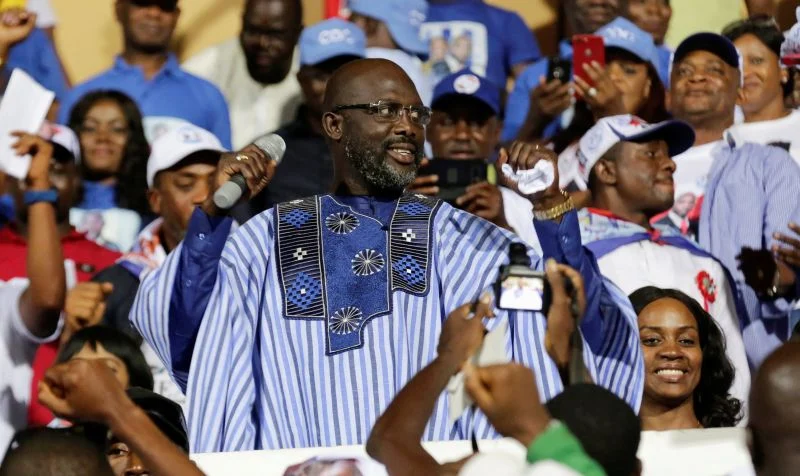
The remarkable journey of George Tawlon Manneh Oppong Ousman Weah, from the dusty football pitches of Monrovia to the pinnacle of global football and ultimately to the highest office in his native Liberia, represents a narrative of extraordinary achievement, unwavering determination, and a profound connection to his homeland. Officially elected as the President of Liberia in December 2017, Weah’s ascent to political leadership followed a storied career that saw him crowned FIFA World Player of the Year in 1995, a testament to his exceptional talent and global impact on the sport.
Weah’s path to the presidency was not a sudden departure from a life of privilege, but rather a culmination of years of dedicated service and a growing awareness of his nation’s challenges. Born on October 1, 1966, in Monrovia, Liberia, his early life was marked by the realities of a developing nation. Yet, even in his youth, a prodigious talent for football began to shine through. He honed his skills on the sandy fields of his hometown, a common practice for aspiring young footballers in many parts of West Africa. This raw talent was first nurtured within local clubs, including Invincible Eleven, Mighty Barolle, Bongrange Bonguine, and Young Survivors of Claretown.
Early Sporting Prowess and European Breakthrough
The sheer talent possessed by young George Weah was evident early on. During his teenage years, he was instrumental in leading Young Survivors, a team that notably operated without a formal coach, to promotion into the top division of Liberian football. This remarkable achievement signaled his leadership qualities and his innate understanding of the game. His burgeoning reputation soon attracted the attention of clubs beyond Liberia’s borders. In 1987, at the age of 21, he signed a three-year contract with Tonnerre of Yaoundé in Cameroon. This move proved to be a significant stepping stone, as he immediately experienced league championship success with his new club, further solidifying his status as a rising star in African football.
The trajectory of Weah’s career continued its upward climb when he was scouted by AS Monaco, a prominent club in the French top division. Joining the French side at the age of 22, he embarked on a five-season spell from 1987 to 1992 that would define his early European career. During this period, Weah showcased his electrifying pace, exceptional dribbling ability, and clinical finishing, netting an impressive 57 goals in 108 appearances. His contributions were not solely individual; he also played a key role in AS Monaco securing the French Cup in 1991, adding a significant piece of silverware to his burgeoning collection.
Stardom at Paris Saint-Germain and AC Milan
Weah’s dynamic style of play, characterized by his relentless work ethic and uncompromising technical skill, did not go unnoticed by other European giants. His reputation for speed and accuracy in front of goal led to a lucrative contract with Paris Saint-Germain (PSG) in 1992. At PSG, Weah cemented his status as a world-class player. He became a talisman for the Parisian club, leading them to victory in the French Cup, the league title, and importantly, a memorable run to the semi-finals of the 1995 UEFA Champions League. His goal-scoring prowess in Ligue 1 was undeniable, with a tally of 37 goals and 3 assists in 123 appearances, making him a beloved figure among the club’s supporters.
The pinnacle of his club career arrived in 1995 when AC Milan, one of Italy’s most prestigious footballing institutions, secured his signature from PSG for a substantial transfer fee. His move to Serie A, a league renowned for its defensive rigor, proved to be a masterstroke. Weah continued to excel, helping AC Milan clinch the Scudetto (Italian league title) in both the 1995-96 and 1998-99 seasons. His time in Italy saw him reach the zenith of his individual achievements. In 114 appearances for the Rossoneri, he scored 51 goals and provided 1 assist, demonstrating his consistent impact on the scoreboard.
Global Recognition and the Ballon d’Or
It was during his highly successful tenure at AC Milan that George Weah’s individual brilliance earned him unprecedented global acclaim. In 1995, his extraordinary performances were recognized when he was awarded the prestigious FIFA World Player of the Year award. This honor, bestowed upon the world’s most outstanding footballer, was a monumental achievement for an African player. The following year, in 1996, he further cemented his legendary status by winning the Ballon d’Or, awarded annually to the best player in Europe. These accolades were not merely individual triumphs; they represented a significant moment for African football on the world stage, highlighting the continent’s burgeoning talent and its ability to compete at the very highest level.
The period between 1995 and 1997 is often considered the peak of Weah’s career, where his name was synonymous with footballing excellence. He was not only a prolific goal-scorer but also a player who inspired millions with his resilience, humility, and commitment to the game. His electrifying performances in Serie A and the Champions League captivated audiences worldwide, and his image became a symbol of hope and aspiration for many, particularly in his home country of Liberia, which had endured periods of civil unrest and economic hardship.
Transition to Politics and Presidential Ambitions
Following his illustrious football career, which also included stints at Manchester City and Chelsea in England, George Weah made a deliberate and significant transition into the realm of politics. This move was not an abrupt change of direction but rather a gradual commitment to serving his nation. His political journey began with an understanding of the socio-economic challenges facing Liberia, a country that had been ravaged by prolonged civil wars in the late 20th century. Weah’s footballing fame provided him with a unique platform and a considerable following, which he leveraged to advocate for change and development.
His initial foray into politics saw him contest the Liberian general election in 2005, running for the presidency. While he did not win on that occasion, his candidacy signaled his serious intent and the deep-seated desire among many Liberians for a new kind of leadership. The election was ultimately won by Ellen Johnson Sirleaf, who became Africa’s first elected female head of state. Despite the setback, Weah continued his political engagement, focusing on grassroots initiatives and youth empowerment programs.
Weah’s political career saw him elected as a senator for Montserrado County in the Liberian Senate in 2014. This experience provided him with valuable insight into the legislative process and the complexities of governance. He continued to articulate his vision for Liberia, emphasizing economic development, job creation, education, and healthcare as key priorities. His campaign message often resonated with the youth and the less privileged segments of society, who saw in him a relatable figure who had risen from humble beginnings.
The 2017 Presidential Election and Victory
The 2017 general election presented George Weah with his second opportunity to vie for the presidency. This time, his campaign was more organized and his message more refined. Running under the banner of the Coalition for Democratic Change (CDC), he faced Vice President Joseph Boakai in the run-off election. The campaign was highly anticipated, with both candidates vying for the support of a nation eager for stability and progress after years of political transitions.
The election results, announced in December 2017, confirmed George Weah’s victory. He secured a significant mandate, winning over 60% of the vote in the run-off election. His triumph was met with widespread jubilation across Liberia and garnered international attention, marking a significant moment in the country’s democratic history. It was the first time in decades that Liberia had witnessed a peaceful transfer of power from one democratically elected president to another, following the two terms of Ellen Johnson Sirleaf.
Implications and Challenges of the Presidency
George Weah’s election as president carried significant implications for Liberia and the broader African continent. His journey from a global sports icon to a national leader embodied a narrative of hope and possibility, demonstrating that individuals from diverse backgrounds could ascend to the highest levels of public service. His presidency offered the potential for a fresh approach to governance, informed by his experiences both on and off the football field.
However, the challenges facing President Weah were immense. Liberia, despite its progress, continued to grapple with widespread poverty, high unemployment rates, and a fragile economy heavily reliant on foreign aid and commodity exports. Rebuilding infrastructure, improving access to education and healthcare, and fostering a climate of transparency and accountability were among the critical tasks that lay ahead. The expectations placed upon him were extraordinarily high, fueled by the widespread admiration he commanded.
A Legacy Beyond the Pitch
George Weah’s story is a compelling testament to the power of talent, perseverance, and a deep-seated commitment to one’s community. His transition from a celebrated footballer to a head of state is a rare and remarkable feat, highlighting the potential for individuals to impact society in multiple spheres. While his footballing achievements are etched in the annals of sporting history, his presidency marks a new chapter, one where he aims to translate his lifelong dedication and leadership qualities into tangible improvements for the people of Liberia. The world watches with keen interest as he navigates the complexities of leading a nation, carrying with him the hopes and aspirations of millions who have long admired his journey. His success or failure in office will undoubtedly shape the future trajectory of Liberia and serve as a powerful case study for the role of former athletes in national leadership.