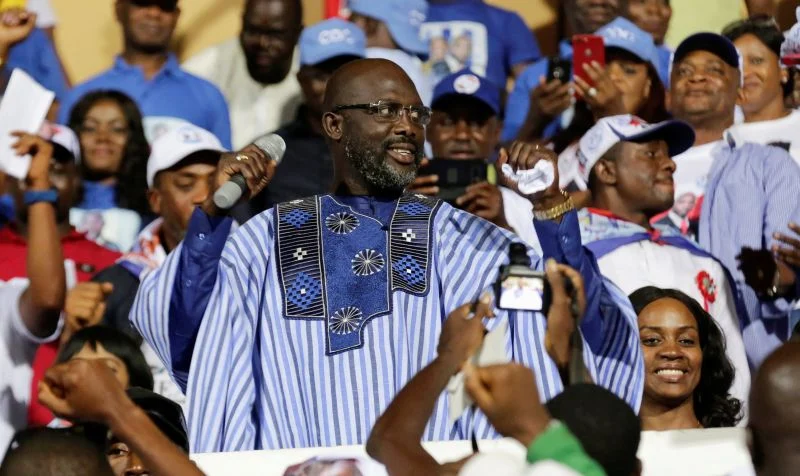
Liberia’s presidential election in December 2017 marked a historic transition, not just for the West African nation, but for the global sporting world. George Tawlon Manneh Oppong Ousman Weah, a name synonymous with footballing brilliance and celebrated as the 1995 FIFA World Player of the Year, officially stepped onto the political stage, elected as the country’s new president. This remarkable journey from the roar of packed stadiums to the solemn duties of state leadership underscores a life dedicated to excellence, resilience, and a profound commitment to his homeland.
Weah’s ascent to the presidency was the culmination of a political career that began after he hung up his boots. His transition from a celebrated athlete to a political figure resonated deeply in Liberia, a nation yearning for transformative leadership after years of civil conflict and economic hardship. His campaign, often characterized by its grassroots appeal and promises of reform, tapped into a deep well of hope among the Liberian populace.
Born on October 1, 1966, in Monrovia, Liberia’s capital, Weah’s early life was steeped in the raw, unpolished passion of street football. The sandy pitches of his hometown were his initial training ground, a far cry from the manicured lawns of professional stadiums. It was here that his innate talent for the sport began to blossom. Before making his mark on the international scene, he honed his skills with local Liberian clubs, including Invincible Eleven, Mighty Barolle, Bongrange Bonguine, and Young Survivors of Claretown. These formative years instilled in him a fierce determination and an understanding of the struggles faced by ordinary Liberians.
Even as a teenager, Weah demonstrated a leadership quality that would later define his presidency. He was instrumental in guiding Young Survivors, a team reportedly operating without a formal coach, to promotion into the top division of Liberian football. This early success foreshadowed his ability to inspire and galvanize others, even in challenging circumstances.
His prodigious talent did not remain confined to Liberia for long. In 1987, at the age of 22, he signed a three-year contract with Tonnerre of Yaoundé, a prominent club in Cameroon. It was in Cameroon that he first experienced the taste of championship success, winning the top-tier league title. This achievement served as a stepping stone, attracting the attention of European clubs eager to harness his electrifying skills.
The French Ligue 1 beckoned, and AS Monaco secured his services. Weah’s five seasons with Monaco, from 1987 to 1992, were a period of significant growth and impact. He netted an impressive 57 goals during his tenure, showcasing his prolific scoring ability. Beyond individual accolades, he also contributed to team success, helping Monaco clinch the French Cup in 1991. His dynamic playing style, characterized by blistering pace, exceptional ball control, and a powerful shot, began to captivate audiences across Europe.
Weah’s relentless work ethic and uncompromising technical prowess soon earned him a lucrative contract with Paris Saint-Germain (PSG). His move to the French capital in 1992 marked another significant chapter in his career. At PSG, he further solidified his reputation as a world-class striker, contributing significantly to the club’s fortunes. He was a key figure in PSG’s triumphs, including winning the Coupe de France, securing the league title, and reaching the semi-finals of the UEFA Champions League in 1995. In Ligue 1, he amassed 37 goals and provided 3 assists in 123 appearances, demonstrating his consistent impact.
The year 1995 proved to be a watershed moment for George Weah. His outstanding performances for PSG and his pivotal role in their European campaign earned him the ultimate individual accolades in the football world. He was crowned the FIFA World Player of the Year, a monumental achievement for an African player at the time, and also secured the prestigious Ballon d’Or, awarded to the best player in Europe. These awards were not merely personal triumphs; they were a testament to the growing global recognition of African football talent and a source of immense national pride for Liberia.
His stellar form in France attracted the attention of Italian giants AC Milan, who acquired his services in 1995 for a substantial transfer fee. His move to Serie A, widely regarded as one of the most competitive leagues in the world, further tested his mettle. Weah continued to shine, playing a crucial role in AC Milan’s Scudetto victories in the 1995-1996 and 1998-1999 seasons. His time at the San Siro saw him score 51 goals and provide 1 assist in 114 appearances, cementing his legacy as one of the most impactful foreign players in Serie A history. During his AC Milan spell, he was also named the Serie A Footballer of the Year in 1996.
Weah’s international career also saw him represent Liberia with distinction. He captained the Liberian national team, known as the Lone Stars, and played a vital role in their qualification campaigns for the Africa Cup of Nations. His commitment to his national team, despite the demanding schedule of club football, highlighted his deep sense of patriotism.
Following his illustrious playing career, which also included brief stints with Chelsea and Manchester City in England before concluding in the United Arab Emirates, Weah turned his attention to the political arena. His decision to enter politics was driven by a desire to contribute to the rebuilding and development of Liberia, a nation that had endured decades of civil war and political instability.
His political journey was not without its challenges. He first ran for the presidency in 2005, but was defeated by Ellen Johnson Sirleaf. Undeterred, Weah continued to engage with the Liberian people, building his political base and refining his message. He founded the Congress for Democratic Change (CDC) party, which became a significant political force in the country. His platform consistently focused on issues such as poverty reduction, education, healthcare, and tackling corruption – perennial challenges that have plagued Liberia.
The 2017 presidential election was a closely watched event, both within Liberia and internationally. Weah faced incumbent Vice President Joseph Boakai in a run-off election. His campaign resonated with a younger generation of Liberians who had grown up amidst the aftermath of conflict and sought a leader who embodied hope and change. His slogan, "Change for Hope," became a powerful rallying cry.
The election results, announced in December 2017, confirmed Weah’s victory, with over 61% of the vote. The international community, including former football stars and sporting organizations, largely welcomed the news, seeing it as a positive development for Liberia and a unique testament to the influence of sports figures in public life.
Background Context: Liberia’s Path to Democracy
Liberia’s history is marked by periods of significant upheaval. Founded by freed American slaves in the 19th century, it was the first African republic to declare its independence. However, the nation was plunged into a brutal civil war that lasted from 1989 to 2003, leaving hundreds of thousands dead and displacing millions. The subsequent period has been characterized by efforts to rebuild institutions, foster reconciliation, and establish stable democratic governance.
The election of Ellen Johnson Sirleaf in 2005, the first female head of state in Africa, was a landmark moment in Liberia’s post-war recovery. Her tenure saw significant strides in rebuilding the nation, but also highlighted the persistent challenges of poverty and economic development. The 2017 election represented Liberia’s third democratic election since the end of the civil war, a crucial step in solidifying its democratic foundations. Weah’s victory was seen by many as a mandate for fresh leadership and a new direction for the country.
Chronology of George Weah’s Journey:
- 1966: Born in Monrovia, Liberia.
- 1980s (early): Plays for local Liberian clubs, developing his footballing talent.
- 1987: Signs with Tonnerre of Yaoundé (Cameroon), wins league title.
- 1988-1992: Plays for AS Monaco (France), scores 57 goals, wins French Cup (1991).
- 1992-1995: Plays for Paris Saint-Germain (France), wins Coupe de France, league title, reaches Champions League semi-finals.
- 1995: Wins FIFA World Player of the Year.
- 1996: Wins Ballon d’Or, named Serie A Footballer of the Year.
- 1995-2000: Plays for AC Milan (Italy), wins Serie A titles (1996, 1999).
- 2000-2001: Plays for Chelsea (England).
- 2001: Plays for Manchester City (England).
- 2001-2002: Plays for Al-Jazira (UAE).
- 2004: Retires from professional football.
- 2005: Runs for President of Liberia for the first time, loses to Ellen Johnson Sirleaf.
- 2014: Elected as a Senator for Montserrado County.
- 2017: Elected President of Liberia.
Supporting Data and Analysis:
Weah’s transition from sports to politics is not entirely unprecedented, though the scale of his success as a global football icon is unique. Globally, several athletes have transitioned into political careers, often leveraging their public profiles and perceived integrity to gain popular support. Examples include Manny Pacquiao in the Philippines and Vitali Klitschko in Ukraine, who have both held significant political offices.
The implications of Weah’s presidency for Liberia are substantial. His victory signals a desire for change and a break from the established political elite. His background as a common man who rose to global prominence offers a narrative of possibility and aspiration for many Liberians. However, the challenges he faces are immense. Liberia, despite its resource potential, struggles with widespread poverty, a nascent economy, and the need for significant investment in infrastructure and human capital.
His administration will need to demonstrate tangible improvements in the lives of ordinary citizens to maintain public trust. Key areas of focus will likely include job creation, improving educational outcomes, strengthening healthcare systems, and combating corruption. Weah’s ability to forge alliances, both domestically and internationally, will be critical to securing the necessary resources and expertise to address these complex issues.
Official Responses and Broader Impact:
The election of George Weah was met with widespread congratulatory messages from world leaders, international organizations, and fellow athletes. United Nations Secretary-General António Guterres, speaking through his spokesperson, welcomed the peaceful conduct of the elections and expressed readiness to support Liberia’s development efforts. The Confederation of African Football (CAF) issued a statement hailing Weah’s victory as an inspiration for aspiring athletes across the continent.
The broader impact of Weah’s presidency extends beyond Liberia’s borders. His journey serves as a powerful symbol of hope and the potential for individuals from humble beginnings to achieve extraordinary success. It highlights the increasing influence of sports personalities in public life and their capacity to mobilize support for social and political change. For Africa, his presidency represents a continuation of the continent’s democratic progress and a testament to the growing leadership potential emerging from its diverse populations.
In conclusion, George Weah’s transformation from a footballing legend to the President of Liberia is a compelling narrative of ambition, resilience, and dedication. His election represents a pivotal moment for Liberia, offering a fresh perspective and a renewed sense of hope. The coming years will be critical in determining whether his presidency can translate the global admiration he garnered as a footballer into lasting positive change for his nation. His journey underscores the profound connection between sport, public service, and the aspirations of a people yearning for a brighter future.