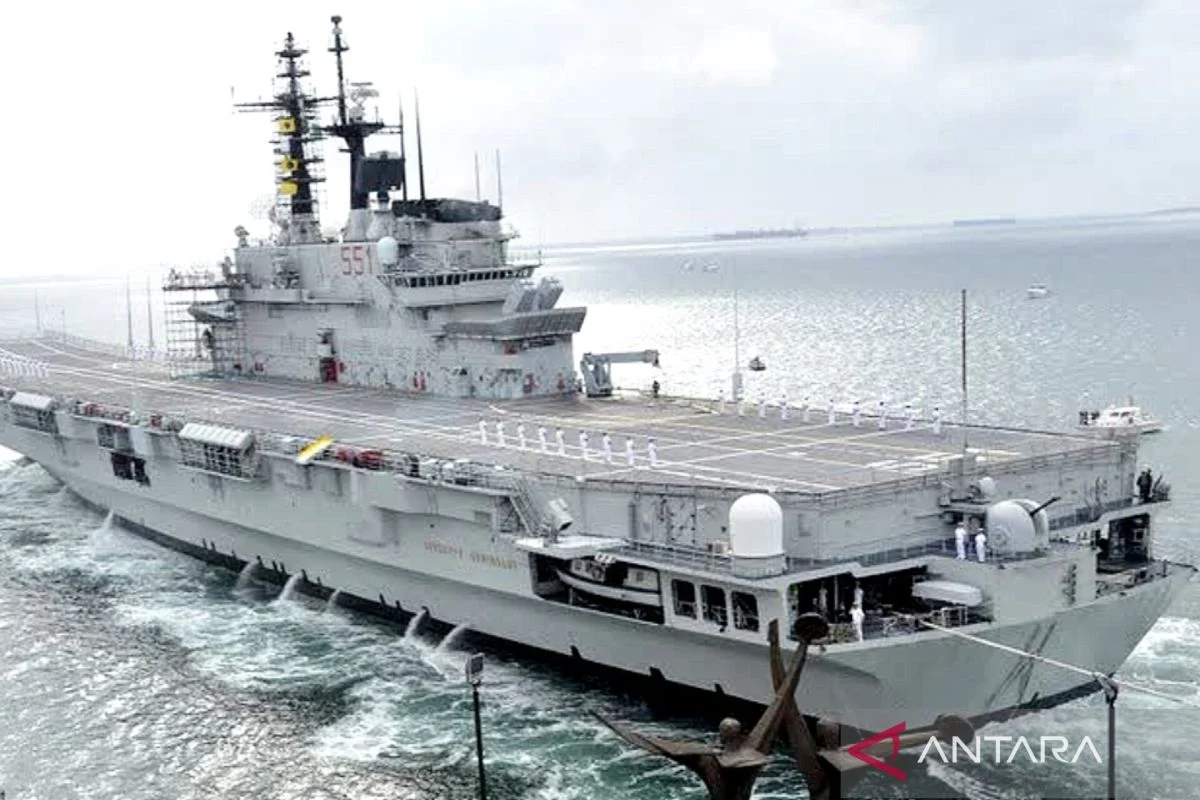
The maritime landscape of Southeast Asia is set for a historic transformation as the Italian aircraft carrier ITS Giuseppe Garibaldi began its long-range transit from Italy to Indonesia on August 24, 2026. This monumental deployment marks the beginning of a new chapter for the Indonesian Navy (TNI Angkatan Laut), as the vessel is slated to be commissioned as the nation’s first-ever aircraft carrier, under the new designation KRI Gajah Mada. The arrival of this flagship, expected in mid-September 2026, represents a significant leap in Indonesia’s naval projection capabilities and regional security posture.
Chief of Staff of the Indonesian Navy, Admiral Muhammad Ali, confirmed that the vessel is currently navigating a complex maritime route spanning more than 20 days. The transit involves passage through the Suez Canal and the Red Sea, escorted by a task force of Italian frigates to ensure the vessel’s safety during its transition from Mediterranean waters to the Indonesian archipelago. This transition is not merely a transfer of hardware but a strategic shift in the naval doctrine of the world’s largest archipelagic nation.
Chronology of the Acquisition and Deployment
The roadmap for this acquisition has been meticulously planned through high-level government-to-government cooperation between Jakarta and Rome. Following the departure from Italy in late August, the ship is scheduled to undergo final inspection and handover protocols upon its arrival in Indonesian territorial waters.
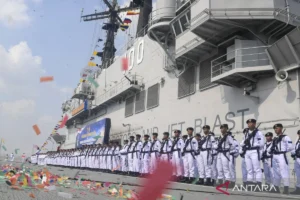
The transition process will culminate on September 25, 2026, when the Italian colors will be lowered for the final time and the Indonesian Merah Putih will be hoisted. This ceremony, marking the official rechristening of the vessel to KRI Gajah Mada, is expected to be attended by high-ranking officials from both nations, underscoring the strengthening of bilateral defense ties. By early October 2026, the vessel is already slated to make its public debut, participating in the prestigious sailing pass ceremony for the 81st anniversary of the Indonesian National Armed Forces (TNI).
Engineering and Technical Specifications
The Giuseppe Garibaldi is a testament to late 20th-century naval engineering, constructed at the Cantieri Navali di Monfalcone shipyard in Italy. Since its launch on June 4, 1983, the ship has served as a cornerstone of the Italian Marina Militare. With a full-load displacement of 13,850 tons, the ship strikes a balance between agility and sustained endurance.
The vessel measures 180.2 meters in length, with a flight deck spanning 173.8 meters, providing sufficient space for Short Take-Off and Vertical Landing (STOVL) operations. The ship’s propulsion system, a sophisticated COGAG (Combined Gas and Gas) arrangement, utilizes four FIAT/GE LM-2500 gas turbines. This power plant generates over 80,000 horsepower, distributed across two shafts, allowing the carrier to achieve a top speed of 30 knots—a critical factor for rapid force projection in the vast Indonesian maritime territory. With an operational range of 7,000 nautical miles, the ship is designed to sustain long-duration deployments across the Indian and Pacific Oceans.
Air Wing Capabilities and Tactical Flexibility
At the heart of the vessel’s utility is its capacity to host a versatile air wing. Depending on mission requirements, KRI Gajah Mada can accommodate between 18 and 20 aircraft. The flight deck is optimized for the operation of rotary-wing assets, including the EH101, SH90A, and AB212 helicopters, which are essential for anti-submarine warfare (ASW), search and rescue (SAR), and utility transport.
Furthermore, the integration of the AV-8B Plus Harrier II provides the Indonesian Navy with organic fixed-wing tactical air support. This capability transforms the carrier from a mere logistics vessel into a mobile command and control hub. By providing an integrated air-sea umbrella, the carrier enhances the Navy’s ability to conduct surveillance, maritime domain awareness, and precision strikes against surface threats, effectively extending the reach of Indonesia’s sovereign territory.
Defensive Systems and Operational Resilience
Beyond its offensive air capabilities, the vessel is equipped with a robust suite of defensive systems. The ship features an eight-cell launcher for Aspide surface-to-air missiles, providing a defensive buffer against aerial threats. Close-in protection is facilitated by three DARDO weapon systems, each equipped with Breda 40/70 cannons, designed to neutralize incoming cruise missiles or small, fast-moving surface craft.
The ship is designed to be operated by a complement of 825 personnel, including crew and air wing staff. This human element is vital for the vessel’s function as a command ship. The integration of advanced electronic warfare suites and passive defense measures ensures that the ship remains survivable in contested environments, a requirement that has become increasingly important given the current geopolitical climate in the South China Sea and the wider Indo-Pacific region.
Infrastructure and Strategic Implications
The Indonesian government is not merely acquiring a ship; it is investing in the infrastructure necessary to sustain such a massive asset. The Navy has been fast-tracking the construction of a dedicated carrier base in Lampung, which serves as a strategic gateway to the Sunda Strait. This facility is designed to handle the logistical demands of a ship of this magnitude, including specialized docking, maintenance workshops, and secure refueling capabilities.
The implications of this acquisition are far-reaching. For the Indonesian military, it represents a realization of the "Blue Water Navy" ambition. By possessing an aircraft carrier, Indonesia elevates its status as a regional security provider. The vessel is expected to be utilized not only for combat operations but also as a centerpiece for humanitarian assistance and disaster relief (HADR) missions. Given Indonesia’s vulnerability to natural disasters, the ship’s ability to act as a floating hospital and logistics command center is invaluable.
Domestic Industry and Technology Transfer
A significant point of discussion within the Indonesian House of Representatives (DPR) is the necessity for technology transfer. Legislators have emphasized that the acquisition must serve as a catalyst for the domestic defense industry. By working closely with Italian counterparts, Indonesian naval engineers and shipyard technicians are expected to gain critical insights into the maintenance, lifecycle management, and modernization of large-scale naval vessels.
This knowledge transfer is viewed as essential for the long-term sustainability of the Indonesian defense industry. If Indonesia can master the complexities of operating and maintaining the KRI Gajah Mada, the technical expertise gained will be pivotal for future indigenous naval construction projects. The Ministry of Defense has confirmed that the project is designed to stimulate the domestic industrial base, ensuring that the ship remains an asset of the Indonesian people for decades to come.
A New Era of Indonesian Naval Power
As the KRI Gajah Mada continues its transit, the eyes of the global maritime community are turned toward Indonesia. The vessel is scheduled to serve as a platform for VVIPs, signaling the ship’s importance in diplomatic missions and international naval exercises.
With its combination of speed, reach, and multi-domain capabilities, the KRI Gajah Mada is poised to redefine Indonesia’s naval strategy. While the vessel is a veteran of the Italian Navy, its life under the Indonesian flag will focus on protecting the nation’s vast maritime interests and contributing to regional stability. The arrival of this ship in September 2026 will undoubtedly be remembered as a landmark moment in the history of the Indonesian Armed Forces, marking the official entry of the nation into the elite circle of global powers that project influence from the sea.
The successful integration of the KRI Gajah Mada into the Indonesian fleet will require rigorous training and seamless coordination between the surface, subsurface, and air elements of the Navy. However, the foundational capabilities provided by the former Giuseppe Garibaldi provide a solid platform upon which the Indonesian Navy can build its future, ensuring the sovereignty and security of the archipelagic state for years to come.