
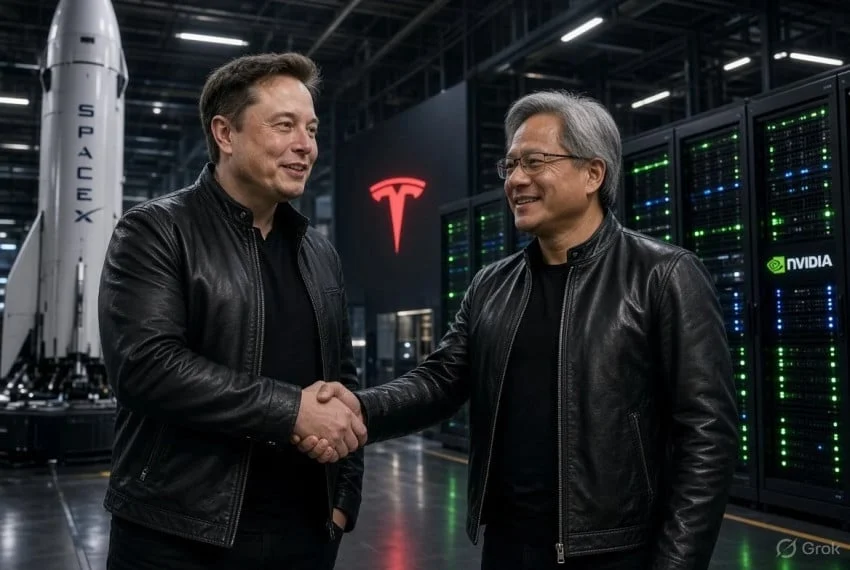
The global technology sector was thrust into a state of high-level speculation this week following a series of digital exchanges and media reports suggesting that Jensen Huang, the long-standing CEO of semiconductor giant Nvidia, could face an imminent departure from his role. The situation intensified after a Wall Street Journal report hinted at potential board-level friction, prompting a surprising and highly publicized offer of employment from Tesla and SpaceX CEO Elon Musk. While the context of the initial discourse remains rooted in social media discourse, the implications of such a leadership shift at Nvidia—a company currently at the epicenter of the global artificial intelligence boom—have sent ripples through the financial markets.
The Origin of the Speculation
The narrative began when the financial news outlet ZeroHedge published a social media post explicitly calling on Elon Musk to hire Jensen Huang. The prompt was a response to an escalating rumor mill regarding the internal stability of Nvidia’s executive suite. In a move that caught the attention of investors and industry analysts alike, Elon Musk responded on November 11, stating that it would be an "honor" to bring the Nvidia CEO into his corporate fold.
While Musk did not delineate a specific role, company, or strategic alignment, his public endorsement of Huang carries significant weight. Musk, who manages a portfolio of companies including Tesla, SpaceX, xAI, and the social platform X, has long held an interest in high-performance computing—the very domain that Huang has dominated through Nvidia’s development of H100 and Blackwell series graphics processing units (GPUs).
The Wall Street Journal Report and Corporate Context
The catalyst for this uncertainty was a report by the Wall Street Journal, which suggested that the Nvidia board of directors was evaluating the future of its leadership. While the report was framed within the context of alleged personal conduct—specifically involving claims of infidelity—the corporate governance implications are profound.
Nvidia, which recently achieved a market capitalization exceeding $3 trillion, operates under the strict scrutiny of institutional investors and regulatory bodies. Any instability at the executive level, regardless of the veracity of the underlying rumors, creates immediate volatility for shareholders. Jensen Huang has been the face of Nvidia since he co-founded the company in 1993, transforming it from a niche gaming hardware manufacturer into the essential engine of the global AI revolution. The prospect of his removal represents a potential paradigm shift for the semiconductor industry.
Chronology of Events
- Early November 2024: Whispers began circulating within tech-adjacent financial circles regarding internal governance reviews at Nvidia.
- November 11, 2024: The Wall Street Journal publishes details regarding potential leadership changes at Nvidia, citing board concerns.
- November 11, 2024 (Later): ZeroHedge posts an appeal for Elon Musk to intervene by hiring Jensen Huang.
- November 11, 2024 (Evening): Elon Musk publicly acknowledges the request on X, confirming he would be "honored" to employ the Nvidia executive.
- November 12, 2024: Market analysts begin assessing the potential impact of executive instability on Nvidia’s stock performance and supply chain partnerships.
Data-Driven Analysis of the Nvidia-Musk Nexus
To understand why Musk’s offer drew such immediate attention, one must look at the dependency of Musk’s AI ambitions on Nvidia’s hardware. Musk’s own artificial intelligence firm, xAI, is one of the world’s largest consumers of Nvidia’s flagship chips. In early 2024, Musk announced that xAI was training its "Grok" model using a cluster of thousands of H100 GPUs.
The synergy between the two men is not merely professional; it is structural. If Jensen Huang were to be removed from Nvidia, the resulting leadership vacuum would likely lead to a period of strategic uncertainty. Should Musk successfully bring Huang into an advisory or executive capacity at xAI or Tesla, it would arguably create the most potent AI development entity in human history.
From a financial perspective, Nvidia’s stock has outperformed almost every other S&P 500 company over the past 24 months, driven by an insatiable demand for AI compute power. Any move that threatens the continuity of the current management team risks upsetting the delicate supply chain relationships that Nvidia maintains with Taiwan Semiconductor Manufacturing Company (TSMC) and its high-end cloud computing clients, including Microsoft, Google, and Amazon.
Corporate Governance and Ethical Scrutiny
The allegation of "cheating" or personal misconduct, if substantiated, places the Nvidia board in a precarious position. Modern corporate governance standards, particularly for companies of Nvidia’s scale, often mandate strict adherence to codes of conduct that extend to the private lives of executives if such behavior poses a reputational or financial risk to the firm.
While Jensen Huang has maintained an impeccable professional record for three decades, the modern media landscape often subjects high-profile CEOs to intense scrutiny. Legal experts note that "morality clauses" in executive contracts are common, and the board of a publicly traded company has a fiduciary duty to investigate any behavior that could lead to a loss of shareholder value.
Reactions and Industry Implications
The tech community remains divided on the sincerity of the Musk-Huang interaction. Many industry veterans interpret the exchange as a classic Musk maneuver—utilizing his massive reach on X to inject himself into the news cycle while simultaneously highlighting the value of the human capital within the AI industry.
However, the implications for the wider market are not purely performative. If Nvidia’s board does move toward a leadership transition, the search for a successor would be one of the most significant events in Silicon Valley history. Candidates with the ability to manage the complexities of modern GPU manufacturing, AI software ecosystems, and geopolitical tensions—particularly concerning trade relations with China—are exceptionally rare.
Furthermore, competitors such as AMD and Intel are likely monitoring the situation closely. Any disruption at the top of Nvidia would provide an opening for rivals to poach engineering talent or challenge Nvidia’s dominance in the data center market.
Looking Ahead: The Stability of the AI Empire
As of the current reporting, Nvidia has not issued an official statement regarding the Wall Street Journal report or the social media interactions between Musk and the public. In the absence of official confirmation, the markets remain in a state of watchful waiting.
The synergy between Jensen Huang’s expertise in chip architecture and Elon Musk’s focus on massive-scale AI infrastructure is a recurring theme in technological speculation. Should the situation at Nvidia escalate, the resulting migration of top-tier talent would reshape the AI landscape. For now, shareholders are focused on the upcoming quarterly earnings report, which will serve as the ultimate barometer for whether the internal turbulence mentioned in the reports is affecting the company’s operational output.
The situation underscores a broader trend in the 21st-century economy: the extreme concentration of power within the hands of a few visionary leaders. When an executive like Jensen Huang faces professional jeopardy, the entire global supply chain for high-performance computing is effectively placed on notice. Whether Musk’s offer remains a gesture of mutual respect or develops into a strategic partnership, the episode highlights the fragility of the current tech boom, where the departure of one individual can potentially alter the trajectory of global innovation.
For investors, the coming weeks will be critical. Any formal communication from the Nvidia board regarding the CEO’s tenure will likely serve as a massive market-moving event. Until then, the speculation surrounding the potential alignment of the world’s most prominent AI chip maker and the world’s most visible AI infrastructure mogul will continue to be a subject of intense analysis by industry observers, regulators, and the global investment community.
