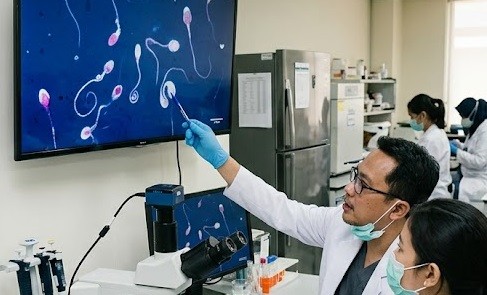
The recent decision by Indonesian actor Krisjiana Baharudin to undergo a vasectomy has sparked widespread public discussion, shedding light on shared family planning responsibilities and dispelling common medical myths surrounding permanent male contraception. Krisjiana and his wife, prominent dangdut singer Siti Badriah, jointly decided against having additional children after welcoming their first child and navigating two pregnancies. This choice reflects a shifting cultural paradigm in modern households, where contraception is increasingly viewed as a shared obligation rather than exclusively a female burden. However, as the couple’s announcement gained traction across digital media platforms, it also reignited traditional misconceptions regarding the physiological consequences of the procedure, specifically concerning male libido, hormonal balance, and sexual performance.
Background Context of the Decision
Family planning dynamics in celebrity households often mirror broader societal conversations regarding reproductive health, gender roles, and marital partnerships. For Krisjiana Baharudin and Siti Badriah, the journey toward finalizing their family size was deliberated with careful consideration of their emotional, physical, and psychological well-being. Following two pregnancies, Siti Badriah experienced the rigorous physical demands of childbirth and postpartum recovery. Recognizing the toll that continuous contraceptive methods—such as hormonal pills, intrauterine devices (IUDs), or repeated invasive procedures—can take on a woman’s body, the couple explored permanent male sterilization as a viable, highly effective alternative.
A vasectomy is classified as a permanent form of male birth control designed for couples who are entirely certain they do not want children in the future. By opting for this procedure, Krisjiana assumed a proactive role in domestic health management. Public reception has largely praised the actor for breaking traditional stigmas associated with male reproductive surgeries in Southeast Asia, where conversation surrounding vasectomies has historically been hindered by cultural taboos, misunderstandings of masculinity, and deeply ingrained societal expectations.

Chronology of the Announcement and Public Discourse
The revelation came to light as the couple shared insights into their domestic life and future planning.
- Initial Family Planning Discussions: Following the birth of their child and subsequent recovery periods, Krisjiana and Siti Badriah engaged in extensive discussions regarding the ideal family size, ultimately concluding that their current dynamic was complete.
- Medical Consultation and Decision: After reviewing various contraceptive options, the couple consulted medical professionals to evaluate permanent solutions, culminating in Krisjiana’s decision to undergo a vasectomy.
- Public Disclosure: The couple openly discussed their choice in media interviews and social media spaces, aiming to normalize conversations around male-centric family planning.
- Emergence of Public Inquiries: As the news circulated widely, digital platforms experienced a surge in inquiries regarding the physiological aftermath of the surgery, most notably concerning whether the procedure impairs sexual desire or erectile function.
Medical Facts: Debunking Myths Surrounding Vasectomies and Libido
To address public curiosity and correct misinformation, medical experts and health institutions have reiterated the scientific realities of the procedure. The primary concern voiced by critics or those unfamiliar with the surgery is whether a vasectomy diminishes a man’s sexual drive. Medically, the answer is a definitive no.
According to data and guidelines from reputable health organizations, including the National Institute of Child Health and Human Development (NICHD), a vasectomy has zero impact on a man’s libido or sexual desire. The foundational mechanics of the procedure explain why sexual health remains entirely unaffected:
- Hormone Production Remains Unchanged: The testes are responsible for producing testosterone, the primary male sex hormone responsible for libido, muscle mass, facial hair, and overall vitality. A vasectomy does not involve the removal or alteration of the testes. Consequently, testosterone continues to be produced and released directly into the bloodstream at normal, pre-surgery levels.
- Erectile Function is Intouched: Erections are governed by complex neurological, vascular, and hormonal systems. Because the anatomical structures responsible for achieving and maintaining an erection—such as the corpora cavernosa and the surrounding nerve pathways—are completely untouched during a vasectomy, erectile capacity remains unchanged.
- Ejaculation Volume Shows Minimal Difference: Sperm accounts for only a very small fraction (approximately 2 to 5 percent) of total semen volume. The vast majority of semen is fluid produced by the prostate gland and the seminal vesicles. Following a vasectomy, a man will continue to ejaculate normally; the only difference is that the seminal fluid will no longer contain sperm cells.
Surgical Mechanics: How a Vasectomy Works
Understanding the precise anatomical steps of a vasectomy helps demystify the procedure and alleviates unnecessary anxiety for prospective patients. A vasectomy is a minor surgical procedure typically performed under local anesthesia in an outpatient setting.

The surgical target is the vas deferens, a pair of muscular tubes that transport mature sperm from the epididymis to the urethra in preparation for ejaculation. During the operation, the urologist locates the vas deferens through a small incision or puncture in the scrotum. The tubes are then cut, tied, cauterized, or sealed using clips to create a physical barrier.
Because the pathway is blocked, sperm produced by the testes can no longer mix with the seminal fluid. Instead, the body naturally absorbs the unused sperm safely through a process called phagocytosis, identical to how the body handles cells that have reached the end of their lifecycle. The entire procedure usually takes less than 30 minutes, and recovery times are remarkably swift, allowing patients to resume normal non-strenuous activities within a couple of days.
Broader Impact and Implications for Modern Family Planning
The decision made by Krisjiana Baharudin highlights a crucial evolution in public health awareness and marital equality. Historically, contraceptive burdens have fallen disproportionately on women. From oral contraceptives and injectables to barrier methods and surgical tubal ligations, female anatomy has traditionally been the primary target for birth control interventions.
By choosing a vasectomy, male figures in the public eye help normalize a procedure that is statistically underutilized in many developing and middle-income nations compared to female-oriented surgeries. Medical sociologists note that public disclosures by influential personalities serve as powerful educational tools. When prominent figures discuss reproductive health transparently, it encourages men to seek accurate medical information rather than relying on cultural myths or folklore.

Furthermore, healthcare professionals emphasize that while vasectomies are classified as permanent, the decision must be approached with absolute certainty. Although vasectomy reversal procedures (vasovasostomy or vasoepididymostomy) exist, they are complex, expensive microsurgeries that do not guarantee the restoration of fertility. Therefore, pre-surgical counseling remains a mandatory step in reputable medical facilities to ensure that patients understand the permanence of the choice.
Conclusion
Krisjiana Baharudin’s public journey regarding his vasectomy transcends celebrity news, serving as a valuable case study in modern reproductive health, shared marital responsibility, and the power of medical education. By openly addressing the procedure and confronting common anxieties head-on, the discourse successfully separates medical fact from fiction. Scientific consensus remains unequivocal: a vasectomy is a safe, highly effective, and permanent form of birth control that preserves testosterone production, leaves libido untouched, and maintains normal sexual function. As awareness continues to grow, the normalization of male-centric family planning is poised to foster more equitable health decisions within households globally.