
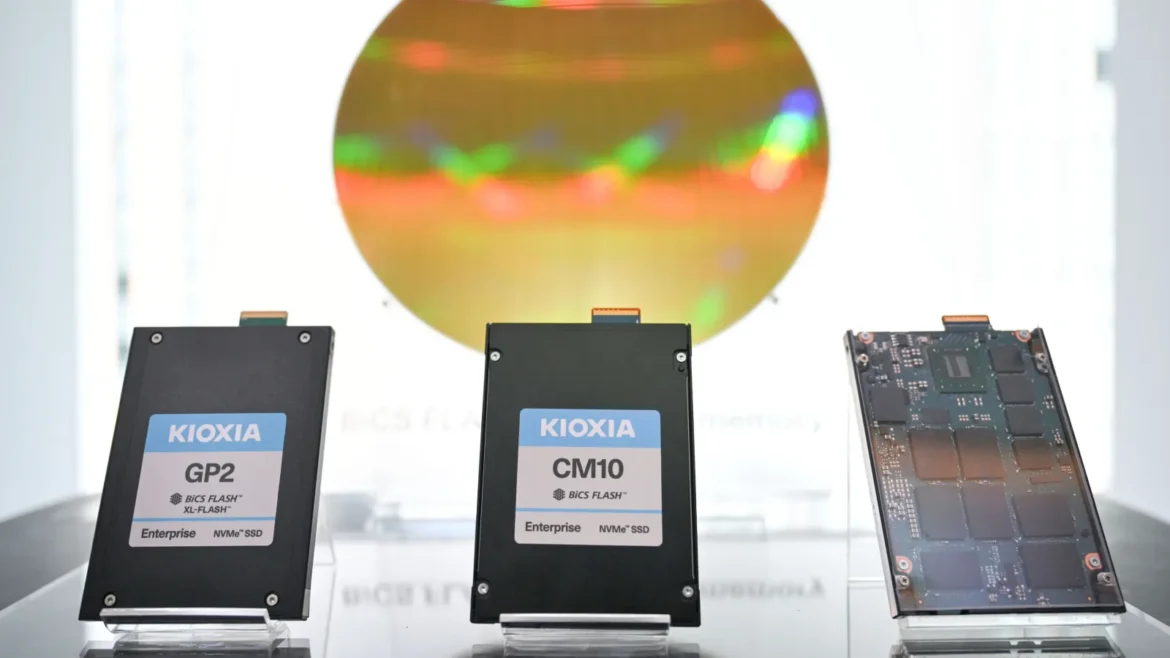
The rapid evolution of artificial intelligence has unlocked unprecedented capabilities in generative models, natural language processing, and complex data analysis, but it has simultaneously exposed a critical hardware bottleneck: GPU memory limitations. As artificial intelligence models scale to hundreds of billions—and soon trillions—of parameters, the datasets required to train and deploy these systems have grown exponentially. Traditionally, Graphics Processing Units have relied heavily on High Bandwidth Memory, commonly known as HBM, to ensure ultra-fast data transfer rates. While HBM offers unrivaled speeds necessary for intensive parallel computing, its physical architecture severely limits total capacity. This structural constraint has forced technology companies to seek innovative ways to bridge the gap between high-speed volatile memory and massive storage systems. Addressing this industry-wide challenge, memory solutions provider Kioxia Corporation and AI computing pioneer NVIDIA have announced a strategic collaboration designed to fundamentally change how GPUs interact with large-scale datasets by leveraging high-performance solid-state drives to achieve petabyte-scale effective memory capacity.
The Genesis of the Partnership and the HBM Bottleneck
To understand the significance of the Kioxia and NVIDIA collaboration, one must examine the fundamental architectural challenges currently facing enterprise artificial intelligence infrastructure. Modern accelerators, such as NVIDIA’s flagship GPUs, depend entirely on HBM stacks situated physically close to the processor die. This close proximity minimizes latency and maximizes bandwidth, allowing the GPU to crunch numbers at blistering speeds. However, manufacturing constraints, thermal limitations, and high production costs mean that individual GPUs are typically restricted to tens of gigabytes of HBM. When enterprise workloads require the processing of massive datasets—such as trillion-parameter language models, vast vector databases, or intricate Graph Neural Networks—the limited pool of HBM quickly becomes saturated.
When HBM reaches full capacity, systems traditionally face a severe performance penalty. Data must be constantly swapped back and forth between the high-speed memory and conventional storage mediums over standard system buses, creating a major performance bottleneck that leaves expensive GPU compute cores sitting idle while waiting for data. Recognizing that throwing more physical HBM at the problem is economically and physically unsustainable for petabyte-scale workloads, Kioxia and NVIDIA initiated a joint engineering effort to explore alternative memory tiering architectures. By combining NVIDIA’s advanced software frameworks with Kioxia’s enterprise-grade NVMe SSD technology, the two companies aimed to create a seamless extension of the GPU memory hierarchy, effectively transforming high-speed storage into a vast reservoir of accessible memory.
Technological Mechanics: How NVIDIA SCADA and Kioxia SSDs Integrate
The core of this new collaborative approach relies on cutting-edge software and hardware integration, specifically utilizing NVIDIA’s SCADA, which stands for Scaled Accelerated Data Access, alongside Storage-Next architectures, paired directly with Kioxia’s high-performance NVMe SSD lineups. In traditional computing environments, storage devices are accessed through conventional operating system file systems and block input-output stacks, which introduce significant latency that is unacceptable for real-time GPU processing.
NVIDIA SCADA and Storage-Next bypass these traditional software overheads by establishing a direct, high-speed communication pipeline between the storage subsystem and the GPU memory space. This allows the accelerator to read and write directly to NVMe-based flash storage with minimal CPU intervention. Crucially, the technology is optimized to handle small block-size data accesses efficiently—a historically difficult task for traditional block storage when paired with massively parallel processor architectures.
To draw a simplified analogy for everyday computer users, the concept bears a conceptual resemblance to the virtual memory paging files found in modern operating systems, such as Windows Page File or Linux swap space. When a consumer PC runs out of physical RAM, the operating system temporarily shifts inactive data onto a local storage drive to prevent application crashes. However, comparing consumer virtual memory to the Kioxia-NVIDIA architecture is like comparing a bicycle to a supersonic jet. The solution developed by Kioxia and NVIDIA operates at an enterprise server scale, utilizing massive parallelization, dedicated high-speed interconnects, and specialized hardware-software co-design to achieve bandwidth and IOPS performance levels capable of keeping pace with enterprise-grade accelerators without causing catastrophic processing stalls.
Proof-of-Concept Architecture and Real-World Testing Parameters
To validate the feasibility and performance limits of this architectural approach, Kioxia and NVIDIA constructed a rigorous proof-of-concept testing environment. The evaluation setup centered around the formidable NVIDIA GB200 NVL72 server system, an advanced architecture designed specifically for hyperscale AI and high-performance computing workloads. In this experimental configuration, the system integrated 18 interconnected server nodes.
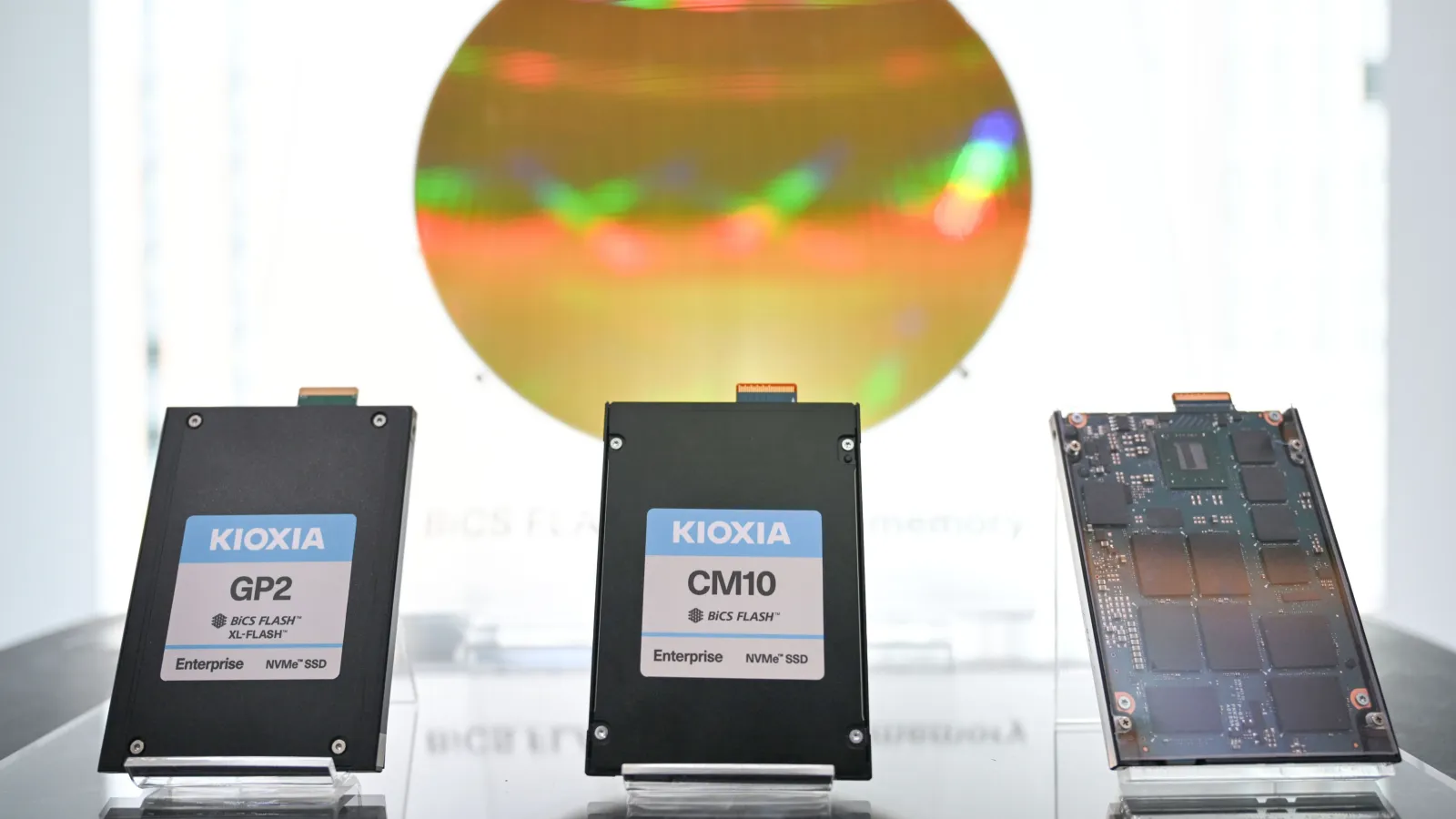
To supply the necessary storage capacity and high-throughput flash performance, the testbed was outfitted with a staggering 144 units of Kioxia XD8 Series enterprise NVMe SSDs, each boasting a capacity of 7.68 terabytes. Combined, this hardware array delivered a total raw storage capacity of approximately 1.1 petabytes. More importantly, this configuration successfully provisioned nearly 60 terabytes of flash-based auxiliary memory capacity dedicated to each individual server node, creating a massive secondary memory pool that drastically expands the operational headroom of the system.
During initial evaluations, this architecture was pushed to handle demanding database processing workloads involving up to 2 trillion vectors, with each vector sized at 512 bytes. Such massive vector database scales are increasingly vital for modern retrieval-augmented generation systems, semantic search platforms, and complex Graph Neural Network deployments that map relationships across billions of distinct data points. By offloading and efficiently managing these massive datasets within the flash-extended memory tier, the system demonstrated the potential to process workloads that would otherwise physically exceed the memory boundaries of traditional server clusters.
Industry Implications and the Road to Commercialization
Despite the promising technical achievements demonstrated in the proof-of-concept phase, both Kioxia and NVIDIA have emphasized that the architecture is still undergoing intensive evaluation. The companies are carefully analyzing technical feasibility, sustained input-output endurance, power efficiency, and real-world performance metrics before declaring the technology ready for widespread commercial deployment.
The implications of this collaboration, however, extend far beyond an incremental hardware upgrade. If successfully commercialized and adopted across data centers worldwide, this technology could fundamentally alter the economics of artificial intelligence infrastructure. Currently, organizations scaling up their AI operations face monumental capital expenditures primarily driven by the need for massive clusters packed with high-end GPUs equipped with maximum HBM capacities. By enabling SSDs to act as a seamless, high-performance extension of effective GPU memory, enterprises could potentially achieve comparable or superior dataset processing capabilities at a significantly lower total cost of ownership.
Furthermore, this development aligns with a broader industry trend toward disaggregated server architectures and advanced memory tiering. As large language models continue to expand and multimodal AI systems require the simultaneous ingestion of text, high-resolution imagery, video streams, and structured databases, the demand for creative memory solutions will only intensify. The collaborative efforts of Kioxia and NVIDIA signal a crucial step toward breaking the memory wall, paving the way for the next generation of artificial intelligence scale and capability.
