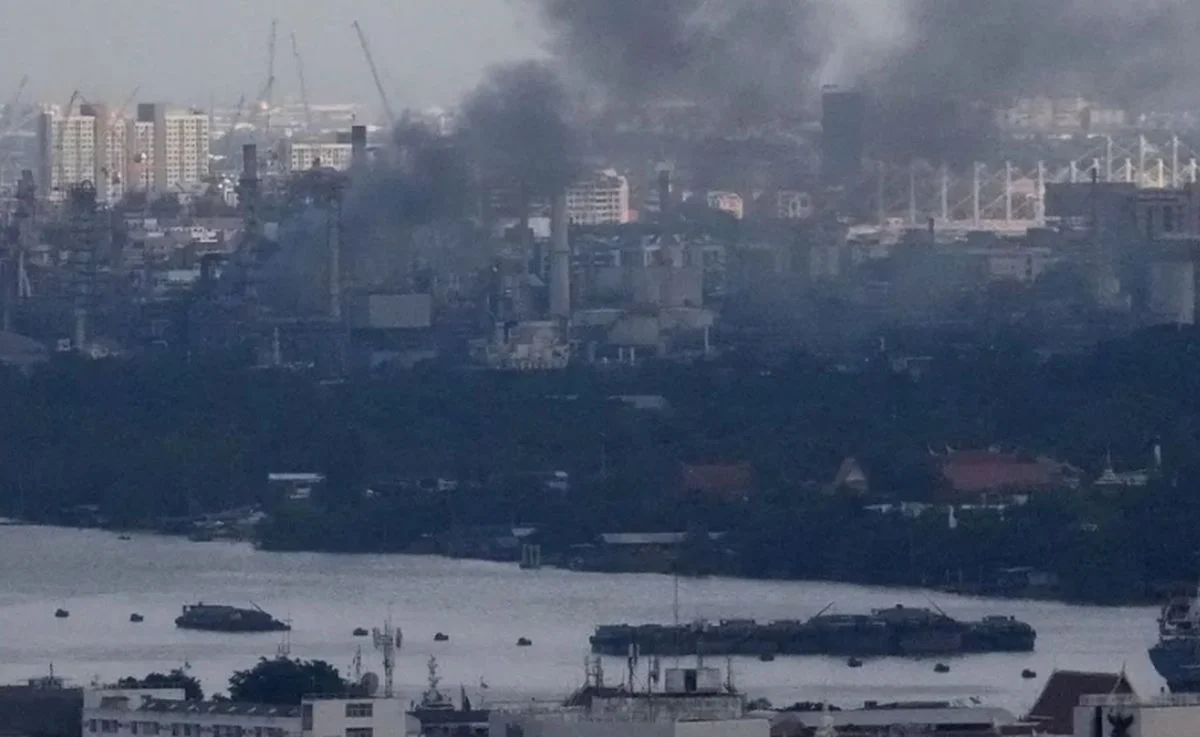
A powerful explosion rocked the Bangchak oil storage facility in the eastern district of Bangkok, Thailand, on Thursday, November 26, 2026, triggering a massive emergency response and forcing the immediate evacuation of nearby residential areas. The blast, which sent plumes of thick, black smoke billowing into the sky, has left seven individuals injured, with four reported to be in critical condition as authorities scramble to contain the aftermath.
Chronology of the Incident
The incident began in the late afternoon on Thursday at the Bangchak Corporation facility located in the Bangna district. Local witnesses reported hearing a thunderous detonation that shook the ground for several kilometers, with some residents in neighboring districts reporting that the shockwave was strong enough to rattle doors and windows.
Within minutes of the initial blast, emergency services were dispatched to the site. The Erawan Emergency Medical Center, the city’s primary authority for medical crisis response, arrived on the scene to triage the victims. According to their initial assessment, four individuals were classified as "red" category patients, indicating life-threatening injuries requiring urgent surgical intervention. Three others were classified as "yellow," sustaining moderate injuries that, while serious, did not pose an immediate threat to their lives. All victims were promptly transported to nearby metropolitan hospitals for specialized care.
By early evening, the Bangna District Office issued an urgent directive via its official social media channels, advising all residents in the immediate vicinity to evacuate their homes. The proximity of the facility to residential zones has raised significant concerns regarding potential toxic inhalation and the risk of secondary explosions, should the fire spread to additional storage tanks.
Emergency Response and Containment Efforts
The Bangkok Metropolitan Administration (BMA) coordinated with the Department of Disaster Prevention and Mitigation (DDPM) to establish a perimeter around the facility. Firefighting units equipped with foam-based suppression systems were deployed to combat the blaze, which remained visible from significant distances as darkness fell over the capital.
The Bangchak facility is a critical component of Bangkok’s energy infrastructure, responsible for the storage and distribution of refined petroleum products. Because of the highly volatile nature of the materials involved, fire crews faced significant challenges in bringing the fire under control. The primary objective for the incident commanders has been to prevent the fire from compromising the integrity of surrounding tanks, which could potentially trigger a chain reaction of explosions.
Local authorities have restricted access to the area, with police establishing roadblocks to ensure that emergency vehicles have unimpeded routes to and from the site. Traffic in the Bangna district, already known for heavy congestion, saw significant disruption as commuters were diverted away from the smoke-filled zones.
Contextualizing the Bangchak Facility
The Bangchak Corporation is a prominent player in Thailand’s energy sector. The facility in question serves as a vital hub for fuel distribution, connecting supply chains from coastal refineries to the urban demand centers of Bangkok. Historically, the facility has operated under strict industrial safety protocols, making this explosion a matter of significant concern for national energy security and public safety regulators.
Industrial accidents of this magnitude are relatively rare in Thailand’s capital, which has seen rapid modernization and industrial expansion over the last decade. The facility’s location, while economically strategic, has long been a subject of urban planning discussions due to the encroachment of residential housing into formerly industrial zones. This incident highlights the inherent risks of maintaining large-scale hazardous storage facilities in proximity to high-density population centers.
Official Statements and Investigations
As of Friday morning, the cause of the explosion remains unknown. Representatives from Bangchak Corporation have issued a brief statement acknowledging the incident and pledging full cooperation with government authorities. "Our primary focus at this moment is the well-being of our personnel and the safety of the community," a company spokesperson noted. "A formal internal investigation will be launched in parallel with the official inquiry to determine the root cause of the ignition."

The Ministry of Energy is expected to form a special committee to conduct a comprehensive audit of all safety systems at the site. Forensic investigators from the Thai police force, specializing in industrial accidents, have begun the process of collecting debris and analyzing surveillance footage to identify the point of origin for the explosion.
Broader Implications and Public Health Concerns
The incident has triggered a broader debate regarding urban safety regulations in Bangkok. Experts in environmental science and industrial engineering have pointed to the necessity of updated safety buffers and improved automated suppression systems for facilities handling hydrocarbons.
Public health officials have issued warnings to residents living downwind of the facility to keep their windows closed and avoid outdoor activities until the air quality returns to safe levels. The combustion of petroleum products releases a complex mixture of particulate matter, sulfur dioxide, and nitrogen oxides, which can cause acute respiratory distress, particularly in vulnerable populations such as children and the elderly.
Furthermore, the economic implications of the explosion may be felt in the coming days. If the supply chain from the Bangchak depot is significantly interrupted, fuel distribution to service stations in Bangkok and the surrounding provinces could face temporary shortages. While officials have suggested that alternative supply lines are being activated, the market may experience localized volatility in fuel prices as a precautionary reaction.
Industrial Safety Standards in Southeast Asia
This disaster serves as a sobering reminder of the hazards associated with industrial growth in rapidly developing economies. Over the past several years, Southeast Asia has seen a push toward stricter oversight for hazardous material handling, yet infrastructure aging remains a pervasive issue.
In the wake of this event, the Bangkok government is under pressure to reassess the zoning laws that allow for the proximity of residential developments to hazardous industrial sites. Proponents of stricter regulation argue that the "cost of doing business" must include robust investment in safety technology, as the social and economic costs of an incident like the Bangchak explosion far outweigh the savings achieved through deferred maintenance or lax safety protocols.
Looking Ahead
The next 48 to 72 hours will be critical as the fire is fully extinguished and the structural stability of the remaining tanks is assessed. The four victims in critical condition remain the primary focus of the city’s healthcare system, and their recovery will be closely monitored by both the public and government officials.
As investigations continue, the public is urged to rely on official channels for updates. The incident serves as a significant test for Bangkok’s emergency response capabilities, highlighting both the efficiency of the Erawan Center in mobilizing medical aid and the challenges of managing large-scale industrial disasters in a sprawling, densely populated metropolis.
Moving forward, the results of the official investigation will likely lead to a nationwide review of safety protocols for all fuel storage and processing plants in Thailand. The goal will be to implement more stringent safety margins, enhance early-warning systems, and improve the coordination between private industrial entities and municipal emergency services to ensure that such a tragedy is not repeated.
For the residents of Bangna, the coming days will be spent waiting for the "all-clear" signal, as the city reflects on the fragility of its infrastructure and the enduring importance of prioritizing human safety over industrial efficiency. The explosion at the Bangchak depot is not merely a local incident; it is a wake-up call for urban planners, corporate leaders, and safety regulators across the region to re-examine the safety architecture of modern industrial life.