The escalating crisis surrounding juvenile violence and bullying in East Java reached a volatile climax late Friday night, November 27, 2026, when a massive, enraged mob converged on a residential complex in Malang Regency. The target of the violent demonstration was the private residence of the parents of a primary suspect involved in a brutal bullying and assault case that ultimately claimed the life of a local female high school student. The unrest, which began as a peaceful expression of community outrage, rapidly deteriorated into an uncontrollable riot. Demonstrators breached police barricades, hurled stones and fireworks, and ultimately set fire to two police patrol vehicles. The incident also resulted in numerous injuries among law enforcement personnel, including a high-ranking local police commander who sustained severe trauma during the clashes.
The outbreak of mass violence underscores a dangerous trend of public vigilantism and a profound erosion of trust in institutional channels when high-profile crimes intersect with law enforcement families. This comprehensive report details the chronology of the riot, the tragic background of the initial crime, the operational challenges faced by security forces, and the broader sociological and legal implications of the unrest in Malang Regency.
Background Context: The Tragedy of Bullying and Fatal Violence
To understand the ferocious public reaction that culminated in the attack on the Saptorenggo housing complex, it is necessary to examine the underlying catalyst: the tragic death of a local high school student resulting from coordinated peer abuse. According to preliminary police investigations and local reports, the victim—a teenage female student whose identity has been withheld to protect her family’s privacy—became the target of severe, sustained bullying driven by romantic jealousy and personal vendettas, commonly referred to in local discourse as dendam asmara.
Bullying in Indonesian secondary educational institutions has evolved from verbal taunts and minor physical altercations into organized, highly aggressive peer-group violence, often recorded and circulated on social media platforms. In this specific case in Malang, the escalation from psychological torment to physical violence proved fatal. The victim suffered catastrophic injuries during an assault orchestrated by a group of peers, including a minor identified by the initials CAN.
What intensified public fury exponentially was the revelation that one of the primary suspects, CAN, is the child of a serving member of the Indonesian National Police (Polri). In a society increasingly sensitive to allegations of impunity, institutional protection, and abuse of power, the familial link to law enforcement acted as a powerful accelerant. Local residents and sympathetic citizens across Malang quickly mobilized online, fueled by grief for the deceased victim and a deep-seated suspicion that the justice system might falter or protect the perpetrator due to familial connections within the force.
Chronology of the Riot: From Vigil to Violence
The sequence of events on Friday, November 27, 2026, demonstrates how rapidly a crowd can transition from localized protest to widespread civil disobedience. Intelligence units within the Malang Regency Police (Polres Malang) had detected unusual digital chatter and community mobilization hours before the incident, prompting a preemptive deployment of security forces.
Around 21:00 Western Indonesian Time (WIB), the first wave of demonstrators began arriving at the Emerald Garden housing complex, situated along Jalan Raya Bamban in Dusun Boro Bugis, Saptorenggo Village, Pakis District, Malang Regency. The initial gathering consisted of several dozen individuals demanding accountability and justice for the deceased student. Recognizing the potential for escalation, local police units had already established a defensive perimeter around the residence of CAN’s parents.
However, as the evening progressed into night, the demographic and scale of the crowd shifted dramatically. Individuals from various parts of Malang—many unaffiliated with the victim’s immediate circle—converged on the location. Estimates suggest the crowd swelled to several hundred people. Banners, placards demanding justice, and blunt instruments such as wooden staves began to appear among the demonstrators.
By midnight, the atmosphere shifted from tense to hostile. The initial demands for legal transparency gave way to open aggression. Demonstrators began shouting hostile slogans directed at both the suspect’s family and the guarding officers.
Police Operational Challenges and the Escalation of Force
Faced with a rapidly multiplying, hostile crowd, the initial detachment of Polres Malang personnel found themselves severely outnumbered. Realizing the tactical disadvantage, regional commanders requested reinforcements, leading to the deployment of Mobile Brigade (Brimob) units from the East Java Regional Police.
Despite the arrival of reinforcements, the security forces confronted significant tactical constraints. Operating in a densely populated residential neighborhood limited the deployment of aggressive crowd-control munitions, such as tear gas, due to the high risk of harming nearby residents, families, and children residing within the Emerald Garden complex.
Shortly before dawn, the situation crossed the threshold into outright rioting. A barrage of fireworks and heavy stone-throwing targeted the police lines. Exploiting the darkness and the confusion caused by the projectile barrage, aggressive elements within the mob breached the residential gates and advanced toward the targeted property.
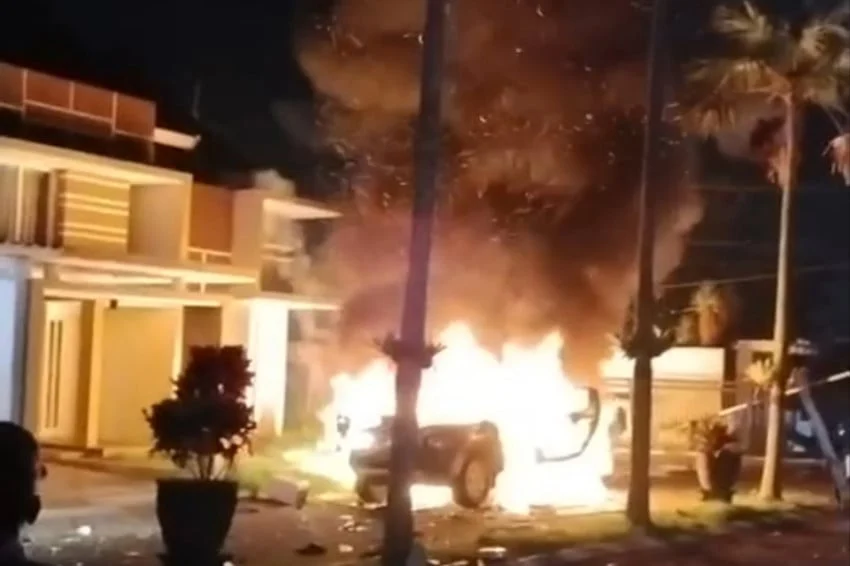
During the melee, two official patrol vehicles belonging to the Pakis Sector Police (Polsek Pakis) were isolated by the crowd, overturned, and set ablaze. The thick black smoke from the burning vehicles illuminated the neighborhood, symbolizing a total breakdown of public order.
Casualties Among Law Enforcement
The violent confrontation resulted in multiple injuries among the police officers tasked with maintaining public safety. Due to the intensity of the stone-throwing, several officers sustained lacerations, contusions, and fractures.
The most severe casualty reported during the riot was AKP Bambang Subinanjar, the Head of the Pakis Sector Police (Kapolsek Pakis). According to field reports, AKP Subinanjar was struck directly in the head by a heavy paving stone thrown by a rioter while attempting to negotiate with community representatives and manage the police line. He sustained severe head trauma and was immediately evacuated from the riot zone to a nearby medical facility for emergency treatment. The injury of a senior commander underscored the severity of the threat faced by law enforcement during the peak of the disturbances.
Official Responses and Institutional Reactions
In the wake of the violence, regional authorities moved quickly to restore order, manage public relations, and address the dual crises of the initial homicide and the subsequent riot.
High-ranking officials from the East Java Regional Police and Polres Malang issued public statements condemning the fatal assault on the high school student, assuring the public that the legal process regarding the juvenile suspects would proceed with absolute transparency and impartiality. Emphasizing that the familial ties of any suspect to the police institution would not influence the investigation, authorities urged the community to exercise restraint and allow the judicial system to function.
Concurrently, a separate internal investigation was launched to identify the instigators of the Saptorenggo riot. While public grief and anger over the student’s death were acknowledged as understandable human emotions, authorities stressed that criminal acts—including property destruction, the burning of police vehicles, and assaults on law enforcement personnel—are punishable by law and will be prosecuted rigorously. Investigators are currently reviewing CCTV footage, mobile phone recordings, and social media uploads to identify key agitators responsible for leading the assault on the police perimeter and destroying public assets.
Broader Social Implications and Analysis
The events in Malang Regency on November 27, 2026, serve as a stark case study in the intersection of modern social media mobilization, public distrust in institutions, and the fragility of local security infrastructure.
-
The Erosion of Institutional Trust: When crimes involve the families of law enforcement officers or public officials, public skepticism spikes immediately. The perception—whether grounded in fact or assumption—that institutional protection might be granted creates an environment where communities feel compelled to take justice into their own hands. Restoring faith requires proactive, transparent communication from police leadership from the very inception of an investigation.
-
The Danger of Digital Mobilization: Unlike traditional protests that require days of physical organization, digital platforms allow for the rapid aggregation of angry crowds within hours. The influx of individuals from outside the local community who arrived at Saptorenggo demonstrates how viral narratives can summon volatile crowds, turning a localized mourning process into a regional civil disturbance.
-
The Limits of Local Crowd Control: The incident highlights tactical vulnerabilities for regional police sectors. Standard sector-level police stations (Polsek) are not equipped or staffed to manage hundreds of hostile, aggressive rioters. The time gap required to mobilize and deploy specialized riot control units, such as Brimob, leaves local commanders exposed to extreme risk during sudden escalations.
-
The Double Tragedy of Vigilantism: While the original crime—the bullying and murder of the high school student—remains an unforgivable tragedy, the subsequent riot compounds the community’s suffering. Two police vehicles were destroyed at taxpayer expense, critical public safety resources were diverted, an officer was severely injured, and numerous local residents were terrorized by hours of nocturnal violence. Furthermore, individuals identified as rioters now face severe criminal charges, potentially destroying their own futures while seeking to avenge an injustice.
Conclusion
The outbreak of violence in Saptorenggo, Malang, represents a critical juncture for community relations and law enforcement in East Java. As the legal proceedings against the suspects in the high school student’s bullying and homicide case move forward, authorities face the dual imperative of delivering undeniable justice for the victim while holding accountable those who chose the path of lawlessness and destruction during the November 27 riot. Only through absolute transparency in the judicial process and a measured, lawful approach to public order can stability and trust be restored to the community.