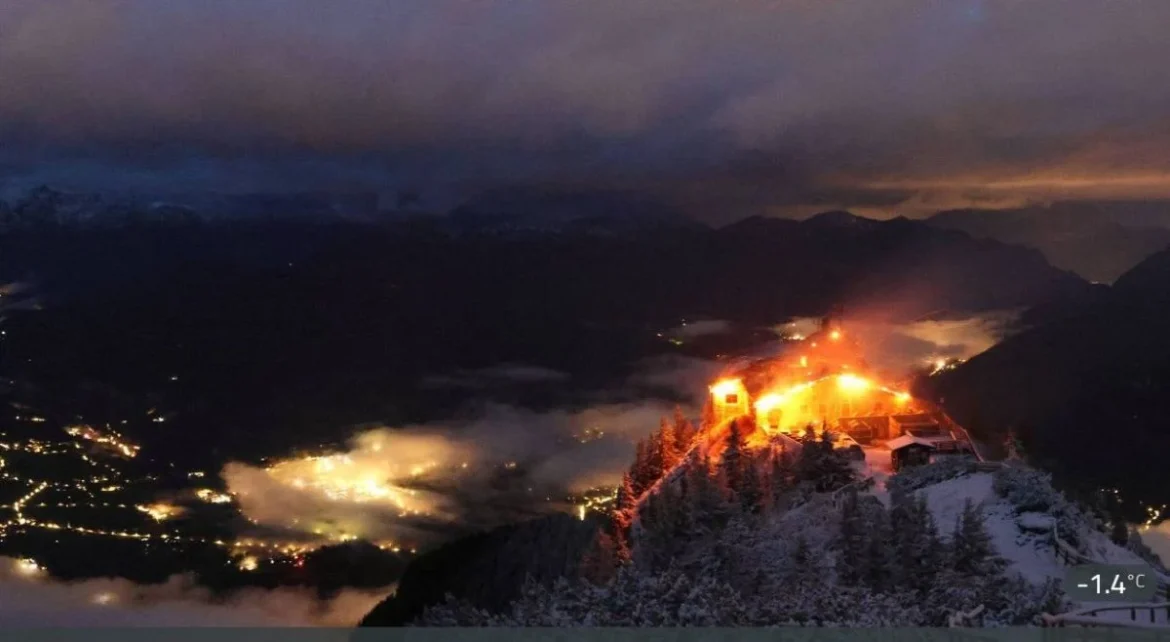
The historic Kehlsteinhaus, internationally recognized as the Eagle’s Nest, was devastated by a major fire on the evening of Friday, October 23, 2026, marking a significant loss to one of Europe’s most controversial historical sites. Situated in the Bavarian Alps near Berchtesgaden, Germany, the structure serves as a poignant, albeit divisive, symbol of the Third Reich. Local authorities confirmed the blaze erupted shortly after 9:00 PM local time (19:00 GMT), triggering an emergency response that mobilized dozens of firefighters from the surrounding alpine regions.
While the investigation into the incident is in its preliminary stages, German law enforcement has already taken one individual into custody. The suspect, whose identity has not been released pending further investigation, was intercepted by authorities shortly after the fire began, raising immediate concerns regarding the security of historical landmarks associated with the Nazi era.
Chronology of the Incident
The emergency services were alerted to the fire at approximately 9:05 PM on Friday. Given the remote and elevated location of the Eagle’s Nest—perched at an altitude of 1,834 meters (6,017 feet)—the logistical challenges of the operation were immense. By the time the first responders reached the summit, flames were already visible through the structure’s stone walls, signaling an advanced stage of combustion.
A critical turning point in the initial investigation occurred when responding officers encountered a motorcyclist traveling away from the scene at a high rate of speed. This individual’s proximity to the site during the exact window of the fire’s ignition drew immediate suspicion. Police units successfully intercepted the suspect shortly thereafter. While local media outlets have reported this apprehension, the Bavarian police department has stated that the investigation remains active and that they are currently forensic analyzing the scene to determine the precise origin of the fire, including whether it was caused by arson, electrical failure, or an external human factor.
Historical Context of the Eagle’s Nest
The Kehlsteinhaus was commissioned by Martin Bormann in 1937 as a diplomatic retreat for Adolf Hitler and the Nazi leadership. Completed in 1938, the project was an engineering marvel of its time, featuring a sophisticated elevator shaft bored directly through the solid granite of the Kehlstein mountain. The site served as a setting for high-level political meetings and international diplomacy prior to the outbreak of World War II.
Post-1945, the site was spared from destruction by Allied forces, unlike many other Nazi structures, due to its historical significance and its subsequent transformation into a tourist destination and restaurant. For decades, the site has operated as a place of historical reflection. Managed by the Berchtesgadener Land tourism board, it has attracted thousands of visitors annually who come to understand the geography of the Nazi regime and the landscape of the Bavarian Alps. The loss of the structure, whether total or partial, represents the removal of a physical anchor to the historical narratives of the 20th century.
Logistical and Environmental Challenges
Firefighting in the Bavarian Alps is inherently difficult due to the rugged terrain. The Eagle’s Nest is accessible primarily by a specialized bus service and the famous brass-lined elevator. When the blaze broke out, heavy winds and the thin alpine air complicated the efforts of the fire brigades. Emergency teams had to utilize specialized equipment to pump water to the summit, as the site’s distance from municipal water supplies limited the availability of fire hydrants.
The structural composition of the building, which blends heavy granite masonry with timber-frame interior elements and historic wooden fixtures, made it particularly susceptible to rapid fire spread once the blaze reached the internal rafters. Experts from the German Office for Monument Preservation have expressed concern that the fire may have compromised the integrity of the original stone foundation, which is considered a protected cultural monument.
Official Responses and Public Reaction
The incident has sent shockwaves through the German cultural and political landscape. Local officials in Berchtesgaden have expressed their deep regret over the incident, noting that the Eagle’s Nest is not just a tourist site but a site of "dark heritage" that serves to educate future generations about the dangers of totalitarianism.

"We are deeply saddened by the destruction of this site," a spokesperson for the local tourism board stated in an early briefing. "The Eagle’s Nest is a place where history is confronted, not celebrated. Its loss is a loss of our collective ability to witness the physical reality of that era."
Security experts have also weighed in, noting that the event highlights the vulnerability of isolated historic sites. Across Europe, there has been a recurring debate regarding the management of "Nazi sites." Some advocate for the total preservation of these buildings to ensure historical accuracy, while others argue that they should be demolished to prevent them from becoming targets for extremist tourism or, as seen in this incident, acts of arson.
Broader Implications and Historical Memory
The burning of the Kehlsteinhaus raises significant questions about the role of physical architecture in historical memory. When a structure tied to a traumatic past is destroyed—whether through time, natural decay, or human interference—the nature of how that history is taught changes.
Historical sociologists suggest that sites like the Eagle’s Nest function as "negative heritage." They are not preserved for their aesthetic value but for their capacity to provoke critical engagement with history. The removal of such a site through an act of suspected arson complicates the discourse, as the event itself becomes a new layer of history added to the original site.
Furthermore, the economic impact on the region cannot be overlooked. The Berchtesgaden area relies heavily on historical tourism. The closure of the Eagle’s Nest, even if temporary, will have a cascading effect on local businesses, mountain guides, and transport services that rely on the seasonal influx of visitors.
The Path Forward: Forensic Analysis and Restoration
As of Saturday, October 24, 2026, the area around the Kehlsteinhaus remains cordoned off. Forensic experts from the Bavarian State Criminal Police Office (LKA) are currently on-site conducting a detailed sweep. The investigation will focus on identifying the presence of accelerants and verifying the movements of the suspect taken into custody.
Simultaneously, heritage architects are beginning the task of assessing the structural damage. If the granite walls have remained stable, restoration may be a possibility, though the interior, which held significant period-accurate artifacts and architectural detailing, may be impossible to replicate faithfully.
The German government has historically taken a firm stance on the preservation of sites related to the Nazi era, ensuring they are treated as educational tools. Whether this incident will prompt a shift in how Germany secures its controversial landmarks remains to be seen. For now, the Eagle’s Nest remains a charred silhouette against the backdrop of the Alps, a silent witness to both the history of the 20th century and the instability of the 21st.
Conclusion
The fire at the Kehlsteinhaus is a stark reminder of the fragile nature of history. As authorities continue their investigation into the suspect and the causes of the fire, the public is left to contemplate the future of such sites. The incident serves as a focal point for a wider discussion regarding how modern societies interact with the physical remnants of a dark past. Whether the Eagle’s Nest will be rebuilt or maintained as a ruined monument to this event remains an open question, one that will likely be debated by historians, policymakers, and the public for years to come. The investigation continues, and the world waits for further details on the motivations behind the potential crime that has altered one of Germany’s most significant, if somber, landmarks.