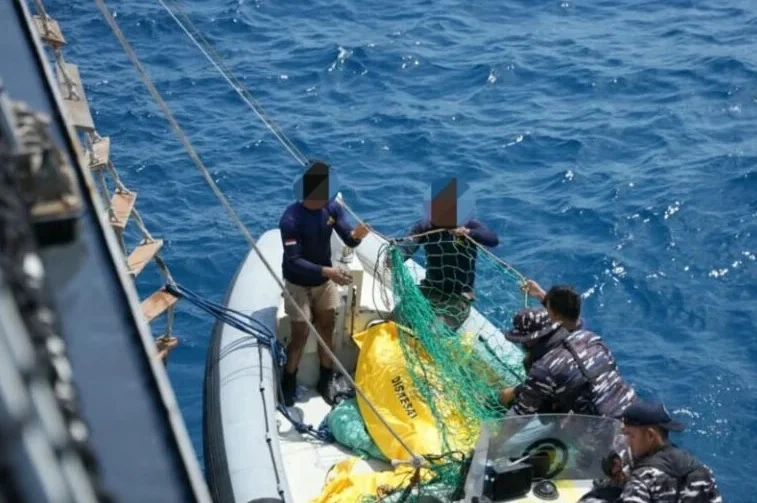
In a high-stakes maritime recovery operation, the elite divers of the Indonesian Navy’s Frogman Command (Satkopaska) and the Underwater Salvage and Rescue Unit (Satkoppeba) successfully retrieved the bodies of three victims from the wreckage of the KM Virgo Transport 8. The vessel, which sank under mysterious circumstances in the treacherous waters of the Masalembo Strait in the Java Sea, has become the focal point of an intensive search and rescue operation led by the Second Fleet Command (Koarmada II) of the Indonesian Navy.
The operation, which concluded on Sunday, September 20, 2026, underscored the extreme physical and technical challenges faced by military personnel operating in one of Indonesia’s most volatile maritime corridors. Laksma TNI Edy Setyawan, acting as the On Scene Commander (OSC) and Commander of the Combat Security Group (Danguskamla) of Koarmada II, confirmed that the bodies—two men and one woman—were recovered from deep within the sunken hull. The mission required precise coordination, specialized deep-sea diving equipment, and extreme caution due to the unstable state of the submerged vessel.
The Chronology of a Maritime Tragedy
The sinking of the KM Virgo Transport 8 follows a series of maritime incidents in the Java Sea, an area notoriously difficult for navigation due to erratic weather patterns and strong currents, particularly near the Masalembo area. While the exact cause of the sinking remains under investigation by the National Transportation Safety Committee (KNKT), initial reports indicate that the ship encountered severe weather conditions that compromised its structural integrity.
The distress signal from the KM Virgo Transport 8 was received early in the week, prompting a rapid mobilization of the Indonesian Navy’s search and rescue assets. Upon arriving at the coordinates provided by the ship’s last automated identification system (AIS) transmission, the rescue team identified the vessel lying on the seabed at a significant depth, complicating the recovery efforts.
By the time the dive teams reached the wreckage, the vessel had already settled into the seabed, with debris and shifting currents posing a significant risk to the divers. The recovery process was segmented into three distinct phases: initial sonar mapping of the hull, structural assessment to ensure diver safety, and the final extraction of the victims.
Tactical Challenges: The Frogman Operation
The recovery of the victims was not a standard salvage operation. The Satkopaska divers were required to execute what is known as "penetration diving," where personnel enter the interior of a sunken structure. This is considered one of the most dangerous disciplines in professional diving, as the risk of entanglement, low visibility, and sudden structural collapse is exceptionally high.
The interior of the KM Virgo Transport 8 was reportedly cluttered with shifted cargo and damaged interior partitions. According to reports from the field, the team had to systematically clear pathways before reaching the cabin areas where the victims were located. In a harrowing turn of events, the divers were forced to break through the reinforced glass of the ship’s bridge and cabin windows to gain access. This maneuver required extreme precision, as the pressure differential at that depth could have caused an implosion or caused the remaining structure to shift, potentially trapping the divers.
Once access was secured, the divers used specialized tethering techniques to retrieve the remains and bring them to the surface. The operation was monitored by a support vessel on the surface, which maintained constant communication with the divers, managing their decompression stops to ensure they did not suffer from decompression sickness (the "bends") during their ascent.

Statistical Context of Masalembo Waters
The Masalembo Strait is frequently referred to by mariners as the "Bermuda Triangle of Indonesia." The area is characterized by the confluence of different currents from the Java Sea and the Makassar Strait, creating unpredictable underwater turbulence and steep waves. Historically, this region has witnessed numerous maritime disasters, ranging from small fishing boats to large commercial ferries.
Data from the Indonesian Ministry of Transportation suggests that the Masalembo region sees an average of two to three significant maritime incidents annually. The tragic fate of the KM Virgo Transport 8 adds to a growing list of casualties that have prompted government officials to call for stricter maritime safety regulations, including mandatory real-time weather monitoring for all commercial vessels operating in the Java Sea.
Official Statements and Continued Search Efforts
In the wake of the successful recovery of the three bodies, Laksma TNI Edy Setyawan held a press briefing to address the ongoing concerns of the victims’ families and the general public. "The primary objective of this operation was to provide closure to the families and ensure that all victims are accounted for," stated Laksma Edy. "The complexity of this operation demonstrates the high level of training possessed by our frogmen. However, we are not concluding our mission yet. The search for other potential victims and the investigation into the cause of the sinking remain our top priorities."
The Indonesian Navy, in collaboration with the National Search and Rescue Agency (Basarnas), has expanded the search radius to account for potential drift patterns caused by the strong currents in the Masalembo area. While the recovery of the three individuals provides a tragic clarity to the fate of some, the uncertainty surrounding the total number of passengers aboard the KM Virgo Transport 8 continues to drive the search effort.
Broader Implications for Maritime Safety
The incident has triggered a broader debate regarding the safety protocols of commercial cargo and passenger ships in Indonesia. Industry analysts point to the aging fleet of vessels currently operating in the archipelago as a primary concern. Many of these ships lack the modern navigation and stabilization technology required to handle the sudden weather shifts common in the Java Sea.
Furthermore, the incident raises questions about emergency response times. While the Navy’s response was swift, the logistical challenges of reaching remote areas of the Java Sea underscore the need for more decentralized emergency response hubs. Experts suggest that the establishment of permanent maritime safety outposts near the Masalembo Strait could significantly reduce response times, potentially saving lives in future incidents.
As the recovery team continues its work, the Indonesian public remains focused on the human element of this tragedy. The bravery of the Satkopaska and Satkoppeba divers serves as a reminder of the inherent dangers of the sea and the vital role the Indonesian Navy plays in protecting maritime sovereignty and ensuring the safety of those who traverse these challenging waters.
The investigation into the KM Virgo Transport 8 will now transition into a forensic phase, where the focus will shift from rescue to identifying the systemic failures that led to the sinking. Experts expect the KNKT to examine the ship’s maintenance logs, cargo manifest, and communication records as part of a formal inquiry. In the coming weeks, a detailed report is expected to be released, which may lead to legislative changes in how Indonesian maritime authorities monitor the seaworthiness of commercial vessels in high-risk zones.
For now, the focus remains on the families of the victims and the divers who remain on-site, performing the grueling, vital work of ensuring that no one is left behind. The tragedy of the KM Virgo Transport 8 stands as a somber marker of the ongoing struggle between human activity and the unpredictable, often unforgiving, nature of the Indonesian seas.