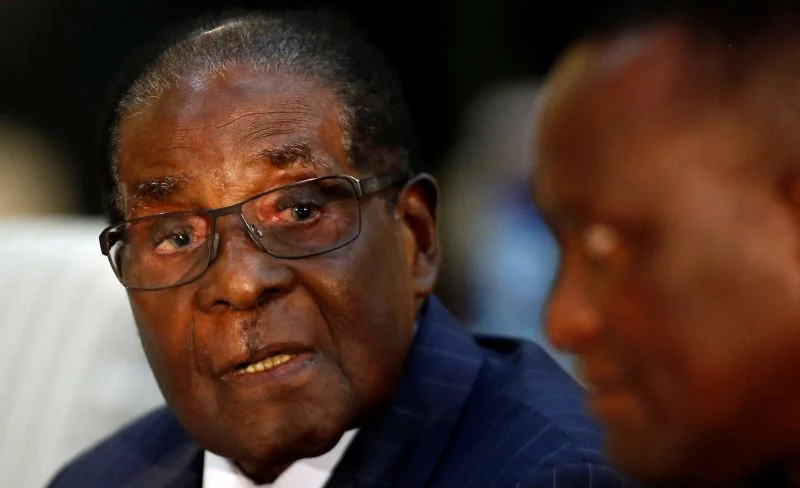
Robert Gabriel Mugabe officially became the former President of Zimbabwe on Wednesday, November 22, 2017, bringing an end to nearly four decades of iron-fisted rule. At the age of 93, the world’s oldest head of state at the time finally relinquished power following a military takeover that paralyzed the nation’s capital and triggered a rapid succession of political maneuvers within the ruling ZANU-PF party. Mugabe’s departure closed a monumental, albeit deeply controversial, chapter in modern African history, transitioning Zimbabwe into an uncertain new political era.
The announcement of his resignation was met with unbridled jubilation across the southern African nation. Citizens poured into the streets of Harare and other major cities, waving flags, dancing, blowing horns, and weeping tears of relief. For a population that had endured decades of economic devastation, political intimidation, and systemic isolation, the moment felt surreal. Inside the Parliament building, lawmakers erupted into wild celebrations, instantly halting impeachment proceedings as the speaker read out Mugabe’s historic letter of resignation.
Main Facts and the Catalyst for the Coup
The dramatic downfall of Robert Mugabe began unfolding days before his formal resignation when the military intervened, placing the veteran leader under house arrest and seizing control of state television broadcaster ZBC. Army commanders insisted their actions did not constitute a military coup, but rather a targeted operation aimed at purging "criminals" surrounding the president—a thinly veiled reference to the faction loyal to Mugabe’s ambitious wife, Grace Mugabe.
For months, tensions had been simmering over the question of presidential succession. Grace Mugabe had positioned herself to succeed her aging husband, leading to the abrupt firing of Vice President Emmerson Mnangagwa, a liberation war veteran with deep ties to the military. Mnangagwa’s ouster proved to be a critical miscalculation. Fearing that the liberation credentials of the ruling party were being hijacked by a younger faction with no combat history, military chiefs stepped in to protect their institutional interests and restore constitutional order.
Faced with imminent impeachment by a united front of his former ZANU-PF loyalists and the parliamentary opposition, Mugabe finally yielded. His resignation letter declared that the decision was voluntary and motivated by a desire to ensure a smooth, peaceful transfer of power. However, political analysts widely agreed that he had been cornered with no viable alternatives remaining.
Chronology of a Complex Life: From Freedom Fighter to Autocrat
To understand the trajectory of Robert Mugabe is to understand the complex duality of modern post-colonial African leadership. Born on February 21, 1924, in Kutama, northeast of Salisbury (now Harare) in then-Southern Rhodesia, Mugabe was an exceptionally educated individual. Before entering full-time revolutionary politics, he earned multiple university degrees and worked as a schoolteacher, teaching in various parts of southern Africa.
Mugabe’s political awakening occurred during the height of white minority rule in Rhodesia, led by Ian Smith. In 1964, Mugabe was arrested and imprisoned for a decade following a speech deemed subversive by the colonial administration. Despite the harsh conditions of imprisonment, he continued his academic pursuits, earning additional degrees through correspondence courses.
Upon his release in 1974, Mugabe crossed into neighboring Mozambique, where he assumed leadership of the Zimbabwe African National Union (ZANU) and its military wing, ZANLA. He orchestrated a protracted, bloody guerrilla war against the white-minority regime. The armed struggle eventually forced the colonial government to negotiate, leading to the historic Lancaster House Agreement and the birth of an independent Zimbabwe in 1980.
Initially hailed as a visionary statesman and a champion of racial reconciliation, Mugabe assumed the office of Prime Minister in 1980, before transitioning to the presidency in 1987. The early years of his administration were marked by notable achievements in healthcare, education, and social infrastructure, which significantly raised literacy rates and living standards for the black majority.
However, the promise of the liberation era gradually soured. As political opposition grew, particularly with the emergence of the Movement for Democratic Change (MDC) led by Morgan Tsvangirai in the late 1990s, Mugabe’s administration resorted to increasingly authoritarian tactics.
Supporting Data and Systemic Economic Decline
Mugabe’s governance eventually became synonymous with economic mismanagement and democratic regression. The turning point for the nation’s economy arrived around 2000 with the chaotic, often violent, fast-track land reform program. While framed as a measure to redress colonial-era injustices by redistributing white-owned commercial farms to landless black Zimbabweans, the implementation was deeply flawed. Agricultural output plummeted by over 60%, destroying the backbone of an economy that had once been celebrated as the "breadbasket of Africa."
The collapse of agriculture triggered a cascading economic crisis. To finance foreign interventions and domestic political survival, the government resorted to printing money, leading to hyperinflation of historic proportions. By 2008, Zimbabwe’s inflation rate reached astronomical, incomprehensible levels—officially calculated in the sextillions of percent—rendering the local currency entirely worthless. Citizens watched their life savings evaporate overnight, basic commodities vanished from supermarket shelves, and unemployment skyrocketed to over 80%.
Human rights organizations repeatedly condemned the regime for suppressing dissent, manipulating elections, and orchestrating violent crackdowns on political opponents. The infamous 2005 "Operation Murambatsvina" (Operation Drive Out the Filth) displaced hundreds of thousands of urban poor by demolishing informal homes and businesses under the guise of urban cleanup.
Official Responses and Regional Reactions
The international community monitored the unfolding events in Harare with cautious optimism and diplomatic engagement. Western governments, which had imposed targeted sanctions on Mugabe and his inner circle due to human rights abuses and election rigging, welcomed the prospect of a new political dispensation, though they maintained that the lifting of sanctions would depend on genuine democratic reforms.
Regional bodies, particularly the Southern African Development Community (SADC) and South Africa, played a delicate diplomatic role. While historically reluctant to criticize a veteran liberation leader who enjoyed continental prestige, regional leaders recognized that Zimbabwe’s prolonged instability posed a severe security and economic threat to neighboring countries, which had absorbed millions of Zimbabwean economic refugees over the decades.
Emmerson Mnangagwa, who returned from exile shortly after Mugabe’s resignation to assume the presidency, struck a conciliatory yet pragmatic tone in his inauguration address. Pledging to revive the crippled economy, attract foreign investment, and foster national unity, Mnangagwa sought to reassure both domestic skeptics and international creditors that Zimbabwe was "open for business."
Broader Impact and Future Implications
The exit of Robert Mugabe marks the definitive end of an era defined by the generation of African leaders who fought for and won independence from colonial rule. While his anti-imperialist rhetoric and pan-Africanist stance retained symbolic appeal for some across the continent, his domestic legacy remains overwhelmingly marred by autocracy, corruption, and economic ruin.
The immediate implications of his resignation center on whether ZANU-PF can reform from within or if the military-backed administration of President Mnangagwa will merely perpetuate the systemic structures of the old regime under a new face. Observers note that while the departure of a nonagenarian autocrat removes a major political bottleneck, rebuilding destroyed democratic institutions, restoring judicial independence, and stabilizing the currency will require profound structural reforms.
For the citizens of Zimbabwe, the joyous scenes of November 2022—err, 2017—reflected a profound longing for normalcy, employment, and dignity. As the nation steps into the post-Mugabe era, the ultimate test for its leadership will be translating the euphoria of liberation from an autocrat into concrete policies that deliver sustainable peace, economic recovery, and genuine democratic governance.