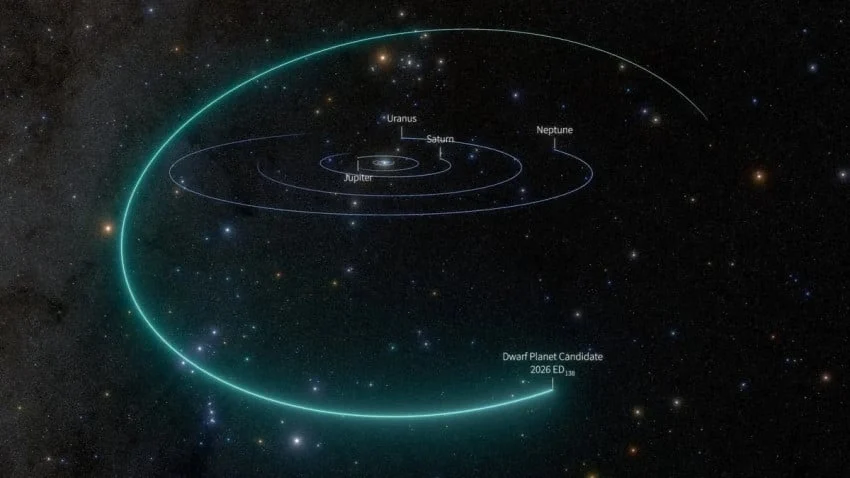
The discovery of a celestial object designated 2026 ED138, situated far beyond the orbit of Neptune, has ignited significant interest within the global astronomical community. Identified through the advanced observational capabilities of the Vera C. Rubin Observatory in Chile, this object represents a potential addition to the catalogue of dwarf planets within our solar system. As researchers continue to analyze the data provided by the observatory’s sophisticated instrumentation, the scientific community is once again reminded of the vast, uncharted territories that persist in the outer reaches of our cosmic neighborhood.
A New Horizon in Trans-Neptunian Research
The object, currently cataloged as 2026 ED138, was detected in the deep-space regions beyond Neptune, a zone characterized by the Kuiper Belt and the scattered disc. This region is home to a myriad of icy bodies and is considered a graveyard of planetary formation, holding clues to the early history of the solar system. The discovery was facilitated by Matthew Holman, a distinguished researcher at the Harvard & Smithsonian Center for Astrophysics (CfA), who utilized specialized computational search algorithms developed in collaboration with Kevin Napier.
The methodology behind this discovery marks a departure from traditional observational astronomy, which often relied on prolonged manual surveying. By leveraging the vast datasets generated by the Vera C. Rubin Observatory—a facility designed to map the southern sky with unprecedented depth and speed—Holman and Napier were able to isolate 2026 ED138 from the background noise of millions of stars and distant galaxies.
Chronology of the Discovery
The identification of 2026 ED138 occurred on October 13, a date that represents a significant milestone in modern Trans-Neptunian object (TNO) research. Following the collection of data by the Vera C. Rubin Observatory, the research team applied their custom-developed search code to the high-resolution imagery. The software, designed to detect motion in the faint light of distant objects against the static background of fixed stars, quickly identified an anomalous trajectory consistent with an object orbiting the Sun at a extreme distance.
Following the initial detection, preliminary orbital mechanics were calculated to confirm that the object was indeed gravitationally bound to our solar system rather than an interstellar interloper. The data indicated that the object resides well beyond the influence of the major gas giants, placing it in a category of objects that remain largely elusive due to their low albedo and extreme distance from the Sun.
Physical Characteristics and Potential Status
One of the most intriguing aspects of 2026 ED138 is its luminosity, which is notably higher than that of most typical TNOs found at similar distances. In astrophysics, luminosity is a key indicator of size and composition. Because the object reflects a significant amount of light despite its distance from the solar radiation source, researchers hypothesize that it possesses a relatively large surface area.
Current estimates place the diameter of 2026 ED138 between 600 and 1,500 kilometers. This range is critical because, under the definitions established by the International Astronomical Union (IAU), an object must have enough mass for its own gravity to overcome rigid body forces and assume a hydrostatic equilibrium—or a near-spherical shape—to be classified as a dwarf planet. While it is currently considered a "candidate," its size range places it firmly in the category where such gravitational rounding is physically expected.
If confirmed as a dwarf planet, 2026 ED138 would join an elite, yet expanding, group of celestial bodies: Pluto, Ceres, Eris, Haumea, and Makemake. These objects are not merely curiosities; they are planetary embryos that provide essential data on the distribution of matter in the primordial solar nebula.
The Role of the Vera C. Rubin Observatory
The Vera C. Rubin Observatory is currently undergoing a transformative phase in its commissioning. Equipped with an 8.4-meter primary mirror and a 3.2-gigapixel camera, the observatory is designed to conduct the Legacy Survey of Space and Time (LSST). This survey is expected to catalog billions of objects, effectively acting as a "time-lapse" movie of the night sky.
The discovery of 2026 ED138 serves as a proof-of-concept for the observatory’s capabilities. Before the existence of such high-throughput, high-sensitivity surveys, objects like 2026 ED138 were virtually impossible to detect unless they were exceptionally bright or passed directly through the field of view of a specialized survey telescope. With the Rubin Observatory, the frequency of such discoveries is projected to increase by orders of magnitude, potentially leading to a paradigm shift in our understanding of the outer solar system’s population.
Scientific Implications and Future Analysis
The discovery of a potential dwarf planet raises broader questions about the architecture of the outer solar system. For years, theorists have posited the existence of a "Planet Nine," a massive, unseen planet that could explain the peculiar orbital clustering of certain TNOs. While 2026 ED138 is not considered to be this hypothetical massive planet, its discovery confirms that the outer solar system is far more populated than previously documented.
Furthermore, the study of 2026 ED138 will allow astronomers to refine models of planetary migration. According to current models, the giant planets of our solar system migrated significantly during their early history, scattering smaller bodies into the Kuiper Belt and the scattered disc. By analyzing the orbital path of 2026 ED138, scientists can better understand the gravitational interactions that occurred billions of years ago.
The Challenge of Precise Classification
Despite the excitement surrounding the object, the scientific community maintains a measured stance. Precise classification requires more than a single detection event. Astronomers must track the object over a longer arc to determine its exact orbital elements, including its eccentricity and inclination.
"We are currently in the initial phase of characterization," noted one independent researcher familiar with the data. "While the size estimates suggest it meets the criteria for a dwarf planet, we require further photometric data to determine its albedo and spectral composition. These factors are essential to confirming its physical nature."
The scientific process, therefore, demands a period of verification. Researchers plan to utilize other ground-based observatories, such as the Keck Observatory or the Very Large Telescope (VLT), to perform follow-up spectroscopy. This will allow the team to determine the surface composition of 2026 ED138—whether it is composed primarily of water ice, methane, or complex organic compounds known as tholins.
Broader Impact on Solar System Education
The discovery of a new dwarf planet candidate has significant implications for educational curricula and the public understanding of the solar system. Since the reclassification of Pluto in 2006, the public has become increasingly aware of the complexity of the outer solar system. The identification of 2026 ED138 reinforces the idea that the solar system is not a finished, static map, but a dynamic, evolving environment that still holds many secrets.
For students and future astronomers, this discovery serves as a reminder that the "final frontier" is not just in deep space, but in the overlooked corners of our own orbital neighborhood. It highlights the importance of continued funding for space-based and ground-based observational infrastructure. Without the investment in the Vera C. Rubin Observatory, an object of this magnitude might have remained in the darkness for centuries to come.
Conclusion and Future Outlook
The detection of 2026 ED138 is a testament to the synergy between advanced hardware and sophisticated data science. By utilizing the massive datasets generated by the Rubin Observatory and applying rigorous computational methods, Matthew Holman and his team have successfully expanded the catalog of known TNOs.
As follow-up observations are planned, the global astronomical community will be watching closely. Whether 2026 ED138 eventually earns the official designation of a dwarf planet or remains a large Trans-Neptunian object, its discovery is undeniably a significant advancement in planetary science. It serves as a precursor to the deluge of new data expected as the Vera C. Rubin Observatory enters full-scale operations, promising to unveil the hidden history of our solar system, one discovery at a time. The outer reaches of the solar system, once thought to be a barren void, are proving to be a treasure trove of information, and 2026 ED138 is merely the latest chapter in this ongoing exploration.