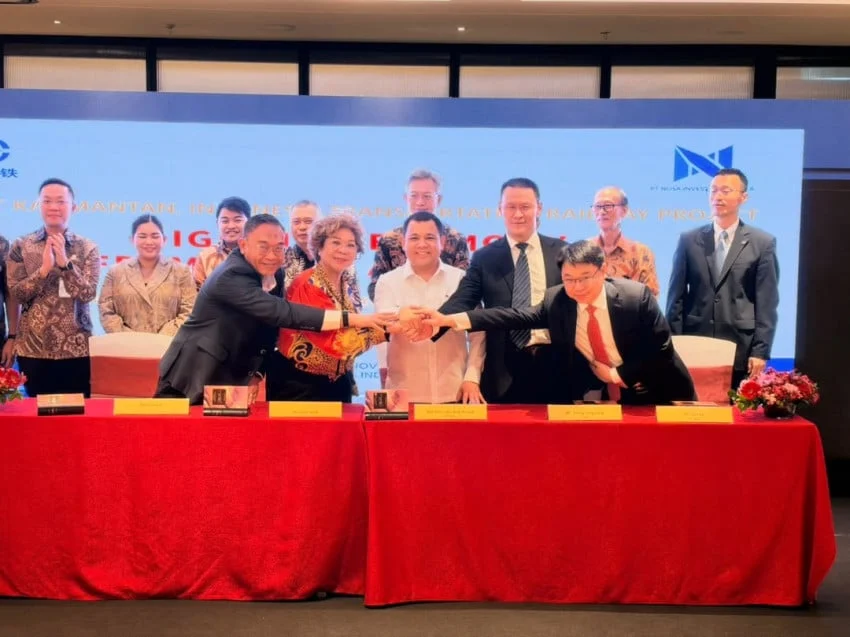
The ambitious vision to transform the logistical landscape of Kalimantan has taken a significant leap forward as PT Nusa Investama Utama officially entered into a strategic Framework Agreement with the China Railway Engineering Corporation (CREC). The signing ceremony, held in Jakarta on Wednesday, November 25, 2026, marks the formal commencement of the preliminary development phase for the Trans-Kalimantan railway network. This multi-billion dollar infrastructure project is positioned as a cornerstone of the national strategy to decentralize industrial growth away from Java and integrate the vast, resource-rich provinces of the Kalimantan archipelago.
The event, officially titled the "East Kalimantan, Indonesia Transportation Railway Project-Signing Ceremony Framework Agreement," was attended by high-level government officials and industry titans. Among the notable figures present were Minister of Transportation Dudy Purwagandhi and Chinese Ambassador to Indonesia Wang Lutong. The private sector was represented by prominent business leaders, including Haji Andi Syamsuddin Arsyad of Jhonlin Group and Dewi Kam of SSP Group, alongside CREC International Engineering Company President Zhang Yongkang.
Strategic Objectives and Project Scope
The agreement outlines a comprehensive roadmap for the initial phase of the project, which will concentrate on connecting Kalimantan Timur with Kalimantan Tengah. This corridor is designed to serve as the backbone of a broader, island-wide network that will eventually extend its reach to Kalimantan Selatan and beyond.
The primary objective of the railway is to streamline the transportation of commodities—most notably coal, minerals, and palm oil—from the interior of the island to coastal ports. Currently, heavy reliance on river and road transport has created logistical bottlenecks that inflate costs and limit export efficiency. By establishing a high-capacity rail link, the government aims to reduce the "logistics tax" currently hindering the competitiveness of Kalimantan’s primary industries.
The framework agreement mandates a rigorous period of preparatory work. PT Nusa Investama Utama and CREC have committed to conducting in-depth technical studies, including comprehensive feasibility reports, spatial planning assessments, environmental impact analyses, and safety evaluations. These foundational steps are critical to ensuring that the project adheres to both Indonesian national standards and international engineering benchmarks for large-scale rail infrastructure.
The Vision for Decentralization
During the signing ceremony, Minister of Transportation Dudy Purwagandhi emphasized that the project is not merely a regional transportation initiative but a direct manifestation of President Prabowo Subianto’s economic policy. The President’s directive focuses on "Indonesia-Centric" development, aiming to diminish the historical economic imbalance where the majority of national infrastructure investment has been concentrated on the island of Java.
"The reinforcement of rail networks outside of Java is born from the directives and initiation of President Prabowo Subianto to boost inter-regional connectivity," stated Minister Purwagandhi. By creating a modern, efficient rail network, the administration intends to unlock the economic potential of Kalimantan’s interior, foster industrialization in previously isolated regions, and create a more resilient national supply chain.
For the Chinese partner, CREC, this project represents a significant expansion of its footprint in Southeast Asia. As one of the world’s largest construction and engineering firms, CREC brings decades of experience in navigating challenging terrain—an expertise that will be essential given the dense tropical rainforests and complex geological conditions characteristic of the Kalimantan landscape.
A Chronology of Progress
The momentum behind the Trans-Kalimantan railway has been building steadily over the past two years. While the formal signing in November 2026 represents a major milestone, the project has been in the planning stages since late 2024.
- Q4 2024: Initial conceptual discussions regarding the necessity of a dedicated rail link for commodity transport in East Kalimantan.
- Q2 2025: Preliminary government meetings to evaluate the feasibility of Public-Private Partnership (PPP) models for the rail project.
- Q1 2026: Engagement with international contractors, with CREC emerging as a lead contender due to their successful track record in similar large-scale infrastructure projects across the Belt and Road Initiative (BRI).
- November 25, 2026: Formal signing of the Framework Agreement between PT Nusa Investama Utama and CREC in Jakarta.
- 2027 (Projected): Commencement of detailed field surveys and environmental impact assessments.
Economic and Logistical Implications
The implications of this railway are far-reaching. Kalimantan is currently the engine of Indonesia’s commodity-based economy. However, the lack of integrated infrastructure often results in high operational costs. A rail network capable of moving bulk commodities directly from mines to deep-water ports will drastically improve the net margins for producers and increase the total export volume for the nation.
Furthermore, the rail line is expected to facilitate the growth of downstream industries. By making it cheaper and faster to move raw materials, the government hopes to encourage the construction of processing plants and refineries along the rail corridor. This transition from raw material export to value-added production is a key component of Indonesia’s national industrialization agenda.
Economists have noted that the project also has a significant "multiplier effect." Beyond the immediate construction jobs, the railway will stimulate secondary service sectors, including logistics management, maintenance services, and energy supply, as the railway itself will require significant electrification or heavy-duty fuel support.
Navigating Environmental and Social Challenges
Despite the economic promise, the project faces complex challenges. Kalimantan is home to vast protected forests and sensitive ecosystems. The Framework Agreement explicitly includes environmental impact studies, which will be subject to strict oversight by the Ministry of Environment and Forestry.
Public transparency and community engagement will be paramount. Large-scale infrastructure projects in Kalimantan often encounter issues regarding land acquisition and the rights of indigenous communities. The success of the project will depend heavily on the ability of PT Nusa Investama Utama and the Indonesian government to implement a fair and transparent land acquisition process that provides adequate compensation and addresses the concerns of local populations.
Looking Toward the Future
The presence of over 300 business leaders at the signing ceremony signals strong private sector confidence in the venture. As the feasibility studies progress throughout 2027, the international community will be watching closely to see how the partnership manages the transition from planning to construction.
The Trans-Kalimantan railway is more than just a track through the jungle; it is a signal to global investors that Indonesia is serious about optimizing its resource potential through world-class infrastructure. If executed successfully, the network could serve as a model for future infrastructure development across the archipelago, proving that large-scale, cross-island connectivity is both feasible and highly profitable.
As the parties move into the implementation phase, the focus will shift to financial structuring and engineering design. With the support of the Indonesian government and the technical prowess of CREC, the Trans-Kalimantan project is now firmly on the national agenda, poised to redefine the economic geography of the region for decades to come.
The successful completion of this rail network would not only cement the economic integration of Kalimantan but also provide a template for future infrastructure endeavors under the current administration. As the country looks toward 2030, the sound of trains traversing the forests of Borneo may soon become the most potent symbol of Indonesia’s rising economic influence on the global stage.