The arrival of President Joko Widodo and his ministerial entourage at the PT Trans Pacific Petrochemical Indotama (TPPI) refinery in Tuban, East Java, on Wednesday, November 11, 2015, marked a pivotal moment in Indonesia’s strategic drive toward energy self-sufficiency. Accompanied by Minister of State-Owned Enterprises (BUMN) Rini Soemarno and Pertamina President Director Dwi Soetijpto, the President sought to inspect the facility that had long been dormant due to financial and legal entanglements. However, before reaching the industrial complex, a spontaneous stop at a local residence highlighted the intersection of high-level industrial policy and the grassroots agricultural economy of the Tuban Regency.
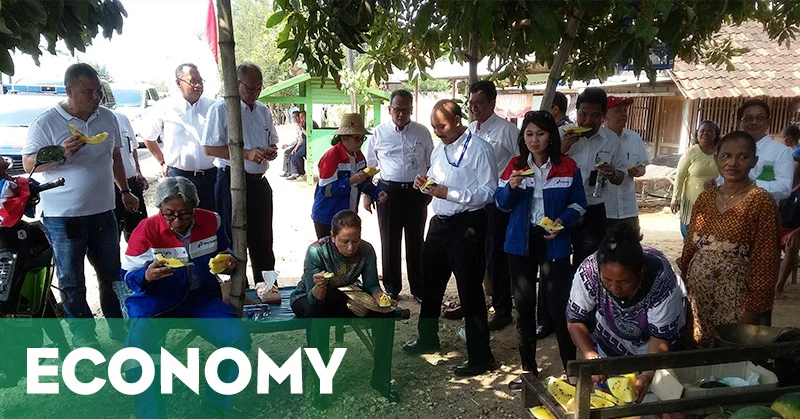
As the motorcade moved through the coastal roads of Tuban, the President and his team were greeted by crowds of local residents eager to catch a glimpse of the nation’s leadership. In a move characteristic of the administration’s "blusukan" (impromptu visit) style, the group paused at a small roadside stall where a local resident was selling freshly harvested watermelons. Minister Rini Soemarno, alongside Dwi Soetijpto and Vice President of Corporate Communication at Pertamina Wianda Pusponegoro, took the opportunity to sample the local produce. The atmosphere was lighthearted as the Minister encouraged the rest of the delegation and the accompanying media to taste the fruit, which was grown in the fields adjacent to the massive petrochemical facility.
"Come on, try the watermelon first. This watermelon is delicious," Minister Rini Soemarno remarked while interacting with the locals. This brief interlude served as a symbolic bridge between the high-tech, multi-billion dollar energy infrastructure of the TPPI refinery and the traditional livelihoods of the surrounding community. Following the refreshment, the delegation proceeded to the main site of the TPPI refinery to conduct a thorough technical inspection and discuss the roadmap for the facility’s full-scale reactivation.
The Strategic Resumption of the TPPI Refinery
The visit to the TPPI refinery was not merely a ceremonial tour; it was a mission of high economic importance. The TPPI facility is one of the largest and most sophisticated refineries in Southeast Asia, yet it had been plagued by a history of operational stops and starts, primarily due to the financial instability of its parent company and a complex web of debt involving the state. By late 2015, the Indonesian government, under President Jokowi’s directive, made the decision to prioritize the refinery’s revival to mitigate the country’s heavy reliance on imported fuel and petrochemical products.
At the time of the visit, Indonesia was facing a significant current account deficit, largely driven by the cost of importing refined petroleum products. The TPPI refinery, with its capacity to process approximately 100,000 barrels of crude oil per day, was viewed as a critical asset in the "Nawa Cita" program—the nine priority goals of the Jokowi administration aimed at achieving economic independence. By processing condensate and crude oil domestically, the government estimated that the refinery could save the state billions of dollars annually in foreign exchange.
The delegation, which also included Director General of Oil and Gas IGN Wiratmaja, focused on the technical readiness of the plant. Pertamina had recently taken a more active role in the management and supply chain of TPPI, ensuring that the refinery had a consistent supply of feedstock to produce gasoline (Premium), diesel, and various aromatic products such as paraxylene, benzene, and toluene, which are essential for the domestic textile and plastic industries.
Historical Context and Economic Significance
To understand the weight of this visit, one must look at the history of the TPPI refinery. Established in the late 1990s, the facility was designed to be a crown jewel of Indonesia’s petrochemical industry. However, the 1997-1998 Asian Financial Crisis left the project burdened with massive debts to the Indonesian Bank Restructuring Agency (BPPN) and later to the state-owned oil company, Pertamina. For years, the refinery operated intermittently, caught in legal disputes involving its majority owner, Honggo Wendratno, and the government’s efforts to reclaim state assets.
By 2015, the legal landscape had begun to shift. The Attorney General’s Office and the National Police were actively investigating irregularities in condensate sales involving TPPI and SKK Migas, yet the government decided that the physical asset must remain operational for the sake of national interest. President Jokowi’s visit signaled that while legal processes would continue, the industrial output of the refinery was a non-negotiable priority for national energy security.
The data presented during the visit indicated that a fully operational TPPI could reduce imports of RON 88 gasoline by approximately 15% to 20%. In an era where Indonesia had transitioned from being an OPEC member and net oil exporter to a net importer, such a reduction was vital for stabilizing the Rupiah and ensuring that domestic energy prices remained manageable for the public.
Technical Capabilities and Production Targets
During the inspection, Dwi Soetijpto, the President Director of Pertamina, provided insights into the technical upgrades required to bring the refinery to 100% capacity. The TPPI refinery is unique because of its flexibility; it can function as both a fuel refinery and a petrochemical plant. This dual capability allows Pertamina to pivot production based on market demand—prioritizing gasoline when domestic supplies are low or focusing on aromatics when global petrochemical prices are favorable.
The refinery’s capacity of 100,000 barrels per day (bpd) is complemented by its ability to produce:

- Gasoline (Premium/RON 88): Reducing the need for imports from the Singapore market (MOPS).
- LPG: Helping to meet the growing domestic demand for cooking fuel.
- Diesel (Solar): Supporting the logistics and transportation sectors.
- Aromatics: Providing raw materials for the domestic manufacturing sector, thereby reducing the "import-heavy" nature of the Indonesian industrial base.
The government’s plan involved a debt-to-equity swap and a more integrated partnership with Pertamina. By securing the supply of condensate from domestic fields like the Cepu Block, the TPPI refinery could operate with lower logistics costs compared to refineries that rely on imported light crude.
Community Impact and Regional Development
The spontaneous stop to eat watermelons in the village of Jenu, Tuban, highlighted the socio-economic dynamics of the region. Tuban has long been an industrial hub in East Java, hosting not only the TPPI refinery but also massive cement plants and other petrochemical ventures. However, the local population remains largely agrarian. The President’s interaction with the watermelon sellers was a gesture of assurance that industrialization would not come at the expense of local livelihoods.
For the residents of Tuban, the reactivation of TPPI meant more than just national energy statistics; it meant the potential for job creation. At its peak, the refinery employs thousands of skilled and semi-skilled workers. Furthermore, the "multiplier effect" of a functioning refinery includes increased demand for local services, housing, and food supplies—such as the very watermelons the President and his ministers enjoyed.
Minister Rini Soemarno emphasized that state-owned enterprises (BUMN) must have a "social soul." This means that while Pertamina and TPPI focus on profit and energy production, they must also engage in Corporate Social Responsibility (CSR) programs that support local farmers and improve infrastructure in the surrounding districts. The vision discussed during the visit included better irrigation for local farms and improved vocational training for Tuban’s youth to ensure they could qualify for technical roles within the refinery.
Timeline of the TPPI Revival Effort
The November 2015 visit was a key milestone in a multi-year effort to stabilize the facility. The chronology of the revival can be traced through several critical phases:
- Late 2014: The Jokowi administration identifies TPPI as a "strategic asset" that must be rescued from its idle state.
- Early 2015: Pertamina begins intensive negotiations with the Ministry of Finance and the Ministry of BUMN to take over operational control of the refinery despite ongoing legal disputes with previous shareholders.
- May 2015: The government initiates a legal investigation into past condensate sales, but the President issues a directive that the refinery must continue to operate under Pertamina’s supervision.
- October 2015: Preliminary testing of the refinery units begins, with the facility successfully producing its first batches of gasoline in years.
- November 11, 2015: The presidential visit serves as the official "green light" for full-scale commercial operations and signals to international markets that Indonesia is serious about reducing its oil imports.
Broader Implications for Indonesia’s Energy Policy
The reactivation of TPPI under the guidance of Minister Rini Soemarno and the Pertamina leadership was a precursor to the broader Refinery Development Master Plan (RDMP). This master plan aims to upgrade existing refineries in Cilacap, Balikpapan, Dumai, and Balongan, while also building new Grass Root Refineries (GRR).
The success of the TPPI model—taking a distressed asset and integrating it into the national energy supply chain—provided a blueprint for how the government could handle other stalled infrastructure projects. It demonstrated that political will, combined with the technical expertise of state-owned enterprises, could overcome the legal and financial "paralysis" that often affects large-scale energy projects in Indonesia.
Furthermore, the visit underscored the importance of Tuban as an emerging energy "super-hub." With its deep-water port capabilities and proximity to major oil and gas fields in East Java, Tuban is positioned to become the center of Indonesia’s petrochemical industry. The government’s long-term vision includes the construction of additional storage tanks and processing units in the area, potentially turning Tuban into the "Jurong Island" of Indonesia.
Conclusion: A Moment of Unity and Purpose
The image of the President of Indonesia and the Minister of BUMN standing in a dusty village in Tuban, sharing watermelons with locals before heading into a massive industrial complex, remains a potent symbol of the 2015 era. It reflected a government that was focused on grand industrial ambitions while remaining tethered to the everyday realities of its citizens.
As the delegation left the watermelon stall and entered the gates of the TPPI refinery, the message was clear: the era of allowing vital national assets to sit idle was over. The revival of TPPI was a declaration of intent—a step toward a future where Indonesia processes its own natural resources for the benefit of its own people. The technical discussions that followed the visit laid the groundwork for years of production, contributing significantly to the nation’s energy resilience and providing a foundation for the continued industrialization of East Java.
By the end of the day on November 11, the "Tuban Watermelon" had become a minor footnote in the history of Indonesian energy policy, but the visit itself ensured that the TPPI refinery would no longer be a footnote, but rather a central pillar of the nation’s economic sovereignty. The commitment shown by President Jokowi and Minister Rini Soemarno during this trip served as a catalyst for Pertamina to finalize the operational transition, eventually leading to the refinery becoming a consistent contributor to the national fuel supply.