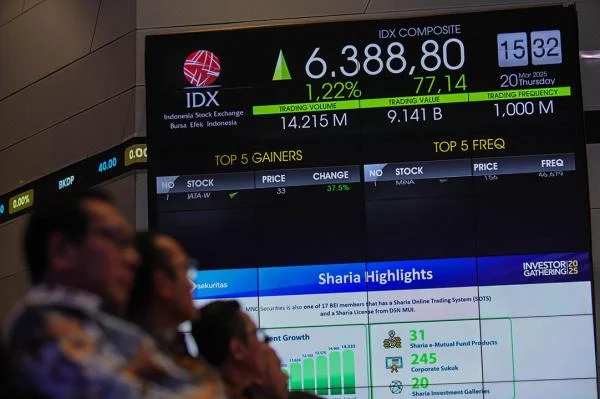
JAKARTA – The Jakarta Stock Exchange Composite Index (IHSG) commenced trading on Wednesday, July 22, 2026, with a positive trajectory, opening in the green zone. The benchmark index registered an early gain of 0.38 percent, reaching the level of 6,364, signaling a cautious yet optimistic start to the trading day. This initial uplift comes as market participants navigate a complex landscape of global economic developments and domestic policy shifts, seeking clear direction amidst fluctuating investor sentiment.
The early market activity painted a picture of mixed sentiment beneath the headline gain. While 250 stocks advanced, contributing to the overall index increase, a notable 335 stocks experienced declines, indicating profit-taking or sector-specific weaknesses. An additional 380 stocks remained stagnant, suggesting a wait-and-see approach for a significant portion of the market. This breadth of market movement underscores a highly selective investment environment where capital is flowing into specific areas deemed resilient or poised for growth, while other sectors face headwinds. The initial transaction value for the day reached a robust Rp5.8 trillion, with a volume of 13.09 billion shares traded, reflecting active participation from investors in the early hours of trading. This early liquidity suggests a keen interest in capital allocation despite the underlying mixed sentiment.
Further examining the performance of key sub-indices reveals nuanced market dynamics. The LQ45 index, which tracks the 45 most liquid and largest market capitalization stocks, saw a slight decline of 0.29 percent, settling at 634. Similarly, the MNC36 index, comprising 36 stocks selected for their strong fundamentals and high liquidity, decreased by 0.27 percent to 277, and the IDX30, representing 30 blue-chip stocks, also weakened by 0.37 percent to 357. This collective downtick in major large-cap indices suggests that while the broader IHSG gained, some of the market’s heavyweights might have faced selling pressure or underperformed smaller and mid-cap stocks. In contrast, the Jakarta Islamic Index (JII), which tracks Sharia-compliant stocks, demonstrated resilience, gaining 0.33 percent to 382. The positive performance of the JII could indicate a flight to quality within ethical investment parameters or growing interest in specific Sharia-compliant sectors.
Sectoral performance on Wednesday morning was distinctly bifurcated, reflecting divergent investor confidence across different industries. Sectors that opened in the green zone included energy, finance, property, technology, and health. The positive momentum in the energy sector can be attributed to a recent rebound in global commodity prices, particularly crude oil and coal, driven by renewed demand forecasts and ongoing geopolitical considerations impacting supply chains. The financial sector, often a bellwether for economic health, likely benefited from stable interest rate expectations and robust corporate earnings reports from major banking institutions. Property and technology sectors continued to attract investment, with property showing signs of recovery fueled by government incentives and lower mortgage rates, while technology maintained its growth trajectory amidst accelerating digital transformation initiatives across industries. The health sector’s gains could be linked to continued public health spending and innovation in medical services and pharmaceuticals.
Conversely, several key sectors experienced declines. These included non-cyclical consumer goods, raw materials, cyclical consumer goods, infrastructure, transportation, and industry. The non-cyclical and cyclical consumer sectors might be feeling the pinch of persistent inflationary pressures, which continue to erode purchasing power despite government subsidies. Raw materials, despite some commodity price gains, could be facing headwinds from oversupply in certain segments or concerns over global economic slowdowns impacting future demand. The infrastructure and industrial sectors, typically capital-intensive, might be grappling with higher borrowing costs and potential delays in project implementation. Transportation, a sector highly sensitive to fuel prices and consumer spending, could be impacted by elevated operational costs and moderated travel demand. These sectoral disparities highlight the intricate balance of forces at play, where specific industry fundamentals and macroeconomic factors are dictating investment preferences.
Among the individual stocks, PT Bersama Zatta Jaya Tbk (ZATA) emerged as one of the top gainers, experiencing a significant surge in its share price. ZATA, an apparel and lifestyle retailer, may have benefited from positive market sentiment surrounding consumer spending recovery or specific corporate actions. PT Alkindo Naratama Tbk (ALDO), a producer of paper-based packaging and chemicals, also saw its shares climb, likely driven by strong demand from the e-commerce sector and improving industrial output. Furthermore, PT Multipolar Technology Tbk (MLPT), an information technology services provider, recorded substantial gains, underscoring the sustained investor interest in Indonesia’s burgeoning digital economy and IT infrastructure development. These companies’ performances often reflect specific catalysts such as favorable earnings reports, strategic partnerships, or positive industry outlooks.
On the other side of the spectrum, PT Puri Sentul Permai Tbk (KDTN) led the list of top losers. KDTN, a property developer, might have faced selling pressure due to concerns over rising interest rates potentially cooling the real estate market or company-specific news. PT SLJ Global Tbk (SULI), a company engaged in timber and forestry products, also saw its shares decline. This could be attributed to fluctuating commodity prices, environmental regulations, or challenges in global supply chains affecting the timber industry. Additionally, PT Teknologi Karya Digital Nusa Tbk (TRON), a digital technology company, experienced a downturn, which might suggest profit-taking after previous rallies or competitive pressures within the fast-evolving tech landscape. These individual stock movements often provide granular insights into investor sentiment and specific company or industry-related challenges.
The market’s performance on July 22, 2026, must be viewed within the broader context of recent economic developments both globally and domestically. In the preceding months, global markets have been grappling with persistent inflation, leading major central banks, including the U.S. Federal Reserve and the European Central Bank, to maintain a hawkish stance on interest rates. While some economists anticipate a plateau in rate hikes, the uncertainty surrounding future monetary policy continues to influence capital flows, particularly in emerging markets like Indonesia. Commodity prices, after a period of volatility, have shown signs of stabilization, providing a mixed blessing: supporting energy and raw material exporters but potentially increasing input costs for manufacturers. Geopolitical tensions, particularly in Eastern Europe and the Middle East, also remain a constant undercurrent, impacting global supply chains and investor risk appetite.
Domestically, Indonesia’s economy has demonstrated resilience, with GDP growth consistently above 5 percent in recent quarters, underpinned by robust domestic consumption and strong exports. The government has continued its focus on infrastructure development, albeit with careful fiscal management. The central bank, Bank Indonesia, has been adept at balancing inflation control with economic growth objectives, maintaining a relatively stable rupiah against major currencies. Corporate earnings season for the second quarter of 2026 has largely been positive, with many companies reporting healthy profits, though some sectors have shown vulnerability to rising operational costs and shifts in consumer behavior. Prior to this week’s trading, the IHSG had experienced a period of consolidation following a strong rally in the first half of the year, driven by optimism over the post-pandemic recovery and favorable commodity prices. The market had been testing resistance levels, with investors closely watching for catalysts to push it higher or signal a correction.

Market analysts offered varied perspectives on Wednesday’s opening. "The IHSG’s positive opening, despite the mixed sectoral performance, indicates underlying resilience in the Indonesian market," stated Dr. Amelia Santoso, Chief Economist at Nusantara Capital. "Investors are selectively picking stocks in sectors with strong fundamentals and clear growth catalysts, such as technology and renewable energy, while taking profits in areas that have run up significantly or face structural challenges. The substantial transaction volume at the open suggests strong liquidity, which is a healthy sign."
However, not all sentiment was unequivocally bullish. Mr. Bayu Prakoso, Senior Market Strategist at Garuda Investama, cautioned, "While the headline gain is encouraging, the divergence among the main indices and the significant number of declining stocks highlight that this is not a broad-based rally. We are likely seeing a rotation of capital, with investors becoming more discerning. The performance of large-cap indices like LQ45 and IDX30, which saw declines, suggests that some institutional investors might be rebalancing their portfolios or locking in gains. Investors should remain vigilant for potential volatility and focus on companies with robust balance sheets and sustainable growth models."
The Financial Services Authority (OJK) and the Indonesia Stock Exchange (IDX) have consistently emphasized their commitment to maintaining market stability and investor protection. Recent regulatory enhancements aimed at improving corporate governance and market transparency have bolstered investor confidence. The IDX has also been proactive in introducing new products and services to deepen market participation and attract both domestic and international investors. These efforts contribute to the overall resilience of the Indonesian capital market, providing a stable platform even amidst global economic uncertainties.
For investors, the current market environment necessitates a strategic approach. Long-term investors may find opportunities in sectors poised for structural growth, such as technology, healthcare, and renewable energy, which align with Indonesia’s demographic trends and national development goals. The resilience of the JII also suggests a growing interest in Sharia-compliant investments, which often emphasize ethical and sustainable business practices. Short-term traders, on the other hand, will need to navigate the mixed signals and sector rotations with agility, focusing on specific catalysts and technical indicators. The significant transaction value at the open indicates that liquidity is present, allowing for strategic entry and exit points for those with a clear investment thesis.
Looking ahead, the IHSG’s trajectory will likely be influenced by several key factors. Domestically, upcoming inflation figures, Bank Indonesia’s monetary policy decisions, and the government’s fiscal spending plans will be closely watched. Any significant shifts in commodity prices or global interest rate expectations could also trigger substantial market movements. Furthermore, the performance of corporate earnings in the third quarter of 2026 will provide crucial insights into the health of various industries and the overall economy. While the opening on July 22, 2026, showcased a positive start for the IHSG, the underlying complexities demand a nuanced understanding from all market participants as they chart their course through the dynamic landscape of the Indonesian capital market.