The Jakarta Composite Index (IHSG) closed the trading period from July 20-24, 2026, firmly in positive territory, marking a significant rebound in investor confidence and market liquidity on the Indonesia Stock Exchange (BEI). This upward trajectory was not merely reflected in the index’s climb but was also accompanied by a substantial surge across all key trading metrics, including transaction volume, value, frequency, and overall market capitalization. The week’s performance painted a picture of a resilient and increasingly attractive Indonesian equity market, drawing both domestic and international attention.
A Week of Ascending Momentum for the IHSG
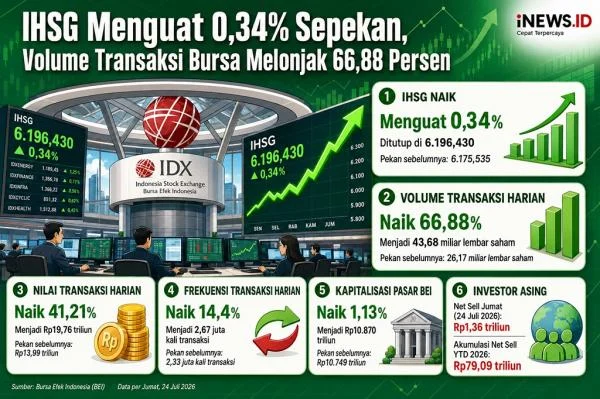
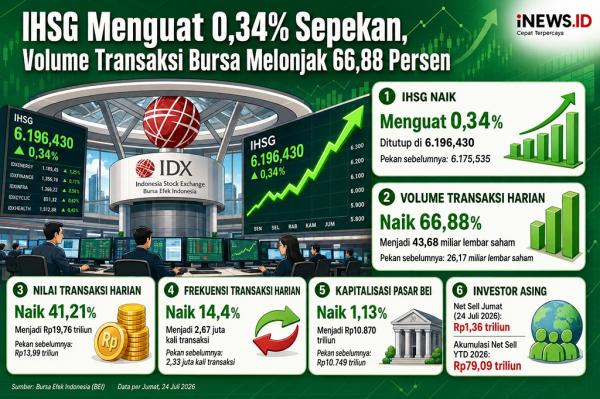
According to Kautsar Primadi Nurahmad, Corporate Secretary of BEI, the IHSG recorded a commendable gain of 0.34 percent over the five trading days, concluding at 6,196.430. This level represented a notable improvement from the previous week’s close of 6,175.535, signaling a positive shift in market sentiment. The week’s closing mark underscored the market’s ability to absorb prior volatilities and consolidate gains, pushing the benchmark index to a stronger position. The consistent upward movement, particularly in the latter half of the week, suggested that investors were increasingly optimistic about Indonesia’s economic fundamentals and corporate earnings prospects.
The IHSG, often regarded as a crucial barometer for the health of the Indonesian economy, represents the weighted average of stock prices of all companies listed on the BEI. Its performance is closely watched by economists, policymakers, and investors worldwide as an indicator of capital market stability and economic growth potential in Southeast Asia’s largest economy. A sustained upward trend in the IHSG typically correlates with positive economic indicators, robust corporate performance, and a generally favorable investment climate.
Chronology of a Dynamic Trading Week
The trading week commenced on Monday, July 20, with a cautious sentiment, as the IHSG initially experienced some pressure, echoing broader global market anxieties or perhaps profit-taking from the previous week. However, this initial softness proved to be temporary. By mid-week, the market began to find its footing, driven by a confluence of positive catalysts. Preliminary indications of strong corporate earnings for the second or third quarter of 2026 from key sectors like banking, consumer goods, and resources started to filter through, fueling buying interest. Positive developments in global commodity prices, particularly for key Indonesian exports such as palm oil, coal, and nickel, also provided a significant boost to related industrial and mining counters.
Thursday, July 23, saw the index fluctuate, as evidenced by earlier reports of the IHSG experiencing an opening in the red zone and closing weaker on specific days. This intra-week volatility is a natural characteristic of dynamic markets, reflecting daily adjustments to news, economic data releases, and global market movements. However, the market demonstrated resilience, quickly recovering from these dips. The final trading day, Friday, July 24, witnessed a strong close, consolidating the week’s gains and pushing the index to its highest point for the period. This end-of-week rally often suggests that investors are willing to hold positions over the weekend, indicating sustained confidence in the short to medium-term outlook. The ability of the market to shrug off daily pressures and achieve an overall weekly gain speaks volumes about the underlying strength and liquidity present.
Unprecedented Surge in Trading Activity
Beyond the index’s numerical ascent, the most striking feature of the week was the dramatic increase in trading activity. The average daily transaction volume on the BEI skyrocketed by an astonishing 66.88 percent, reaching 43.68 billion lembar saham (shares) from 26.17 billion shares in the preceding week. This immense surge in volume signifies a profound increase in market participation, indicating that a broader base of investors, both retail and institutional, actively engaged in buying and selling activities. High trading volumes are typically seen as a sign of a healthy, liquid market where investors can easily enter and exit positions without significantly impacting prices, thus enhancing market efficiency.
Complementing this volume surge was a substantial jump in the average daily transaction value, which climbed by 41.21 percent to a robust Rp19.76 trillion. This figure is a significant leap from the Rp13.99 trillion recorded in the prior week. The simultaneous increase in both volume and value indicates that not only were more shares being traded, but these shares also carried higher monetary value, suggesting increased participation in blue-chip stocks and larger-cap companies. The enhanced liquidity provided by these higher transaction values facilitates larger block trades and allows institutional investors to deploy capital more effectively. Furthermore, the accompanying rise in transaction frequency and overall market capitalization reinforces the narrative of a vibrant and expanding market, reflecting an increase in the total value of all listed companies.
Driving Factors Behind the Market’s Robust Performance
Several key factors are believed to have underpinned the IHSG’s strong performance during this period:
- Domestic Economic Optimism: Indonesia’s macroeconomic landscape has shown consistent resilience. Positive projections for the nation’s Gross Domestic Product (GDP) growth for 2026, estimated to hover around 5.2-5.5 percent, have played a crucial role. This growth is supported by stable inflation rates, effective monetary policy by Bank Indonesia, and sustained government spending on infrastructure and social programs. Consumer confidence indicators have also remained robust, suggesting strong domestic consumption, a major driver of Indonesia’s economy.
- Favorable Corporate Earnings Season: The market was likely buoyed by the anticipation and initial releases of strong corporate earnings reports. Many publicly listed companies, particularly those in the financial, telecommunications, and consumer staples sectors, are expected to post robust profits, reflecting improved economic activity and consumer spending. This positive outlook on corporate profitability tends to attract investors seeking value and growth.
- Global Market Tailwinds: While global markets have their share of uncertainties, the week saw a generally constructive global sentiment. Major indices in the U.S., Europe, and other Asian markets largely trended positively, providing a favorable backdrop for emerging markets like Indonesia. Stability in global interest rate expectations and the absence of major geopolitical shocks contributed to a risk-on appetite among international investors.
- Commodity Price Strength: Indonesia, as a major commodity exporter, significantly benefits from stable or rising prices of key commodities. During the week in question, a favorable environment for commodities like coal, palm oil, and nickel likely boosted the profitability and stock prices of related companies, contributing substantially to the IHSG’s overall performance.
- Foreign Capital Inflows: The robust performance of the IHSG and the broader Indonesian economy often attracts foreign portfolio investment. Increased foreign capital inflows provide additional liquidity to the market and can act as a strong upward catalyst for stock prices, particularly in large-cap stocks that are frequently held by international funds.
Official Responses and Market Analyst Perspectives

Kautsar Primadi Nurahmad’s statement highlighted the official recognition of the market’s strong week. Beyond this, market analysts and economists largely echoed a positive sentiment regarding the IHSG’s trajectory. "This week’s performance is a clear indicator of Indonesia’s economic resilience and the growing confidence among both domestic and international investors," commented Dr. Sariwijaya Hadi, a senior economist at a prominent Jakarta-based research firm. "The significant uptick in transaction volume and value suggests that investors are actively deploying capital, anticipating continued growth and favorable policy environments."
Analysts from major brokerage houses also noted the broad-based nature of the rally, with gains observed across various sectors, indicating a healthy market rather than a concentrated surge in just a few dominant stocks. "The diversified participation across sectors, from financials to basic materials and technology, points to underlying strength," stated Putri Utami, Head of Equity Research at PT Investama Sekuritas. "It’s not just a liquidity-driven rally; there are fundamental improvements in corporate outlook and macroeconomic stability supporting these gains." This expert consensus reinforces the narrative of a fundamentally sound market rather than one driven purely by speculative fervor.
Broader Implications and Future Outlook
The strong performance of the IHSG has several broader implications for the Indonesian economy and its investment landscape. Firstly, a rising stock market often creates a "wealth effect," where individuals feel wealthier due to their stock holdings, potentially leading to increased consumer spending and further boosting economic growth. Secondly, a buoyant equity market facilitates capital raising for companies, allowing them to fund expansion plans, create jobs, and innovate, thus contributing to long-term economic development.
Looking ahead, market participants will be closely monitoring several key indicators. These include Bank Indonesia’s monetary policy decisions, particularly regarding interest rates, which directly impact borrowing costs and corporate profitability. Global economic developments, including potential slowdowns in major trading partners or shifts in commodity prices, will also remain critical factors. Domestically, government policy continuity, especially concerning investment incentives and infrastructure projects, will be pivotal in sustaining investor confidence.
While the outlook remains largely positive, analysts caution that markets can be susceptible to various headwinds. Geopolitical tensions, unforeseen global economic shocks, or domestic policy changes could introduce volatility. However, the strong closing performance of the IHSG for the week of July 20-24, 2026, provides a robust foundation and a strong signal of investor optimism for the coming periods. The significant surge in trading activity reflects a dynamic and liquid market, positioning Indonesia as an increasingly attractive destination for capital investment in the region.