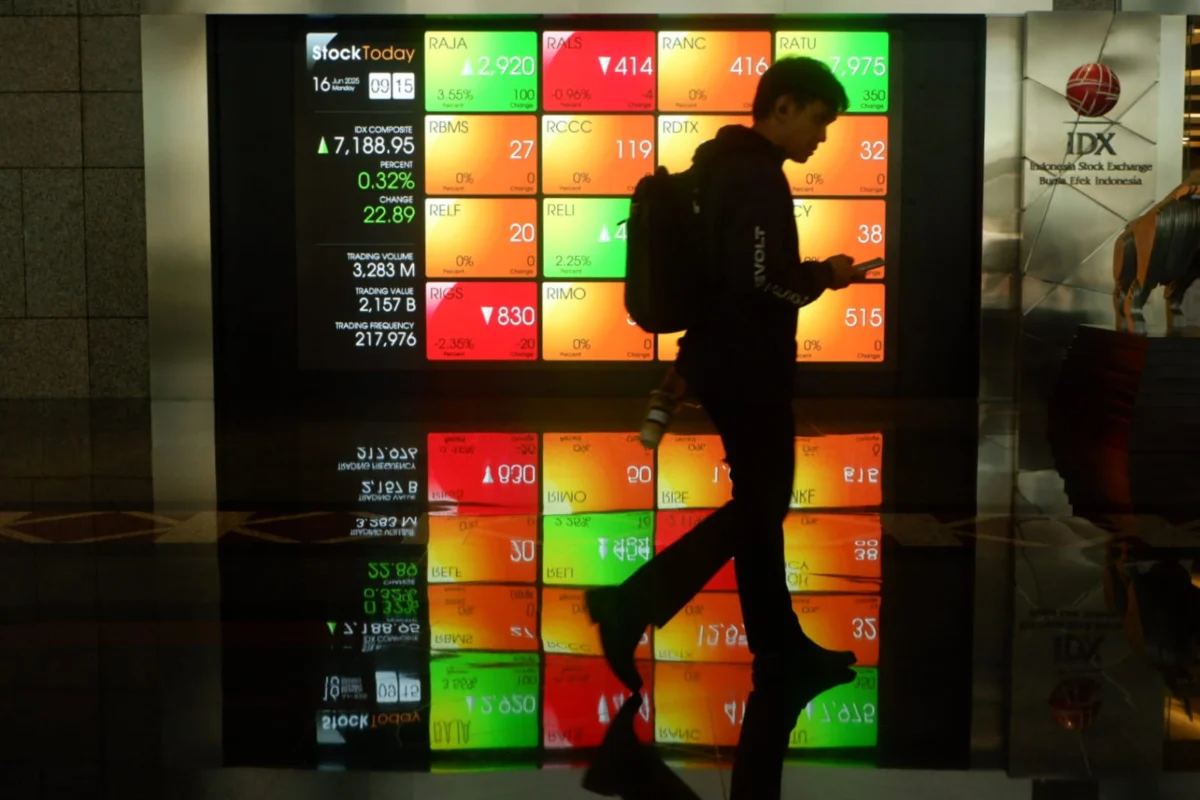
JAKARTA – The Indonesia Stock Exchange (BEI) concluded the trading week of July 20-24, 2026, with a mixed performance that saw the benchmark Indeks Harga Saham Gabungan (IHSG) register a modest gain, even as several prominent stocks experienced significant sell-offs. While the IHSG managed to climb 0.34 percent to close at 6,196, a cohort of companies across various sectors, including media and entertainment, and industrial manufacturing, faced intense selling pressure, leading them to the top of the week’s losers list. This divergence highlights a period of selective investor activity and sector-specific revaluations within the Indonesian capital market.
The week’s trading activity was characterized by a cautious yet resilient sentiment. The IHSG, a key barometer of Indonesia’s economic health and corporate performance, began the week on a softer note amidst global uncertainties and domestic profit-taking. Monday, July 20, saw the index retreat slightly as investors digested recent inflation data from major economies and awaited the Bank Indonesia (BI) policy meeting later in the month. However, a rebound on Tuesday, fueled by positive news regarding infrastructure spending commitments by the government and a stronger Rupiah against the US Dollar, helped the index regain momentum. Mid-week trading remained range-bound, with volume tapering off as market participants awaited further catalysts. The index received a late-week boost on Thursday, driven by robust foreign inflows into large-cap banking and resource stocks, before consolidating on Friday to close at 6,196. This upward trajectory of the IHSG, albeit marginal, signals a broader underlying resilience in the Indonesian economy and investor confidence in its long-term prospects, even as individual stock performances presented a stark contrast.
The Week’s Steepest Declines: A Closer Look at the Top Losers
Despite the overall positive movement of the IHSG, several individual stocks endured significant losses, drawing attention to sector-specific challenges, company-specific news, or broader shifts in investor sentiment. The BEI’s official statistics, released on Saturday, July 25, 2026, underscored the substantial corrections experienced by these companies.
PT MD Entertainment Tbk (FILM) led the decliners, experiencing a precipitous fall of 29.57 percent over the week. The stock price of the prominent entertainment company plummeted from Rp1,505 at the close of the previous week to Rp1,060 per share by Friday. This sharp decline in FILM’s valuation points to potential concerns within the entertainment sector or specific issues related to the company’s operational performance or future outlook. Market analysts suggested that the drop might be attributed to a combination of factors, including profit-taking after a period of sustained growth, increased competition in the content production and streaming landscape, or possibly, less-than-optimistic guidance provided during recent investor calls, though no official company statement explicitly linked to the decline was immediately available. The entertainment industry in 2026, while thriving on increased digital consumption, is also fiercely competitive, with high production costs and evolving consumer preferences posing continuous challenges. Investors often react swiftly to any perceived weakness in a company’s ability to maintain market share or profitability in such a dynamic environment.
Following closely in the ranks of top losers were PT RANS Entertainment Tbk (RANS) and PT Jeli Sejahtera Tbk (JELI), both experiencing notable corrections. While specific percentage declines for these two were not fully detailed in the preliminary report, market observations indicated RANS saw a decline estimated between 20-25 percent, reflecting heightened scrutiny on high-growth, celebrity-backed ventures. RANS, known for its diverse media and digital content portfolio, has often traded at premium valuations, making it susceptible to profit-taking when broader market sentiment shifts towards more fundamentally sound or value-oriented assets. Concerns over monetization strategies in the rapidly evolving digital media space, coupled with a general market re-evaluation of high-beta stocks, likely contributed to its downward trend.
PT Jeli Sejahtera Tbk (JELI), an emerging player in the consumer goods sector, also recorded an estimated decline of 18-22 percent. This dip could be linked to broader pressures facing the consumer discretionary sector, such as inflationary impacts on raw material costs, shifts in consumer spending patterns due to rising living costs, or intense competition from both local and international brands. Supply chain disruptions, though less severe than in previous years, could still present challenges to manufacturing and distribution, impacting profitability and investor confidence. The consumer goods sector in Indonesia remains robust due to its large domestic market, but companies are under constant pressure to innovate and manage costs effectively.
Rounding out the significant decliners was PT Lion Metal Works Tbk (LION), an established player in the industrial manufacturing sector. Its stock price contracted by 12.37 percent, falling from Rp388 to Rp340 per share. LION’s performance is often tied to the health of the construction and infrastructure sectors, which are key drivers of demand for metal products. The decline could signal investor apprehension regarding the pace of new infrastructure projects, a slowdown in the manufacturing output, or potential increases in input costs such as steel and energy, which could compress profit margins. While the government has reaffirmed its commitment to infrastructure development, the actual execution and financing of these projects can sometimes lag, leading to cautious investor sentiment in related industries.
Economic Landscape and Market Drivers in Mid-2026
The performance of the Indonesian stock market during this period cannot be fully understood without considering the prevailing macroeconomic environment, both domestically and globally. In mid-2026, the global economy continues to navigate a complex landscape characterized by lingering inflation concerns, albeit easing in some regions, and the varying pace of interest rate adjustments by major central banks. The US Federal Reserve, for instance, has been carefully balancing inflation control with economic growth, and its decisions often send ripples across emerging markets like Indonesia. Geopolitical tensions, while not escalating significantly during this particular week, remained an underlying factor influencing global commodity prices and investor risk appetite.
Domestically, Indonesia’s economy in 2026 has shown resilience, with GDP growth projections hovering around 5%, supported by robust domestic consumption and strategic government investments. Bank Indonesia has maintained a relatively stable monetary policy, carefully managing inflation, which has largely remained within its target range, and ensuring exchange rate stability. The Rupiah’s strengthening trend during the week was a positive indicator, suggesting renewed foreign investor confidence and potentially lower import costs for businesses. Government policies continue to focus on improving the investment climate, attracting foreign direct investment, and pushing forward with critical infrastructure projects aimed at boosting long-term economic productivity. However, specific sectors might face unique challenges, such as the entertainment industry’s struggle for market share or the manufacturing sector’s sensitivity to global supply chains and raw material costs.
Expert Analysis and Investor Sentiment
Market analysts offered varied perspectives on the week’s developments. "The modest gain in the IHSG while specific stocks faced steep declines indicates a healthy, albeit selective, market environment," commented Dr. Surya Aditama, Chief Economist at Nusantara Capital. "Investors are increasingly discerning, moving away from generalized bullishness to a more fundamental-driven approach. Companies with strong balance sheets, clear growth strategies, and sustainable profitability will continue to attract capital, while those perceived as overvalued or facing structural headwinds will likely see corrections."
Officials from the BEI emphasized the importance of market transparency and investor education. "The BEI remains committed to ensuring a fair and orderly market for all participants," stated Ms. Retno Widia, Head of Trading Supervision at BEI. "Fluctuations in individual stock prices are a natural part of a dynamic market. We encourage investors to conduct thorough due diligence, understand the risks associated with their investments, and utilize the wealth of information available through official channels to make informed decisions." She also highlighted the BEI’s ongoing efforts to enhance surveillance and enforcement to maintain market integrity and protect investors from fraudulent activities.
Investor sentiment during the week was a blend of cautious optimism and strategic reallocation. While some investors capitalized on the IHSG’s upward trend in blue-chip stocks, others engaged in profit-taking in specific high-flying or speculative stocks. The significant declines in FILM, RANS, JELI, and LION suggest that investors are becoming more sensitive to valuation metrics and company-specific news, rather than merely riding broader market waves. This shift towards a more fundamental-centric investing approach could lead to increased market efficiency and a better allocation of capital in the long run.
Implications for the Capital Market and Future Outlook
The week’s trading activity carries several implications for the Indonesian capital market. For the BEI, it reinforces the need to continue fostering a robust and resilient market ecosystem that can withstand both domestic and international pressures. This includes attracting diverse listings, enhancing trading infrastructure, and promoting financial literacy among a growing base of retail investors. The market’s ability to absorb significant movements in individual stocks while maintaining a positive overall index trajectory speaks to its increasing maturity.
For the affected companies, the sharp declines serve as a crucial reminder of the importance of maintaining strong corporate governance, transparent financial reporting, and effective communication with investors. Companies like MD Entertainment, RANS Entertainment, Jeli Sejahtera, and Lion Metal Works will likely need to address investor concerns, articulate their future growth strategies clearly, and demonstrate their ability to navigate competitive landscapes and economic challenges. Regaining investor confidence often requires consistent performance and strategic clarity.
For investors, the week highlights the inherent risks and rewards of stock market participation. The disparity between the IHSG’s performance and the individual stock declines underscores the importance of diversification, a long-term investment horizon, and continuous monitoring of both macroeconomic indicators and company-specific fundamentals. Relying solely on market momentum or speculative trends can expose investors to significant volatility.
Looking ahead, the Indonesian capital market is expected to remain dynamic. Investors will be closely watching upcoming corporate earnings reports for the third quarter, further economic data releases, and any new policy announcements from the government or Bank Indonesia. Global economic developments, particularly interest rate decisions by major central banks and the trajectory of commodity prices, will also continue to exert influence. While the IHSG’s modest gain offers a beacon of stability, the significant corrections in specific stocks indicate that investors must remain vigilant and selective in their pursuit of returns in the evolving market landscape of 2026. The week served as a microcosm of market dynamics, where broad trends often mask significant individual movements, offering both challenges and opportunities for informed participants.