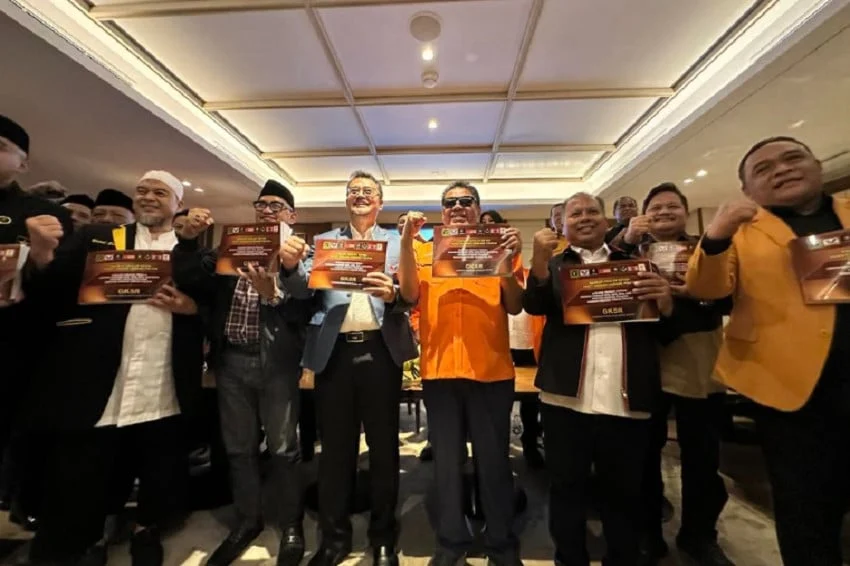
The debate surrounding the ongoing revision of Indonesia’s Election Law has intensified as non-parliamentary political parties, united under the banner of the People’s Sovereignty Movement (Gerakan Kedaulatan Suara Rakyat, or GKSR), formally proposed that the parliamentary threshold be set at a flat 1 percent. This pivotal proposal was announced during the first-anniversary celebration of GKSR, held at a prominent venue in Central Jakarta, drawing significant attention from political observers, lawmakers, and civil society organizations alike.
According to the leadership of GKSR, the current discourse on electoral reforms must prioritize inclusivity, constitutional fairness, and the protection of pluralism over the political self-preservation of major parties currently seated in the House of Representatives (DPR). As legislative bodies deliberate on amendments to the legal framework governing upcoming democratic exercises, the voices of smaller and non-parliamentary entities are increasingly demanding a structured and equitable platform in shaping the nation’s political landscape.
Main Facts of the GKSR Proposal
During the anniversary event, GKSR General Chairperson Said Iqbal outlined the coalition’s core demands regarding the legislative changes to the Election Law. The central argument revolves around the reduction of the parliamentary threshold—the minimum percentage of the national popular vote a political party must receive to secure seats in the national legislature—down to 1 percent.
Said Iqbal emphasized that this specific figure is not an arbitrary political bargain, but rather a scientifically grounded recommendation. The proposal draws upon established academic research regarding electoral systems, notably incorporating the Taagepera formula, a widely recognized political science methodology used to analyze proportionality and seat allocation in representative democracies.
In addition to the 1 percent threshold, GKSR’s framework incorporates several mechanisms designed to ensure that the votes of citizens supporting smaller parties are not wasted. These include provisions for combined parliamentary factions at the national level within the DPR and the implementation of formal electoral pacts, commonly known as stembus accoord, established prior to the commencement of the voting process rather than retroactively calculated after the ballots are cast.
Furthermore, the coalition addressed the administrative burdens associated with party qualification for general elections. GKSR put forward a differentiated verification model for political parties wishing to participate in future electoral cycles. Under this proposed system, non-parliamentary parties that have already successfully undergone and passed both administrative and factual verification processes in preceding elections would only be subjected to administrative verification moving forward. Conversely, brand-new political entities entering the electoral arena for the first time would still be required to undergo the comprehensive dual-verification process—comprising both administrative and factual checks—to ensure organizational readiness and compliance with electoral laws.
Background Context and Chronology of the Electoral Threshold Debate
To fully understand the gravity of the GKSR proposal, it is essential to examine the historical trajectory of the parliamentary threshold in Indonesia’s post-Reformasi democratic era. Since the transition to democracy in 1998, the threshold has been systematically raised with each successive election cycle, a legislative trend critics argue is systematically designed to consolidate power among established major parties while gradually squeezing out smaller competitors.
In the 2009 general election, the parliamentary threshold was established at 2.5 percent. This figure was subsequently raised to 3.5 percent for the 2014 election, and further increased to 4 percent ahead of the 2019 and 2024 elections. Each incremental increase has historically been accompanied by intense legislative negotiations, where parties already represented in parliament frequently sought higher thresholds to minimize competition, resulting in the elimination of numerous smaller parties from national legislative representation despite collectively garnering millions of votes.
The ongoing discussions for the upcoming revision of the Election Law began gaining momentum following the conclusion of the 2024 general elections. As political parties began preparing for subsequent electoral cycles, the Constitutional Court issued rulings regarding the implementation of the parliamentary threshold. The Court previously mandated that changes to the threshold must be rational, transparent, and established well before the staging of the elections to prevent sudden, politically motivated rule changes. Capitalizing on this legal environment, non-parliamentary formations such as GKSR intensified their advocacy efforts throughout 2025 and into 2026, culminating in their formal policy platform announcements during their anniversary events.
Critiques of Parliamentary Parties and Verification Disparities
A cornerstone of the critique delivered by GKSR leadership targets what they describe as systemic double standards applied by political parties currently holding seats in the national parliament. Said Iqbal pointedly criticized the eight political factions currently entrenched within the DPR, accusing them of attempting to manipulate electoral rules—including fluctuating threshold percentages—to serve their own partisan interests rather than strengthening national democracy.
Of particular contention is the stark contrast in verification requirements between established parliamentary parties and emerging or non-parliamentary political organizations. Under current practices, political parties that already hold seats in the legislature often enjoy streamlined pathways or perceived institutional advantages when re-registering for subsequent elections. GKSR has vehemently opposed this dynamic, asserting that if non-parliamentary parties are subjected to rigorous, resource-heavy administrative and factual verifications every cycle, parliamentary parties should similarly face simplified registration without unnecessary bureaucratic hurdles, or alternatively, that the entire verification framework must be applied with absolute impartiality.
"There is no valid justification for the eight parliamentary parties currently in the DPR to manipulate figures for tactical maneuvering," Said Iqbal stated during his address. He stressed that within the context of the legislative revisions, existing parliamentary parties should essentially be permitted to register smoothly without redundant administrative and factual audits, mirroring the fairness that should be extended across the entire political spectrum.
Broader Impact and Implications of a 1 Percent Threshold
The proposition to lower the parliamentary threshold to 1 percent carries profound implications for the structure of Indonesia’s party system, the quality of democratic representation, and the stability of the executive-legislative relationship.
From a theoretical standpoint, a lower threshold promotes greater proportionality. In electoral systems with high thresholds, millions of votes cast for parties that fall just short of the cutoff are effectively discarded, leading to a severe disconnect between the aggregate national vote and the distribution of legislative seats. Proponents of a 1 percent threshold argue that it honors the principle of popular sovereignty by ensuring that diverse ideological, regional, and socioeconomic interests find a voice in the national parliament. This inclusivity can significantly reduce political alienation among minority groups and smaller constituencies.
However, political analysts and mainstream parliamentary parties often raise counter-arguments centered around governmental stability and legislative efficiency. A fragmented parliament characterized by a high number of small parties can complicate coalition-building, slow down the legislative process, and lead to protracted political negotiations. Critics of lower thresholds contend that a proliferation of parties in the DPR risks executive instability, as governments must continually manage fragile multi-party coalitions to pass crucial national policies and state budgets.
To mitigate these concerns, GKSR’s inclusion of pre-election electoral alliances (stembus accoord) and combined parliamentary factions serves as an institutional safety valve. By encouraging smaller parties to consolidate their voting power or form structural coalitions before ballots are cast, the system can potentially harness the benefits of broad representation while preventing extreme legislative fragmentation.
Official Responses and Future Outlook
While major political factions in the DPR have yet to issue a formal, unified response to the specific 1 percent proposal by GKSR, preliminary indicators from various parliamentary commissions suggest that debates over the threshold will remain one of the most contentious battlegrounds in the upcoming Election Law deliberations. Established parties have traditionally favored thresholds hovering between 4 and 5 percent, arguing that such figures are necessary to maintain a simplified and effective party system.
Civil society organizations and election watchdog groups have welcomed the inclusion of non-parliamentary actors in the discourse, emphasizing that electoral law revisions must be conducted transparently and inclusively rather than behind closed doors among political elites. As the legislative calendar progresses, the pressure exerted by coalitions like GKSR is expected to stimulate robust public debates, forcing lawmakers to justify their positions on threshold mathematics and administrative fairness before the broader Indonesian electorate.
Ultimately, the outcome of these legislative revisions will determine the shape of Indonesia’s democracy for years to come. Whether lawmakers will accommodate the voices of non-parliamentary movements or maintain status-quo exclusionary mechanisms remains one of the most closely watched storylines in the nation’s contemporary political evolution.